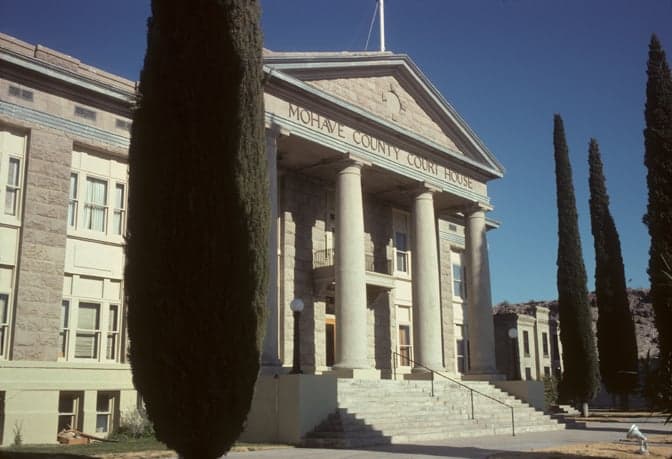
Photo: Wikipedia
Political ClimatePolitical Climate in Kingman, AZ
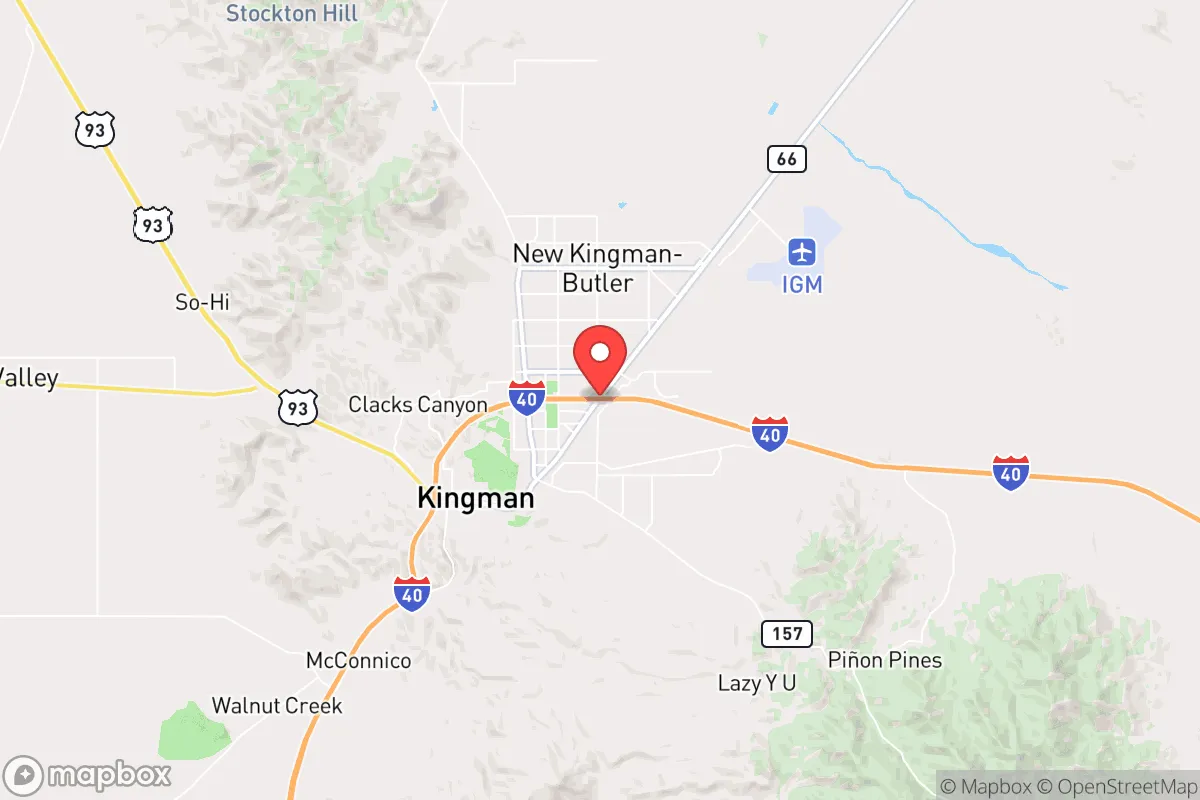
District shown is the primary district for this city’s centroid. Cities may span multiple districts.
Local Political AnalysisPolitical Analysis of Kingman, AZ
Kingman, Arizona, is about as solidly conservative as they come, with a Cook PVI of R+15 that tells you exactly where the political winds blow here. We’ve been reliably red for as long as anyone can remember, and that’s not changing anytime soon—locals take pride in that. The area leans heavily Republican, and the trajectory has actually been hardening in that direction over the last decade, as folks from more progressive states move in looking for a place where their values still matter and the government stays out of their business.
How it compares
If you drive 90 miles south to Lake Havasu City, you’ll find a similar conservative vibe, though it’s a bit more tourist-driven and transient. But head west toward Laughlin, Nevada, or especially southeast to Prescott Valley, and you start seeing a different story—Prescott Valley has seen some influx of younger, more moderate voters, and there’s a noticeable uptick in progressive-leaning chatter there. Kingman, by contrast, has held the line. We don’t have the same pressure from Phoenix-style growth, and our local politics reflect that: the city council and county board are overwhelmingly Republican, and ballot measures that try to nudge things leftward—like tax hikes for social programs or zoning changes that favor dense development—tend to get shot down hard. The contrast with Flagstaff, about two hours north, is stark: that town’s a blue island in a red sea, with all the government overreach and high cost of living that comes with it. Kingman residents see that and want no part of it.
What this means for residents
For the average person living here, the political climate means you can go about your life without the government breathing down your neck. Gun rights are respected, property taxes are low, and there’s no push for the kind of woke policies that are creeping into schools and local ordinances elsewhere. You won’t see mask mandates or business shutdowns being debated at city hall—those fights are largely avoided because the community’s values are aligned. That said, there’s a growing concern among long-time residents about outside influence. As retirees and remote workers from California and the Pacific Northwest trickle in, some bring their voting habits with them. So far, the local culture has absorbed them without shifting the needle much, but there’s a quiet worry that if the influx picks up, we could see the same kind of ideological drift that’s turned places like Bend, Oregon, or even parts of rural Colorado into battlegrounds. For now, though, Kingman remains a place where personal freedom is the default, and that’s exactly how most folks want it.
Culturally, Kingman stands out for its no-nonsense approach to policy. There’s a strong sense of self-reliance here—people don’t look to the government to solve their problems, and they’re suspicious of anyone who tries to expand its reach. You see it in the local opposition to federal land management restrictions, which are a constant sore spot given the vast public lands surrounding the area. There’s also a deep skepticism of any progressive social engineering, whether it’s critical race theory in schools or environmental regulations that hurt small businesses. The long-term outlook is cautiously optimistic: as long as the community stays engaged and keeps voting its conscience, Kingman will likely remain a conservative stronghold. But it’s a watch-and-see situation, and anyone who’s lived here a while knows that the fight to keep government out of our lives never really ends.

State Political ClimatePolitical Climate in Arizona
State Political AnalysisPolitical Environment in the State
Arizona has transformed from a reliably Republican stronghold into a true battleground state over the past two decades, now leaning narrowly Republican at the state level but with a Democratic tilt in its largest county. The dominant coalition is a mix of conservative retirees, libertarian-leaning independents, and a growing Hispanic electorate that is not monolithic but increasingly split. Over the last 10-20 years, the state has shifted from solid red to purple, with Democrats winning the presidency in 2020 and both Senate seats in 2020 and 2022, while Republicans still hold the governorship (as of 2026) and control the state legislature by slim margins.
Urban vs. rural divide
The political map of Arizona is a classic story of urban vs. rural, but with a twist. The Phoenix metro area, particularly Maricopa County, is the epicenter of the state’s political shift. Maricopa County alone holds about 60% of the state’s population and has moved from reliably red to a true swing county—Biden won it by about 2 points in 2020, and it has since oscillated. Within Maricopa, the city of Phoenix itself is heavily Democratic, while suburbs like Mesa and Gilbert remain conservative strongholds, though they are softening. Tucson (Pima County) is a Democratic bastion, with its university and government workforce driving the lean. Meanwhile, the rest of the state—places like Yavapai County (Prescott), Mohave County (Kingman), and Cochise County (Sierra Vista)—vote overwhelmingly Republican, often by 30-40 point margins. The rural-urban split is stark: the vast, sparsely populated counties outside the two major metros are deeply red, but they lack the population to offset the blue tilt of Phoenix and Tucson. A notable outlier is Flagstaff (Coconino County), a liberal mountain town surrounded by conservative rural areas, while Yuma (Yuma County) leans Democratic due to its large Hispanic and agricultural worker population.
Policy environment
Arizona’s policy environment is a mixed bag for conservatives. On the plus side, the state has a flat income tax rate of 2.5% (passed in 2021), one of the lowest in the nation, and no estate tax. Property taxes are relatively low, and the state has a right-to-work law. However, the regulatory posture is uneven: the state has a robust school choice program (Empowerment Scholarship Accounts) that allows parents to use public funds for private or homeschool expenses—a major win for parental rights. On the downside, the state has a minimum wage of $14.35/hour (indexed to inflation), which is higher than the federal rate and a burden on small businesses. Education policy is a flashpoint: the state has seen battles over critical race theory and mask mandates, with the legislature passing laws to ban CRT in schools and prohibit mask mandates in 2021. Healthcare is largely free-market, but the state expanded Medicaid under the Affordable Care Act in 2013, a move many conservatives still resent. Election laws have been tightened: SB 1260 (2022) requires proof of citizenship for voting in federal elections, and the state has a voter ID law, though it’s not as strict as some other states. Overall, the policy environment is more conservative than California or Colorado, but it’s not Texas—there’s still room for improvement on regulatory freedom.
Trajectory & freedom
Arizona is on a knife’s edge regarding personal freedom. On the positive side, the state has expanded gun rights significantly: constitutional carry (permitless carry) became law in 2010, and the state preempts local gun ordinances, so cities like Tucson cannot ban firearms. Parental rights were strengthened with the Parental Rights in Education Act (2022), which requires schools to notify parents of any curriculum involving sexuality. However, the trajectory is concerning on several fronts. The state has seen a push for medical autonomy restrictions: in 2024, voters approved a constitutional amendment enshrining abortion rights up to fetal viability, overriding a 15-week ban passed by the legislature. This is a major loss for pro-life advocates. Property rights are generally strong, but the state has seen eminent domain abuse in some water rights cases. Taxation is trending in the right direction—the flat tax was a big win—but the state’s sales tax is relatively high (5.6% state rate, plus local add-ons). The biggest threat to freedom is the influx of out-of-state migrants, particularly from California, who are bringing progressive voting habits. If current trends hold, Arizona could flip blue in the next 5-10 years, which would likely mean higher taxes, more regulation, and erosion of gun rights.
Civil unrest & political movements
Arizona has been a hotbed of political activism, particularly around immigration and election integrity. The state was ground zero for the SB 1070 immigration law in 2010, which required police to check immigration status during stops—a law that sparked massive protests and boycotts. Today, the border crisis remains a flashpoint: Cochise County and Santa Cruz County see heavy illegal crossings, and local ranchers have formed civilian patrols. On the left, groups like Living United for Change in Arizona (LUCHA) push for driver’s licenses for illegal immigrants and sanctuary policies. Election integrity has been a major issue since 2020, with the Cyber Ninjas audit of Maricopa County ballots in 2021 sparking national controversy. While the audit found no evidence of widespread fraud, it exposed vulnerabilities in the voting system, and the state has since passed stricter voter ID laws. Protests have been common: Black Lives Matter demonstrations in Phoenix in 2020 turned violent, and pro-Trump rallies in 2020-2021 were large but peaceful. The state also saw a secessionist movement in rural counties like Mohave, where some activists have called for joining Idaho or forming a new state, though this is fringe. A new resident should expect to see political polarization in daily life—yard signs, bumper stickers, and heated local news debates are common.
Projection
Over the next 5-10 years, Arizona is likely to become more competitive and potentially flip blue at the state level. The key driver is demographic change: the state is growing rapidly, with most new residents coming from California and other blue states. These newcomers tend to be younger, more diverse, and more progressive. The Hispanic population, which is about 32% of the state, is not uniformly Democratic—many are conservative on social issues—but younger Hispanics lean left. If Republicans fail to hold the line on cultural issues (like immigration and education), they could lose the state permanently. The 2026 gubernatorial race will be a bellwether: if a Democrat wins, expect a push for higher taxes, expanded Medicaid, and stricter gun laws. Conversely, if Republicans hold the governorship and legislature, they may push for further tax cuts and school choice expansion. The wildcard is water scarcity: as the Colorado River shrinks, the state may face federal intervention, which could shift political dynamics. For a conservative moving in now, expect the state to remain purple for the next decade, with a real risk of turning blue by 2032 if current migration patterns continue.
For a new resident, the bottom line is this: Arizona offers a lower tax burden and more personal freedom than California or Illinois, but it’s not a conservative safe haven like Texas or Florida. You’ll find a strong conservative base in the suburbs and rural areas, but the cities are increasingly liberal. If you’re moving here, get involved in local politics—school boards, city councils, and county commissions—because those are the battlegrounds where the future of the state will be decided. And keep an eye on the border: the immigration issue isn’t going away, and it will shape the state’s politics for decades to come.
* Values derived from national, state, county, city and local statistics and may differ in a specific area. Last updated: 2026-04-22T11:26:40.000Z
Narrative content on this page is AI-generated and may contain mistakes. Verify any details that matter before acting on them.
ReloMaps may earn a commission from affiliate links at no extra cost to you.

