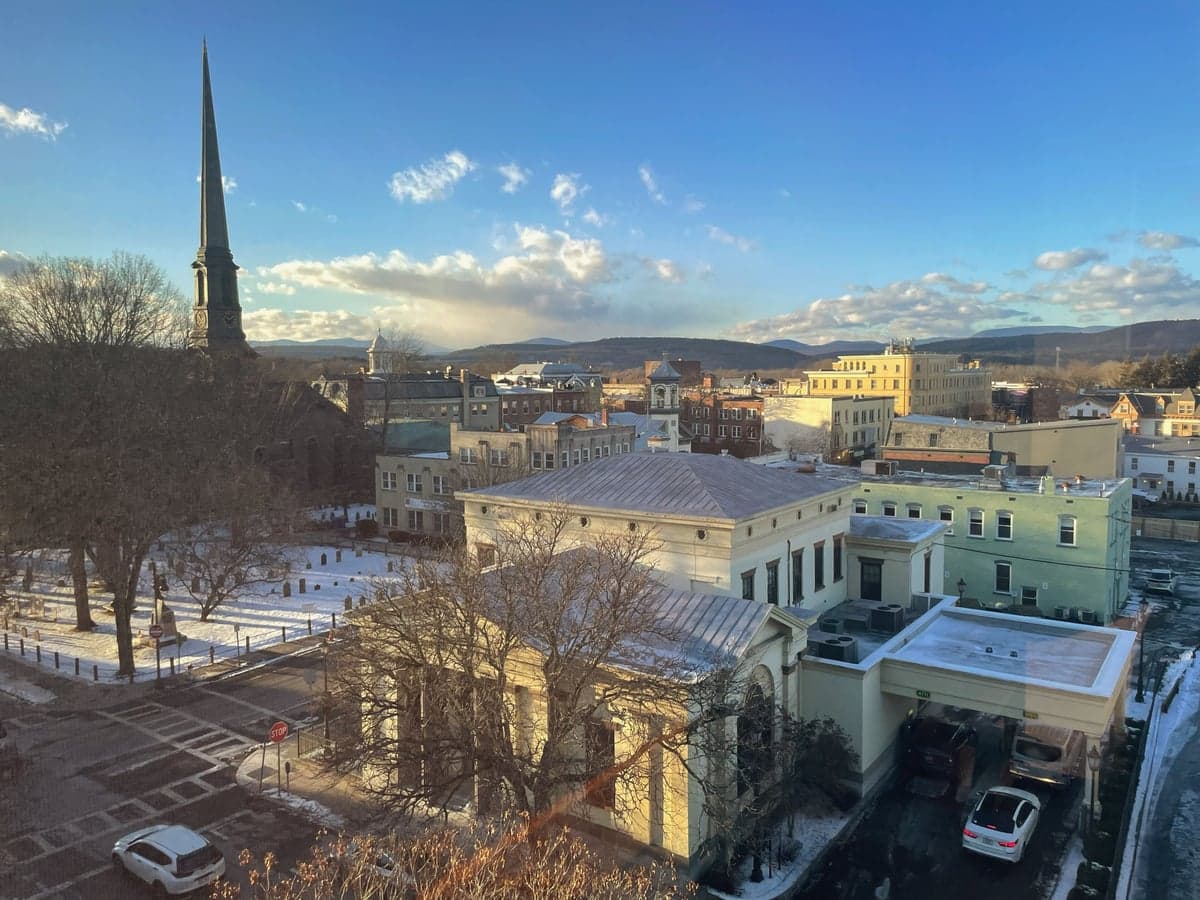
Photo: Wikipedia
Personal Sovereignty in Kingston, NY
Moderate friction. Expect trade-offs in some aspect of personal liberty and independence.
What does Personal Sovereignty tell us?
Personal Sovereignty measures your capacity for self-reliance and independence with minimal government friction. Higher scores mean fewer barriers between you and the way you want to live... but it assumes you have the space you need and good neighbors.
What does this tell us?
Personal Sovereignty measures your capacity for self-reliance and independence with minimal government friction. Higher scores mean fewer barriers between you and the way you want to live... but it assumes you have the space you need and good neighbors.
State Policy
Energy independence: Importer (12% of energy produced in-state)
Personal Liberty
Homesteading

Personal Liberty Analysis
Kingston, New York, presents a complex environment for personal sovereignty, where the city’s local character is heavily constrained by New York State’s aggressive regulatory and fiscal posture. For a conservative-leaning individual or family prioritizing autonomy, the Hudson Valley offers a scenic, historic setting, but the reality is that state-level policies on taxes, gun rights, medical freedom, and property use create significant headwinds. The autonomy environment here is best described as a trade-off: you gain a tight-knit, semi-rural community with some local flexibility, but you must navigate one of the most interventionist state governments in the Northeast. This analysis examines the specific levers of personal freedom in Kingston, focusing on where you can carve out self-reliance and where the state’s reach is most restrictive.
Tax burden and regulatory posture: How New York state policies affect your wallet and freedom
New York’s tax burden is among the highest in the nation, and Kingston residents feel it acutely. The combined state and local income tax rate can exceed 10% for higher earners, and property taxes in Ulster County are notably steep—often exceeding 2.5% of assessed home value annually. This directly reduces the capital available for self-reliance investments like land, equipment, or emergency supplies. The regulatory posture is equally burdensome. New York’s Scaffold Law, strict environmental conservation rules (like the Freshwater Wetlands Act), and a dense web of permitting requirements for home construction or renovation mean that even minor property improvements can require months of bureaucratic approval. For a prepper or survivalist, this translates to less control over your own land and a higher cost of entry for building a secure, self-sufficient homestead. The state’s aggressive tax collection and regulatory enforcement create a climate where your income and property are never fully yours.
Self-defense and gun law specifics: Navigating New York's restrictive firearms environment
Kingston’s gun laws are dictated by Albany, and they are among the most restrictive in the country. The SAFE Act, passed in 2013, mandates universal background checks, bans so-called “assault weapons” (with a feature-based test), and limits magazine capacity to ten rounds. For self-defense, the concealed carry process is now heavily constrained by the 2022 “Concealed Carry Improvement Act,” which requires a “proper cause” showing (effectively a good reason beyond general self-defense) and designates sensitive locations like restaurants that serve alcohol and private property without explicit permission as off-limits. In practice, this means that carrying a firearm for daily protection in Kingston is legally difficult and requires a lengthy, expensive application process. Open carry is effectively banned. For a survivalist mindset, this is a major sovereignty deficit: the state has placed significant barriers between you and the primary tool for defending your family and property. The local sheriff’s office in Ulster County is generally more pro-2A than downstate agencies, but they must enforce state law, so don’t expect local leniency on magazine limits or registration requirements.
Self-reliance and homesteading viability: Lot sizes, zoning, and off-grid feasibility in Kingston
Kingston offers some genuine opportunities for self-reliance, but they come with caveats. The city itself is a mix of dense urban lots and older suburban parcels, but the surrounding towns of Ulster, Hurley, and Saugerties (within a 15-minute drive) offer larger lots—often 1 to 5 acres—at prices that are lower than Westchester or the Hudson Valley’s core. Zoning in these areas generally permits backyard chickens, small-scale gardening, and even beekeeping, but you’ll need to check local ordinances for specifics. Off-grid feasibility is limited: New York requires grid connection for new construction in most areas, and solar panels must be net-metered through the utility. Rainwater collection is legal but regulated, and composting toilets require a permit. The state’s building codes are strict, meaning a DIY cabin or tiny house is difficult to get approved. For a prepper, the best strategy is to buy a property with an existing dwelling and then gradually add self-sufficiency features—like a wood stove, a well, and a large garden—within the existing regulatory framework. The soil in the region is rocky but workable, and the growing season (about 150 days) supports a solid vegetable garden. The real challenge is the cost of land and the ongoing tax burden, which eats into the financial independence you’re trying to build.
Personal liberties: Parental rights, medical autonomy, speech, and property in Kingston
Parental rights in New York are under increasing pressure. The state’s education system, including Kingston City School District, has adopted progressive curricula that some conservative parents find intrusive, including comprehensive sex education and social-emotional learning programs that can conflict with family values. Opt-out options exist but are not always straightforward, and the state’s mandate for COVID-19 vaccines for school attendance (though currently relaxed) signals a willingness to override parental medical decisions. Medical autonomy is similarly constrained: New York has some of the strictest vaccine mandates in the country, and the state’s health department has broad powers to enforce public health measures. For a survivalist, this means that your ability to make independent medical choices for your family is limited by state law. Free speech is generally protected, but New York’s hate speech laws and social media regulations can chill certain expressions, and the state’s political climate is overwhelmingly progressive, so conservative viewpoints may face social ostracism. Property rights are the strongest of these liberties—you can generally use your land as you wish within zoning and environmental rules—but the state’s power of eminent domain and aggressive tax liens mean that your property is never fully secure from government action. Overall, Kingston offers a mixed bag: you have more local control than in New York City, but the state’s long arm reaches deep into family and medical decisions.
In the broader landscape of personal sovereignty, Kingston sits in a middle tier among U.S. cities. It is far more restrictive than states like Texas, Florida, or New Hampshire on taxes, guns, and medical autonomy, but it offers more space and a slower pace than dense urban centers like Manhattan or Boston. For a conservative-leaning individual or family with a survivalist mindset, the key takeaway is that Kingston can work if you are willing to fight for your freedoms at the local level—engaging with school boards, attending zoning meetings, and building a network of like-minded neighbors. But the state-level constraints on self-defense, taxation, and medical choice are real and persistent. If your priority is maximum personal sovereignty with minimal government interference, you will find Kingston a frustrating compromise. If you value the Hudson Valley’s natural beauty, community, and historical character and are prepared to navigate a high-regulation environment, it can be a viable base for a self-reliant lifestyle—provided you keep one eye on Albany and the other on your property line.

* Values derived from national, state, county, city and local statistics and may differ in a specific area. Last updated: 2026-05-01T23:59:33.000Z
Narrative content on this page is AI-generated and may contain mistakes. Verify any details that matter before acting on them.
ReloMaps may earn a commission from affiliate links at no extra cost to you.

