Photo: Wikipedia
Demographics of Kingston, NY
Affluence Level in Kingston, NY
A middle-class area roughly in line with national averages across income, home values, education, and employment.
People of Kingston, NY
Kingston, New York, is a city of roughly 23,900 residents with a distinctly layered population history, today characterized by a white majority (61.2%), a substantial Hispanic community (17.1%), a significant Black population (14.1%), and smaller East/Southeast Asian (1.2%) and Indian-subcontinent (0.6%) groups. Its foreign-born share sits at 6.8%, and 31.6% of adults hold a college degree. The city’s identity is shaped by its historic role as New York’s first capital, its post-industrial decline, and a recent influx of urban refugees from downstate, creating a tense blend of long-standing ethnic enclaves and newer, more affluent arrivals.
How the city was settled and grew
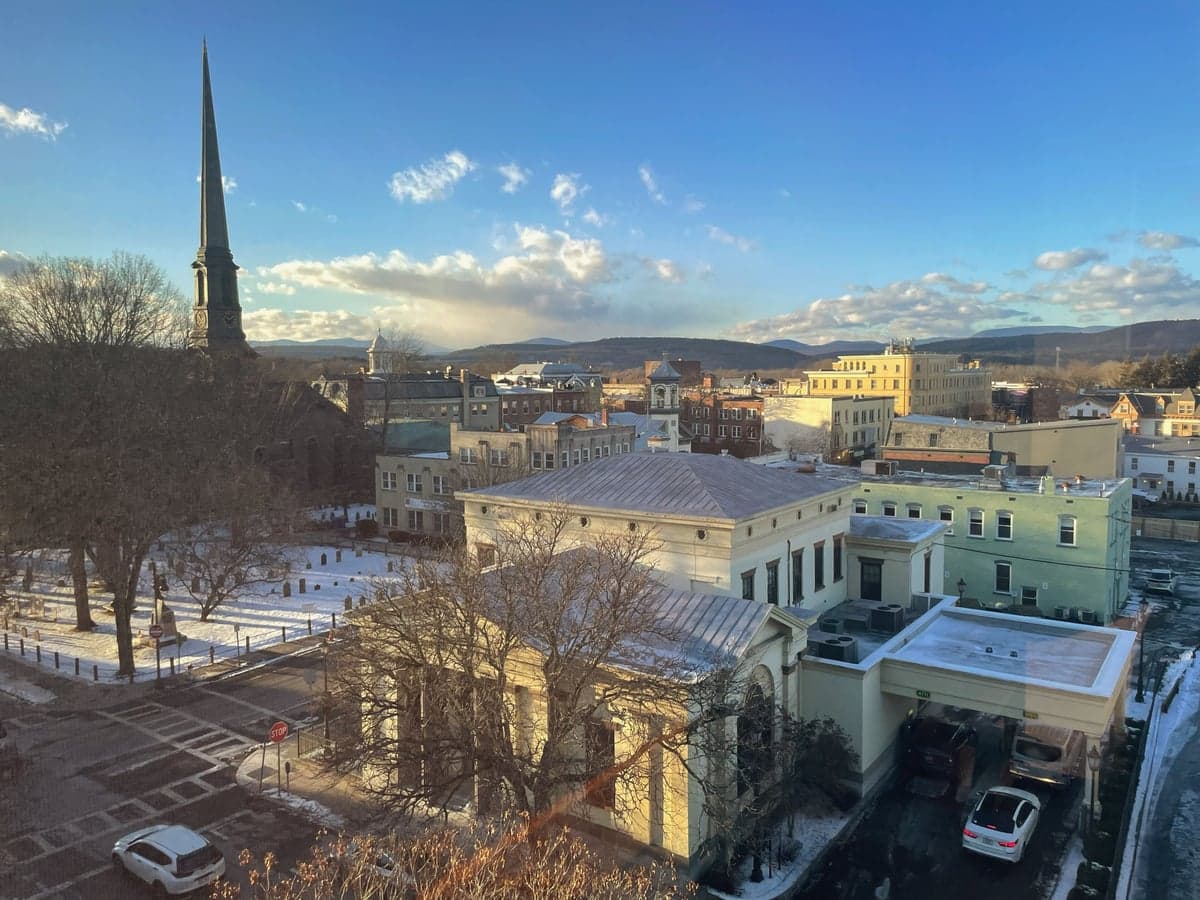
Kingston’s population story begins with Dutch settlers in the 1650s, who established the stockaded village of Wiltwyck (now the Stockade District) on land purchased from the Esopus tribe. The English took control in 1664, renaming it Kingston, and the town grew as a regional trading hub. The 19th century brought the Delaware and Hudson Canal (1828) and the Ulster & Delaware Railroad, transforming Kingston into a major cement-producing and bluestone-quarrying center. This industrial boom drew waves of Irish immigrants, who settled in the Ponckhockie neighborhood along the Rondout Creek, and later Italian immigrants, who clustered in the East Kingston area near the rail yards. By 1900, the city’s population had swelled past 20,000, with a largely white, working-class character rooted in these ethnic Catholic enclaves. The cement industry collapsed in the mid-20th century, and the city’s population peaked at 29,000 in 1960 before beginning a long decline.
Modern era (post-1965)
The 1965 Hart-Cellar Act reshaped Kingston’s demographics, though less dramatically than in larger cities. The Black population, which had been small and concentrated in the Midtown corridor along Broadway, grew steadily through the 1970s and 1980s as African American families moved from the rural South and from downstate New York. The Hispanic population began rising in the 1990s, driven by Puerto Rican migration and later by Mexican and Central American arrivals, who settled primarily in Midtown and the Rondout area. The Asian population remained tiny, with a small East/Southeast Asian community (1.2%) centered near the Kingston Plaza area, and an even smaller Indian-subcontinent population (0.6%) scattered across the city. The most transformative shift, however, has been domestic: since 2010, Kingston has seen a significant influx of white, college-educated professionals from New York City and the Hudson Valley suburbs, drawn by lower housing costs and the city’s historic architecture. These newcomers have concentrated in the Stockade District and the Rondout waterfront, driving up property values and accelerating a demographic bifurcation between the gentrifying north end and the poorer, more diverse Midtown corridor.
The future
Kingston’s population is trending toward greater economic and racial polarization rather than homogenization. The white share has declined from roughly 70% in 2010 to 61.2% today, while the Hispanic share has grown from 12% to 17.1%, driven by both immigration and higher birth rates. The Black population has held steady at around 14%, but the city’s overall population has barely grown (23,942 in 2024 vs. 23,893 in 2010), suggesting that out-migration of lower-income residents is offsetting in-migration of wealthier newcomers. The foreign-born share (6.8%) is modest and unlikely to surge, as Kingston lacks the large immigrant-employer base of New York City or Newburgh. The East/Southeast Asian and Indian-subcontinent populations remain small and are expected to grow only incrementally, primarily through professional hires at nearby institutions like IBM in Poughkeepsie and SUNY New Paltz. The most likely scenario for the next 10-20 years is a slow demographic drift: the Hispanic population will continue to grow as a share, the white population will age in place or be replaced by younger gentrifiers, and the Black population may decline slightly if displacement from Midtown continues. The city will remain a tale of two Kingstons — the historic, increasingly affluent Stockade and Rondout neighborhoods versus the working-class, majority-minority Midtown corridor.
For someone moving to Kingston now, the city offers a choice between two distinct trajectories: the walkable, historic, and increasingly expensive Stockade District, or the more diverse, affordable, but less polished Midtown area. The city is becoming more economically stratified and less ethnically diverse in its neighborhoods, even as its overall Hispanic share rises. A conservative-leaning newcomer should expect a politically progressive city government, rising property taxes, and a school district that reflects the city’s racial and economic divides — but also a place with genuine historic character and a growing sense of local identity.

* Values derived from national, state, county, city and local statistics and may differ in a specific area. Last updated: 2026-05-01T23:59:33.000Z
Narrative content on this page is AI-generated and may contain mistakes. Verify any details that matter before acting on them.
ReloMaps may earn a commission from affiliate links at no extra cost to you.

