 Popular
Photo: Wikipedia
Demographics of Klamath Falls, OR
Affluence Level in Klamath Falls, OR
A low-income area with significant economic hardship. Household wealth and educational attainment are well below national averages.
People of Klamath Falls, OR
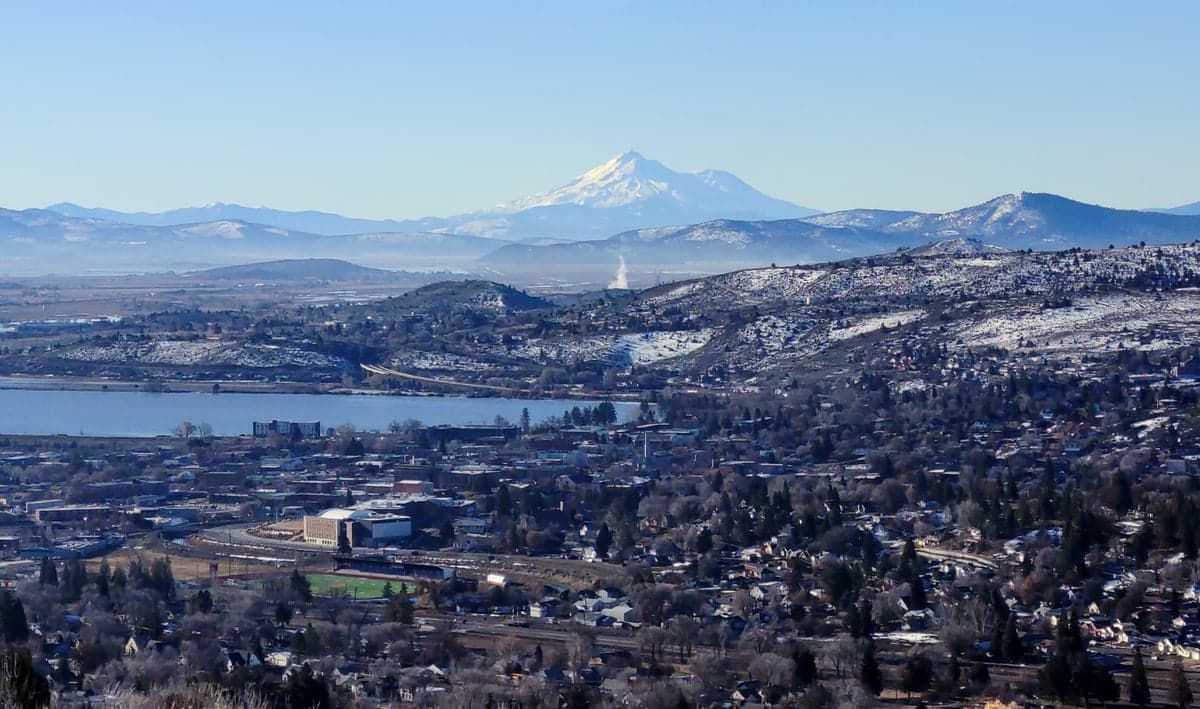
Today, Klamath Falls is a predominantly white, working-class city of 21,879, with a notably small foreign-born population of just 3.0%. The city’s character is shaped by its rural Oregon setting, a history tied to timber and agriculture, and a growing Hispanic community that now makes up 15.7% of residents. It remains less diverse than the national average, with a low college attainment rate of 22.3%, and its identity is rooted in self-reliance and a slower pace of life.
How the city was settled and grew
The original inhabitants of the Klamath Basin were the Klamath, Modoc, and Yahooskin peoples, who lived in the area for thousands of years before European contact. The first permanent white settlers arrived in the 1860s, drawn by the Donation Land Claim Act and the promise of fertile land along the Link River. The city was officially platted in 1882 after the arrival of the Oregon and California Railroad, which connected the region to outside markets. The railroad spurred a boom in timber and agriculture, and the population grew steadily through the early 20th century as loggers, millworkers, and farmers moved in. The historic Downtown Klamath Falls district, centered on Main Street, became the commercial and social hub for these early settlers, many of whom were of Northern European descent—primarily German, Irish, and Scandinavian. The Fairhaven neighborhood, just south of downtown, was developed in the 1910s and 1920s as a middle-class residential area for mill managers and merchants. By the 1940s, the city’s population had reached roughly 15,000, with the economy almost entirely dependent on the timber industry and the nearby Klamath Project irrigation system, which supported farming.
Modern era (post-1965)
The post-1965 era brought significant demographic shifts, though Klamath Falls remained far less diverse than the national average. The Immigration and Nationality Act of 1965 had a muted effect here; the foreign-born share never exceeded 4%, and the city did not see the large-scale immigration waves that transformed other Oregon cities like Portland. Instead, the most notable change was the growth of the Hispanic population, which rose from under 5% in 1990 to 15.7% today. This growth was driven by domestic in-migration from California and the Southwest, as well as direct immigration from Mexico, with many families settling in the South Sixth Street corridor and the Merrill area, a nearby unincorporated community that functions as a de facto Hispanic enclave. The East/Southeast Asian population remains very small at 0.9%, concentrated in the Altamont neighborhood east of the city limits, where a handful of Vietnamese and Filipino families have lived since the 1980s. The Indian subcontinent population is even smaller at 0.3%, with no distinct neighborhood concentration. The Black population is minimal at 0.7%, largely descended from a small number of families who moved here during the World War II era for work at the Klamath Falls Naval Air Station. Suburbanization after 1970 pushed growth into the Hilderbrand area, a newer development on the city’s west side, which attracted white families seeking larger lots and newer homes, while the older core neighborhoods like Downtown and Fairhaven saw population decline and aging housing stock.
The future
The population of Klamath Falls is projected to remain stable or grow slowly, with the Hispanic share likely continuing to rise as younger families move in and white residents age. The city is not tribalizing into distinct ethnic enclaves; rather, the Hispanic community is gradually dispersing across the city, though South Sixth Street remains a visible commercial and residential hub. The East/Southeast Asian and Indian populations are too small to form enclaves and are likely to remain static or slowly assimilate into the broader white population. The white population, while still the majority at 71%, is aging, and the city’s low college attainment rate suggests that out-migration of young adults for education and jobs will continue. The foreign-born share is unlikely to rise significantly, as the city lacks the economic pull of larger metro areas. The next 10–20 years will likely see a slow, steady increase in Hispanic residents, a plateau in other minority groups, and an overall population that remains predominantly white and working-class.
For someone moving in now, Klamath Falls is becoming a slightly more diverse but still overwhelmingly white, rural community. The city offers a low cost of living and a tight-knit feel, but the demographic trends point to a place that is not rapidly changing—it is slowly evolving, with the Hispanic community as the primary source of new growth. New residents should expect a population that values tradition, self-sufficiency, and a slower pace, with limited ethnic diversity outside of the growing Hispanic presence.

* Values derived from national, state, county, city and local statistics and may differ in a specific area. Last updated: 2026-04-20T23:05:01.000Z
Narrative content on this page is AI-generated and may contain mistakes. Verify any details that matter before acting on them.
ReloMaps may earn a commission from affiliate links at no extra cost to you.

