 Popular
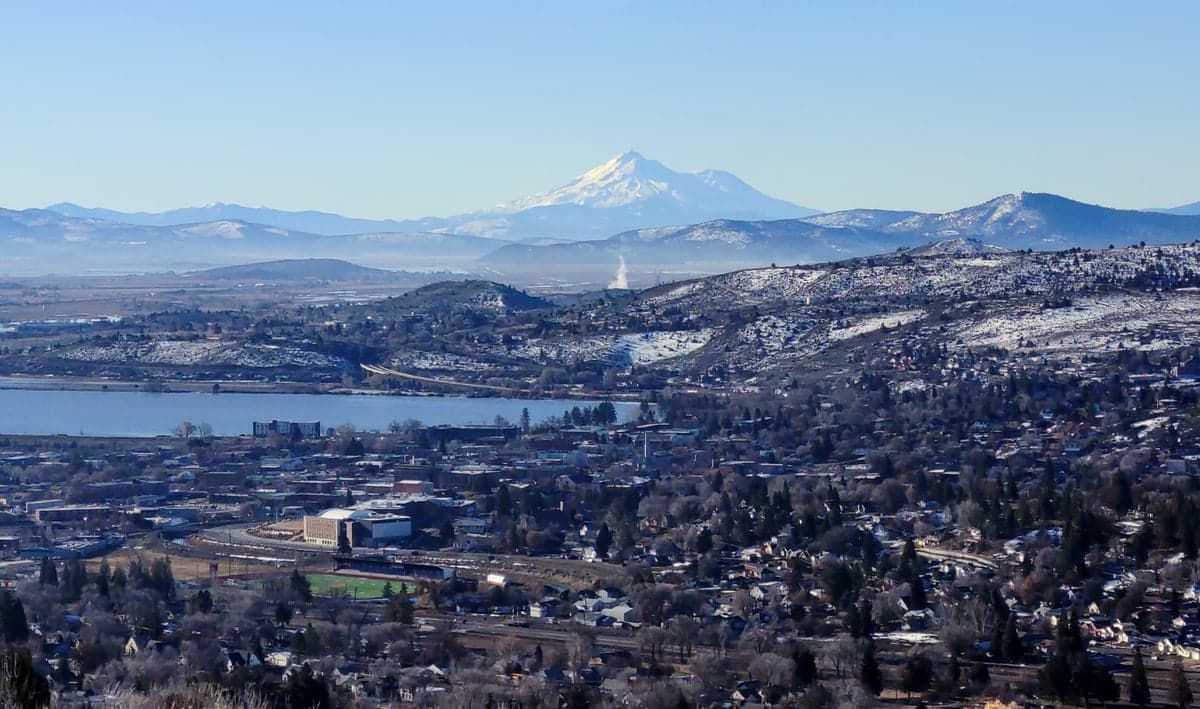
Photo: Wikipedia
Personal Sovereignty in Klamath Falls, OR
Viable for self-reliance. Generally workable, though some barriers may limit total independence.
What does Personal Sovereignty tell us?
Personal Sovereignty measures your capacity for self-reliance and independence with minimal government friction. Higher scores mean fewer barriers between you and the way you want to live... but it assumes you have the space you need and good neighbors.
What does this tell us?
Personal Sovereignty measures your capacity for self-reliance and independence with minimal government friction. Higher scores mean fewer barriers between you and the way you want to live... but it assumes you have the space you need and good neighbors.
State Policy
Energy independence: Importer (35% of energy produced in-state)
Personal Liberty
Homesteading

Personal Liberty Analysis
Klamath Falls offers a notably high degree of personal sovereignty relative to Oregon’s urbanized Willamette Valley, making it a serious consideration for those prioritizing autonomy over convenience. The area’s remote geography, conservative local culture, and relatively light regulatory touch create an environment where self-reliance isn’t just a philosophy—it’s a practical necessity. For single individuals and parents who view government overreach as a growing threat to personal freedoms, Klamath Falls represents a strategic foothold in a state that otherwise trends toward progressive control. The trade-off is clear: you gain significant latitude in how you live, raise your family, and prepare for uncertainty, but you sacrifice the amenities and institutional safety nets of larger cities.
Tax burden and regulatory posture in Klamath Falls
Oregon has no sales tax, which is a genuine advantage for large purchases and prepping supplies, but the state’s income tax is among the highest in the nation—top marginal rates hit 9.9% on income over $125,000 for single filers. Klamath County itself, however, operates with a relatively light local regulatory footprint. Property taxes are capped under Measure 50 at roughly 1% of assessed value, and the county’s rural character means fewer zoning overlays compared to Portland or Bend. The city’s permitting process for home improvements or outbuildings is straightforward, often taking weeks rather than months. For those building a self-sufficient homestead, this matters: you can add a workshop, greenhouse, or chicken coop without navigating a bureaucratic maze. The state’s land-use planning system (Goal 3 and Goal 4) does restrict development on farm and forest land, but Klamath County has more “exception areas” and rural residential zones than western Oregon counties, giving property owners more flexibility to use their land as they see fit.
Self-defense and gun law specifics in Klamath County
Oregon’s gun laws have tightened in recent years, but Klamath Falls remains a stronghold for Second Amendment advocates. The state’s Measure 114, which required permits to purchase and banned magazines over 10 rounds, was passed by voters in 2022 but remains blocked by court injunction as of early 2026. This means standard-capacity magazines and private firearm sales are still legal in practice. Klamath County is a “Second Amendment Sanctuary” county, with local law enforcement publicly stating they will not enforce unconstitutional federal or state gun restrictions. Open carry is legal without a permit, and concealed carry permits are issued by the sheriff’s office with minimal delay—typically under 30 days. For parents, this means you can train your children in firearm safety on your own property without fear of legal harassment. The local gun culture is practical, not performative: you’ll find more hunters and ranchers than tactical enthusiasts. The nearest gun ranges are within 15 minutes of town, and the BLM land east of the city offers unlimited space for private shooting practice.
Self-reliance and homesteading viability in Klamath Basin
The Klamath Basin is one of the most viable areas in Oregon for serious homesteading and off-grid living. Lot sizes in unincorporated Klamath County start at 1 acre and go up to 40-acre parcels, with prices ranging from $3,000 to $10,000 per acre—dramatically cheaper than the Willamette Valley. Zoning is permissive: you can keep livestock (chickens, goats, cattle) on parcels as small as 2 acres without special permits. The county allows “accessory dwelling units” and “tiny houses” on wheels as permanent residences, provided they meet basic septic and well requirements. Off-grid feasibility is high because the area gets over 300 days of sunshine per year, making solar power a realistic primary energy source. Well water is abundant at depths of 100-300 feet, and drilling costs around $15-$25 per foot. The growing season is short (May to September) due to the 4,100-foot elevation, but cold-hardy crops like potatoes, kale, and root vegetables thrive. For preppers, the key advantage is isolation: Klamath Falls is 60 miles from the nearest interstate (I-5), and the surrounding national forest provides a natural buffer against urban chaos.
Personal liberties: parental rights, medical autonomy, speech, and property
Klamath Falls offers strong protections for parental rights in education. The local school district (Klamath Falls City Schools) has a conservative board that rejected critical race theory and gender ideology curricula in 2023, and parents can opt their children out of any sex education or health instruction without pushback. Homeschooling is straightforward: you file a simple notice with the district and provide annual assessments, but no one visits your home or demands curriculum approval. Medical autonomy is more complicated because Oregon has statewide vaccine mandates for school attendance (no philosophical exemption), but Klamath County has a higher-than-average exemption rate due to religious and medical waivers. The county’s health department is underfunded and non-intrusive—you won’t get visits from “vaccine police.” Free speech is robust; the local newspaper, the Herald and News, regularly publishes conservative commentary, and public meetings are civil but direct. Property rights are the strongest pillar: Klamath County has no rent control, no inclusionary zoning, and no short-term rental bans. You can build a fence, cut down trees, or install a security system on your property without asking permission from anyone but the building department.
In the broader context of the Pacific Northwest, Klamath Falls stands out as a pocket of genuine personal sovereignty in a state trending toward centralized control. Compared to rural Idaho or Montana, you get Oregon’s lack of sales tax and more moderate climate, but you also inherit the state’s income tax and the risk of future Portland-driven legislation. The real advantage is cultural: the local population is overwhelmingly self-reliant, suspicious of government overreach, and willing to help neighbors without involving authorities. For a single individual or parent who wants to live free, raise kids with traditional values, and prepare for whatever comes next, Klamath Falls offers a realistic balance of liberty and practicality—provided you’re willing to accept the trade-offs of rural life. It’s not a libertarian utopia, but it’s one of the few places in Oregon where you can still breathe without asking permission.

* Values derived from national, state, county, city and local statistics and may differ in a specific area. Last updated: 2026-04-20T23:05:01.000Z
Narrative content on this page is AI-generated and may contain mistakes. Verify any details that matter before acting on them.
ReloMaps may earn a commission from affiliate links at no extra cost to you.

