Photo: Wikipedia
Demographics of Kotzebue, AK
Affluence Level in Kotzebue, AK
A middle-class area roughly in line with national averages across income, home values, education, and employment.
People of Kotzebue, AK
Today, Kotzebue is a predominantly Iñupiat community of 3,046 residents, where roughly 80% of the population identifies as Alaska Native or American Indian, giving it one of the highest Indigenous concentrations of any incorporated city in Alaska. The city is the economic and transportation hub of the Northwest Arctic Borough, with a young median age and a strong subsistence-based culture that coexists with modern wage employment. Foreign-born residents make up just 1.0% of the population, and the non-Native population—primarily White (18.6%)—is largely transient, drawn by professional roles in healthcare, education, and government. Kotzebue’s identity is rooted in Iñupiat heritage, with the Iñupiaq language still spoken in homes and the annual trade fair, the Kivgiq Messenger Feast, serving as a cultural anchor.
How the city was settled and grew
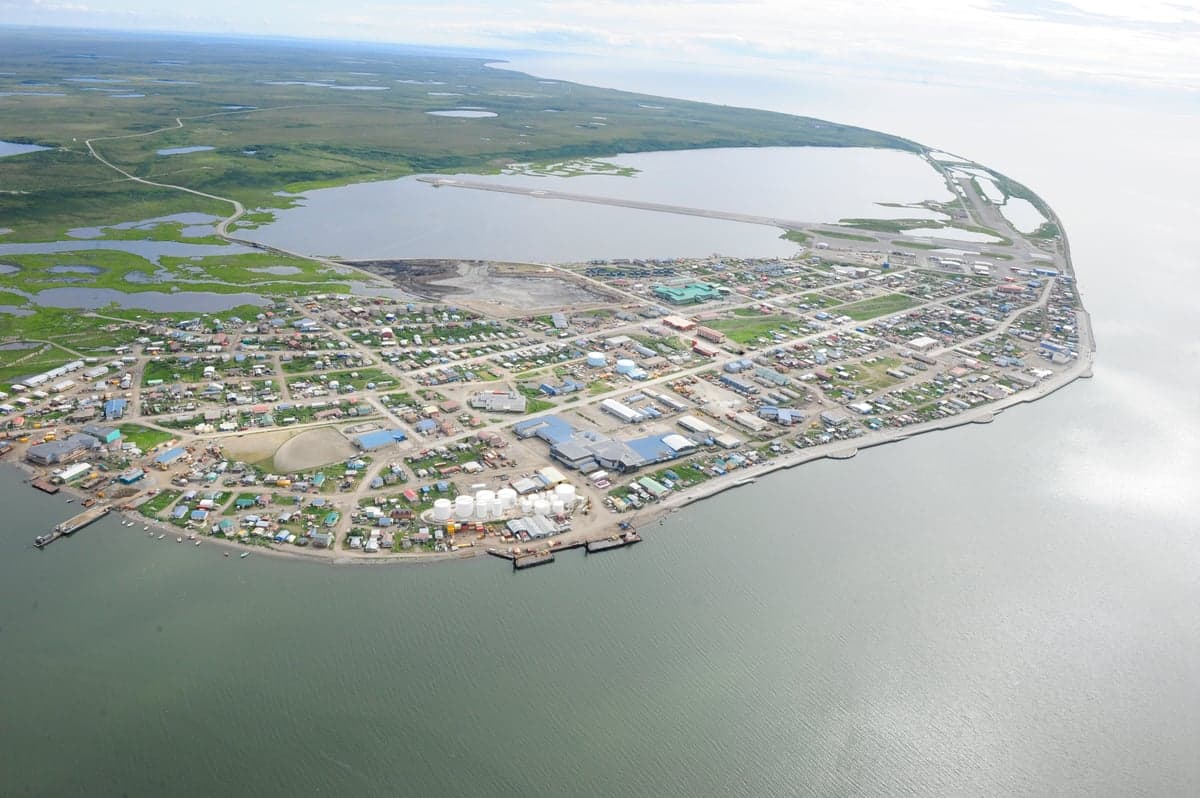
Kotzebue’s human history begins with the Iñupiat people, who have occupied the Kotzebue Sound area for at least 1,000 years, using the site as a seasonal trading and fishing camp at the convergence of three rivers. The modern settlement grew after the Alaska Gold Rush of the late 1890s, when the city was formally established in 1899 as a supply point for miners heading inland. The first permanent non-Native residents—traders, missionaries, and U.S. government agents—built cabins and warehouses along the waterfront in what is now Downtown Kotzebue, the historic core along Front Street. The Alaska Native Service (later the Bureau of Indian Affairs) established a school and hospital in the 1920s, drawing Iñupiat families from outlying villages like Noatak and Selawik into the emerging community. By the 1950s, the U.S. Air Force built a radar station and airstrip on the northern edge of town, creating the Air Force Housing neighborhood, which housed military personnel and their families and remains a distinct enclave of older, non-Native housing stock. The original Iñupiat settlement pattern—clustered family camps along the beach—evolved into the Beach Road area, where many of the city’s longest-residing Native families still live in homes passed down through generations.
Modern era (post-1965)
The passage of the Alaska Native Claims Settlement Act (ANCSA) in 1971 fundamentally reshaped Kotzebue’s population. The act created the NANA Regional Corporation, headquartered in Kotzebue, which became the region’s largest private employer and a powerful force for Iñupiat political and economic self-determination. This period saw a deliberate policy of hiring local Iñupiat for professional and managerial roles, slowing the out-migration of educated young people that plagues many rural Alaska villages. The NANA Housing subdivision, built in the 1970s and 1980s on the south side of town, absorbed many of these new middle-class Native families, offering modern homes with running water and sewer—a stark contrast to the older Beach Road area, where many homes still lack piped water. The city’s White population peaked in the 1980s at roughly 30% but has since declined to 18.6%, as state and federal budget cuts reduced the number of government contractors and teachers. The small Hispanic (4.7%) and East/Southeast Asian (2.0%) populations are almost entirely employed in healthcare (Norton Sound Regional Hospital) or retail management (Alaska Commercial Company), and they tend to rent in the Hospital District or in newer apartment buildings near the airport. The Black population (1.3%) is similarly tied to professional roles, with no distinct ethnic neighborhood. Indian subcontinent residents are statistically zero. The city has not suburbanized in the conventional sense—there are no suburbs—but the Airport Road corridor has seen modest infill of single-family homes and duplexes since 2000, mostly occupied by younger Iñupiat families moving out of crowded multigenerational homes in the core.
The future
Kotzebue’s population is projected to remain stable or grow slowly, driven by high Native birth rates (the median age is 28) and continued in-migration from smaller villages seeking better schools and healthcare. The city is not homogenizing; rather, it is becoming more distinctly Iñupiat, with the non-Native share likely to continue its gradual decline as state funding for outside contractors shrinks. The small Hispanic and Asian communities are not growing—they are transient, tied to specific jobs, and show no signs of forming permanent ethnic enclaves. The most significant demographic trend is the return of Iñupiat college graduates from Anchorage and Fairbanks, drawn back by NANA Corporation jobs and the desire to raise children in a culturally Iñupiat environment. These returnees are buying or building homes in the South Kotzebue subdivision, a newer area of paved roads and modern houses that is becoming the city’s most desirable residential district. The Beach Road area, by contrast, is aging and seeing slower turnover, as younger families prefer the amenities of South Kotzebue.
For someone moving to Kotzebue now, the city is a place where Iñupiat culture is not just surviving but actively reasserting itself in governance, education, and daily life. The non-Native population is small and professional, with little ethnic diversity beyond the Alaska Native majority. New arrivals—whether White, Hispanic, or Asian—should expect to integrate into a community where subsistence hunting and fishing, the Iñupiaq language, and corporate tribal structures define the social and economic landscape. Kotzebue is not becoming more diverse in the conventional American sense; it is becoming more confidently Indigenous.

* Values derived from national, state, county, city and local statistics and may differ in a specific area. Last updated: 2026-04-19T09:46:56.000Z
Narrative content on this page is AI-generated and may contain mistakes. Verify any details that matter before acting on them.
ReloMaps may earn a commission from affiliate links at no extra cost to you.

