
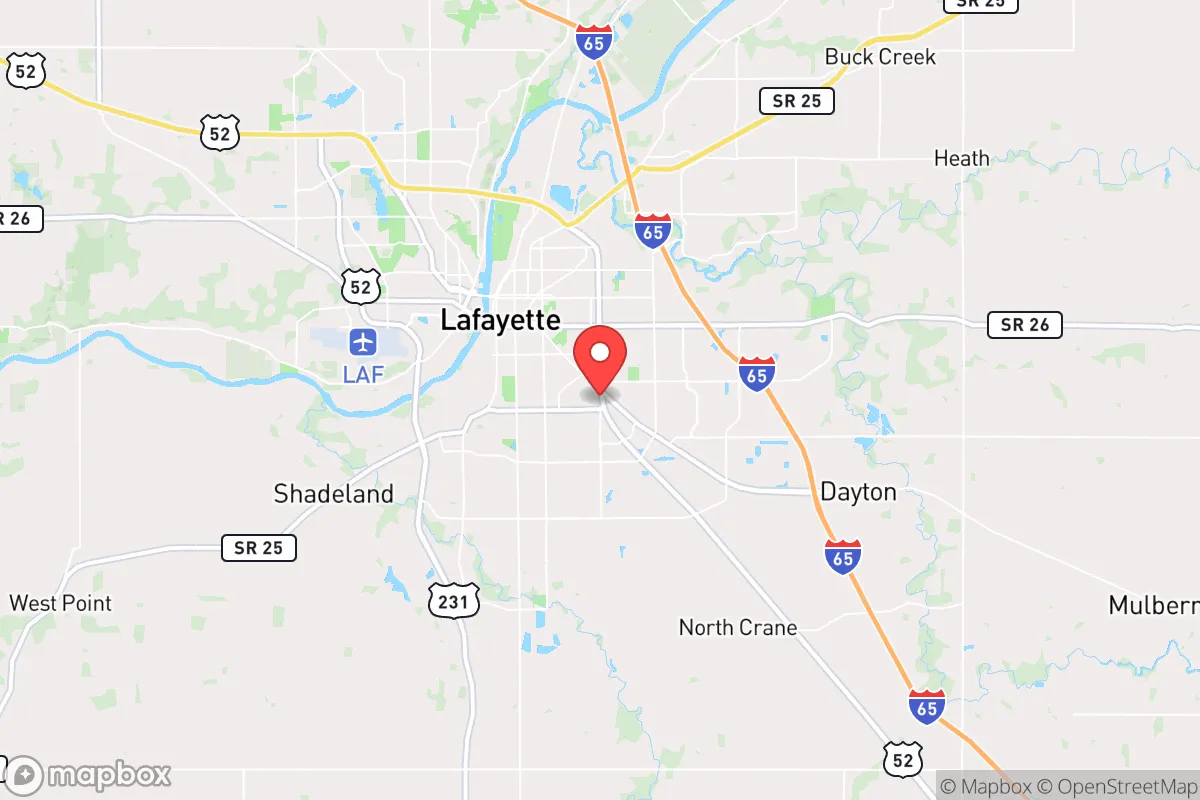
Photo: Wikipedia
Personal Sovereignty in Lafayette, IN
Viable for self-reliance. Generally workable, though some barriers may limit total independence.
What does Personal Sovereignty tell us?
Personal Sovereignty measures your capacity for self-reliance and independence with minimal government friction. Higher scores mean fewer barriers between you and the way you want to live... but it assumes you have the space you need and good neighbors.
What does this tell us?
Personal Sovereignty measures your capacity for self-reliance and independence with minimal government friction. Higher scores mean fewer barriers between you and the way you want to live... but it assumes you have the space you need and good neighbors.
State Policy
Energy independence: Importer (35% of energy produced in-state)
Personal Liberty
Homesteading

Personal Liberty Analysis
Lafayette, Indiana, offers a mixed bag for those prioritizing personal sovereignty, with the state-level legal framework providing a solid foundation for self-determination, but local governance and the broader cultural drift introducing friction points that demand careful navigation. Indiana’s constitutional protections and preemption laws generally shield residents from the most aggressive municipal overreach seen in blue states, yet the reality of living in a mid-sized, university-anchored city means you’ll still contend with zoning restrictions, a moderate tax burden, and the subtle erosion of autonomy that comes with any incorporated area. For a survivalist or prepper mindset, Lafayette is a viable base of operations—not a fortress of liberty, but a place where you can build a life with fewer immediate threats to your rights than you’d face on either coast, provided you’re willing to stay informed and push back when necessary.
Tax burden and regulatory posture: How Indiana’s fiscal landscape affects your autonomy
Indiana’s tax structure is relatively friendly to personal sovereignty, but it’s not a tax-free haven. The state imposes a flat income tax rate of 3.15% as of 2026, down from 3.23% in 2024, with a scheduled phase-down to 2.9% by 2029—a tangible reduction that keeps more money in your pocket for self-reliance projects. Property taxes in Tippecanoe County average about 0.85% of assessed value, which is below the national median, but Lafayette’s local levies for schools and infrastructure can push effective rates higher in certain neighborhoods. Sales tax sits at 7%, with no local add-ons, meaning your purchasing power for prepping supplies, tools, and bulk goods isn’t heavily penalized. The regulatory posture at the state level is notably restrained: Indiana has right-to-work laws, no state-level occupational licensing for many trades, and a general reluctance to impose new business mandates. However, Lafayette’s city council has shown a tendency toward progressive ordinances—think plastic bag bans and energy efficiency mandates for new construction—that nibble at the edges of personal choice. For a prepper, the key takeaway is that the state gives you breathing room, but you’ll need to monitor local zoning boards and city council meetings to prevent creep into your property rights or daily operations.
Self-defense and gun law specifics: What Indiana’s constitutional carry means for your security
Indiana is a strong Second Amendment state, and that’s a critical pillar for anyone serious about personal sovereignty. Since July 2022, Indiana has been a constitutional carry state, meaning you can carry a handgun openly or concealed without a permit—no government permission slip required. This is a non-negotiable baseline for self-reliance, and Lafayette’s local law enforcement generally respects this right, though you’ll still encounter the occasional business with “no guns” signage, which you must honor under Indiana law. The state also has a “Stand Your Ground” statute, codified in IC 35-41-3-2, which removes any duty to retreat before using force in self-defense if you’re lawfully present. For preppers, this is crucial: if a situation deteriorates—whether a home invasion or a broader societal breakdown—you have legal backing to defend yourself without second-guessing. One notable caveat: Indiana passed a “red flag” law (the Jake Laird Law) in 2005, which allows law enforcement to petition for the temporary seizure of firearms from individuals deemed a danger. This law has been used with increasing frequency in Tippecanoe County, and it represents a clear avenue for government overreach that could disarm a lawful gun owner based on a subjective assessment. If you’re moving to Lafayette, understand that while the state’s gun culture is robust and ranges are plentiful (like the Applied Ballistics facility near the Purdue airport), the red flag mechanism is a vulnerability you should factor into your security planning—keep your affairs in order and avoid any behavior that could be weaponized against you.
Self-reliance and homesteading viability: Lot sizes, zoning, and off-grid feasibility in Tippecanoe County
For those looking to reduce dependence on systems, Lafayette’s zoning and land use policies present both opportunities and obstacles. Within the city limits, standard residential lots are typically a quarter-acre or smaller, and the zoning code restricts keeping livestock, building detached workshops beyond a certain size, or installing alternative energy systems without permits. The city’s building department enforces the Indiana Residential Code, which can complicate off-grid setups like composting toilets or rainwater catchment systems—though state law does allow rainwater harvesting for non-potable uses. The real potential for homesteading lies in the unincorporated areas of Tippecanoe County, where you can find parcels of 1 to 10 acres within a 15-minute drive of downtown Lafayette. In these areas, zoning is more permissive: you can keep chickens, goats, and even a few head of cattle, and you’re generally free to install solar panels, build a root cellar, or set up a backup generator without municipal interference. The county’s soil quality is excellent for gardening, with the Wabash River Valley providing rich loam. However, be aware that the county health department has jurisdiction over septic systems and well water, and they enforce strict standards that can add cost and bureaucracy to your off-grid plans. For a prepper, the sweet spot is buying 5+ acres in the county, ideally with a well already drilled, and then working within the county’s reasonable regulations to build a self-sufficient homestead. Avoid subdivisions with homeowners’ associations (HOAs), which are common in newer developments near the Purdue Research Park—these can impose covenants that ban clotheslines, limit vehicle storage, and restrict gardening, directly undermining your autonomy.
Personal liberties: Parental rights, medical autonomy, speech, and property in Lafayette
Indiana has made significant moves to protect parental rights, which is a bright spot for families concerned about government overreach in education and healthcare. The state’s “Parents’ Bill of Rights” (IC 20-33-2) affirms that parents have the fundamental right to direct the upbringing, education, and healthcare of their children, and it requires schools to notify parents of any changes in a student’s services or mental health. Lafayette’s school district, Lafayette School Corporation, has generally complied, though some parents report friction over curriculum transparency—particularly around social-emotional learning programs. Medical autonomy is a more contested arena: Indiana passed a near-total abortion ban in 2022 (with limited exceptions), which aligns with a conservative view of life, but the state also maintains vaccine mandates for school attendance and has not passed broad medical freedom legislation. For preppers, this means you should stockpile essential medications and build relationships with doctors who respect patient choice, as the healthcare system remains entangled with federal and state regulations. Free speech is robustly protected under the Indiana Constitution, which explicitly guarantees the right to speak, write, or print freely on any subject. Lafayette’s public forums—like the weekly farmers’ market or city council meetings—are generally open spaces for expressing dissenting views, though you’ll encounter the typical university-town progressive orthodoxy at Purdue. Property rights are strong, with Indiana’s eminent domain laws requiring just compensation and a public purpose, but the city has used tax increment financing (TIF) districts to redirect property tax revenue for development projects, which can feel like a backdoor erosion of your control over local governance. Overall, your personal liberties in Lafayette are well-protected relative to blue states, but you must remain vigilant—the local government’s appetite for “community benefit” initiatives can encroach on your property and parental decisions if you’re not paying attention.
In the broader landscape of American sovereignty, Lafayette occupies a middle tier—it’s not a libertarian enclave like rural Idaho or New Hampshire’s “Free State” project, but it’s far removed from the regulatory chokeholds of California or New York. The state-level framework gives you a solid platform for self-defense, tax efficiency, and parental control, while the local environment demands active citizenship to prevent mission creep from city planners and school administrators. For a survivalist or prepper, the calculus is straightforward: Lafayette offers affordable land, a gun-friendly culture, and a legal system that generally respects your right to be left alone, but you’ll need to buy outside city limits, avoid HOAs, and stay engaged with county politics to preserve that autonomy. If you’re willing to put in that work, it’s a place where you can build a resilient, self-reliant life without constantly fighting the state—just don’t expect it to be handed to you.

* Values derived from national, state, county, city and local statistics and may differ in a specific area. Last updated: 2026-04-22T10:29:40.000Z
Narrative content on this page is AI-generated and may contain mistakes. Verify any details that matter before acting on them.
ReloMaps may earn a commission from affiliate links at no extra cost to you.

