Photo: Wikipedia
Demographics of Lafayette, IN
Affluence Level in Lafayette, IN
A middle-class area roughly in line with national averages across income, home values, education, and employment.
People of Lafayette, IN
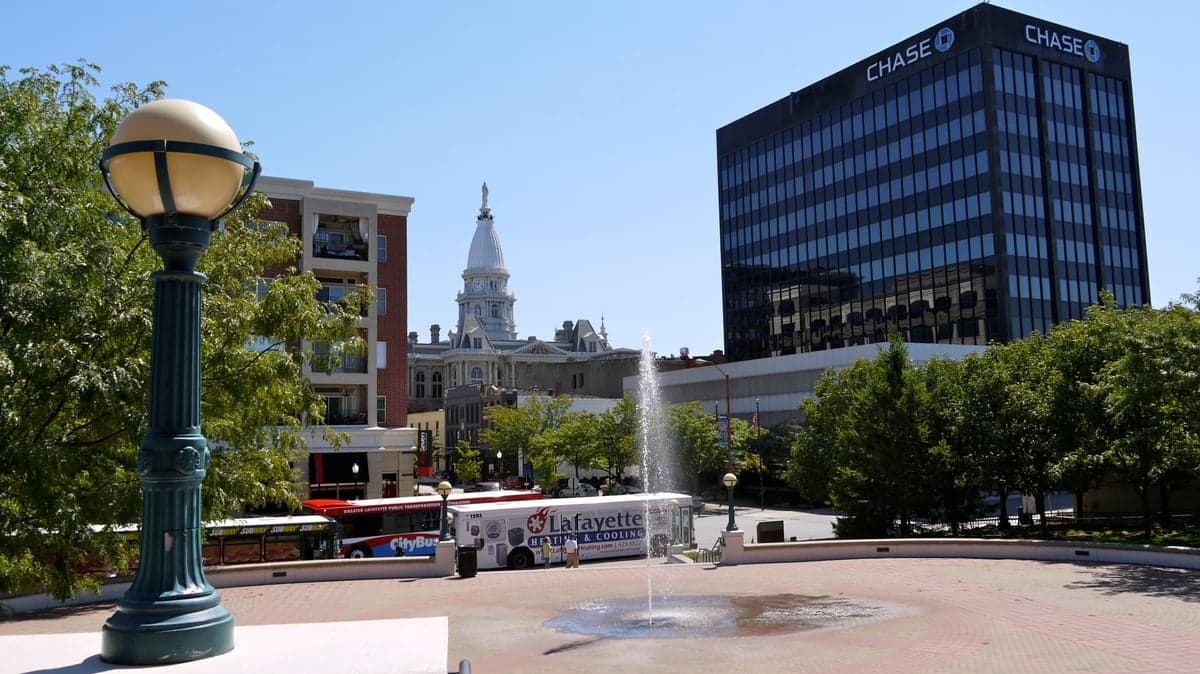
Lafayette, Indiana, today is a Midwestern manufacturing and college city of 70,650 residents, characterized by a working-class backbone, a growing Hispanic population, and a modest but visible international presence. The city’s identity is shaped by its historic role as a regional industrial hub, its anchor institution Purdue University (just across the Wabash River in West Lafayette), and a demographic profile that remains majority-white (71.3%) but is diversifying steadily, with a Hispanic share of 13.8% and a Black population of 8.9%. Lafayette feels more blue-collar and family-oriented than its university neighbor, with a population density of roughly 2,300 people per square mile and a distinct pride in its independent, self-reliant character.
How the city was settled and grew
Founded in 1825 on the south bank of the Wabash River, Lafayette was platted as a trading post and river port, drawing its earliest settlers from Kentucky, Ohio, and the Mid-Atlantic states. The Wabash and Erie Canal, completed through the city in the 1840s, turned Lafayette into a regional shipping and processing center, attracting German and Irish immigrants who built the city’s first brick homes and commercial blocks in the Historic Ninth Street Hill neighborhood and along Main Street. The arrival of the railroads in the 1850s—particularly the Monon and the Wabash lines—cemented Lafayette as a manufacturing and rail junction, drawing a second wave of German, Polish, and Italian immigrants who settled in the working-class St. Mary’s District near the rail yards and the Wabash River. By 1900, the city’s population had reached 18,000, and the industrial base expanded with foundries, machine shops, and the Alcoa aluminum plant (opened 1919), which drew Appalachian migrants and additional Eastern European laborers. The Hills and Dales neighborhood, developed in the 1920s, became home to the city’s professional and managerial class, while the Columbian Park area housed a mix of middle-class families and second-generation immigrant households. The post-World War II boom brought a wave of white domestic migrants from rural Indiana and the South, filling new subdivisions like Southside and Vinton Park, as Lafayette’s population grew from 30,000 in 1950 to 44,000 by 1970.
Modern era (post-1965)
The 1965 Hart-Cellar Act opened immigration from Asia and Latin America, but Lafayette’s foreign-born population remained small (7.1% today) compared to larger Midwestern cities. The most significant post-1965 shift has been the growth of the Hispanic community, which rose from a negligible share in 1980 to 13.8% today, driven by Mexican and Central American immigrants recruited for work in food processing (Purdue’s poultry plants, now operated by Tyson Foods) and light manufacturing. This community concentrated in the South 18th Street corridor and the Union Street area near the industrial parks, where Spanish-language groceries, churches, and small businesses now anchor a visible ethnic enclave. The Black population, 8.9% of the city, grew primarily through domestic migration from Chicago and Gary after the 1970s, settling in the Wabash Avenue corridor and the Greenbush Street area, though Lafayette remains less segregated than many Rust Belt peers. East and Southeast Asian residents (1.4%) are largely tied to Purdue University, living in the West Lafayette border neighborhoods and the State Street area, while the Indian-subcontinent population (1.0%) is similarly university-connected but more dispersed. The college-educated share (28.1%) is below the national average, reflecting Lafayette’s industrial workforce base, though the presence of Purdue’s research park and the growing tech sector (e.g., Saab’s defense facility, Wabash National headquarters) is slowly raising that figure.
The future
Lafayette’s population is projected to grow modestly, reaching roughly 75,000 by 2035, driven by Hispanic natural increase and continued domestic in-migration from higher-cost Midwestern metros like Chicago and Indianapolis. The Hispanic share is likely to rise toward 18-20% over the next decade, as the existing community is young (median age 27) and family-oriented, while the white population (71.3%) is aging and declining slightly. The city is not tribalizing into starkly separate enclaves—neighborhoods like South 18th Street and Union Street remain heavily Hispanic, but there is no evidence of hardening ethnic boundaries; instead, second-generation Hispanic residents are moving into previously white subdivisions like Vinton Park and Southside. The East/Southeast Asian and Indian populations are likely to plateau or grow slowly, as Purdue’s international student enrollment faces headwinds from national visa policy and competition from other universities. The biggest demographic wildcard is whether Lafayette can attract and retain the college-educated workers needed to fill growing tech and advanced manufacturing jobs—if it does, the city may see a modest uptick in Asian and Indian in-migration; if not, the population will continue to skew working-class and Hispanic.
For someone moving to Lafayette now, the city is becoming a more diverse, younger, and slightly more educated version of its historic self—still majority-white and working-class, but with a growing Hispanic community that is reshaping neighborhoods and the local economy. The city offers a stable, family-oriented environment with a low cost of living and a strong manufacturing base, but the social fabric remains relatively homogeneous compared to larger metros, and newcomers should expect a community that values self-reliance and neighborly familiarity over cosmopolitan diversity.

* Values derived from national, state, county, city and local statistics and may differ in a specific area. Last updated: 2026-04-22T10:29:40.000Z
Narrative content on this page is AI-generated and may contain mistakes. Verify any details that matter before acting on them.
ReloMaps may earn a commission from affiliate links at no extra cost to you.

