Photo: Wikipedia
Demographics of Lake Havasu City, AZ
Affluence Level in Lake Havasu City, AZ
A middle-class area roughly in line with national averages across income, home values, education, and employment.
People of Lake Havasu City, AZ
The people of Lake Havasu City, Arizona, today form a predominantly white, politically conservative community of roughly 58,000 residents, marked by a notably low foreign-born share of just 2.3% and a median age well above the national average. The city’s identity is shaped by its role as a Colorado River recreation hub and a retirement destination, with a population that is 79.7% white and 15.5% Hispanic, while Black (0.5%), East/Southeast Asian (0.4%), and Indian subcontinent (0.1%) residents make up very small fractions. The college-educated share sits at 18.4%, reflecting a workforce oriented toward tourism, construction, and healthcare rather than white-collar industries. This is a place where the population is older, less diverse than the national average, and deeply rooted in the postwar Sun Belt migration pattern.
How the city was settled and grew
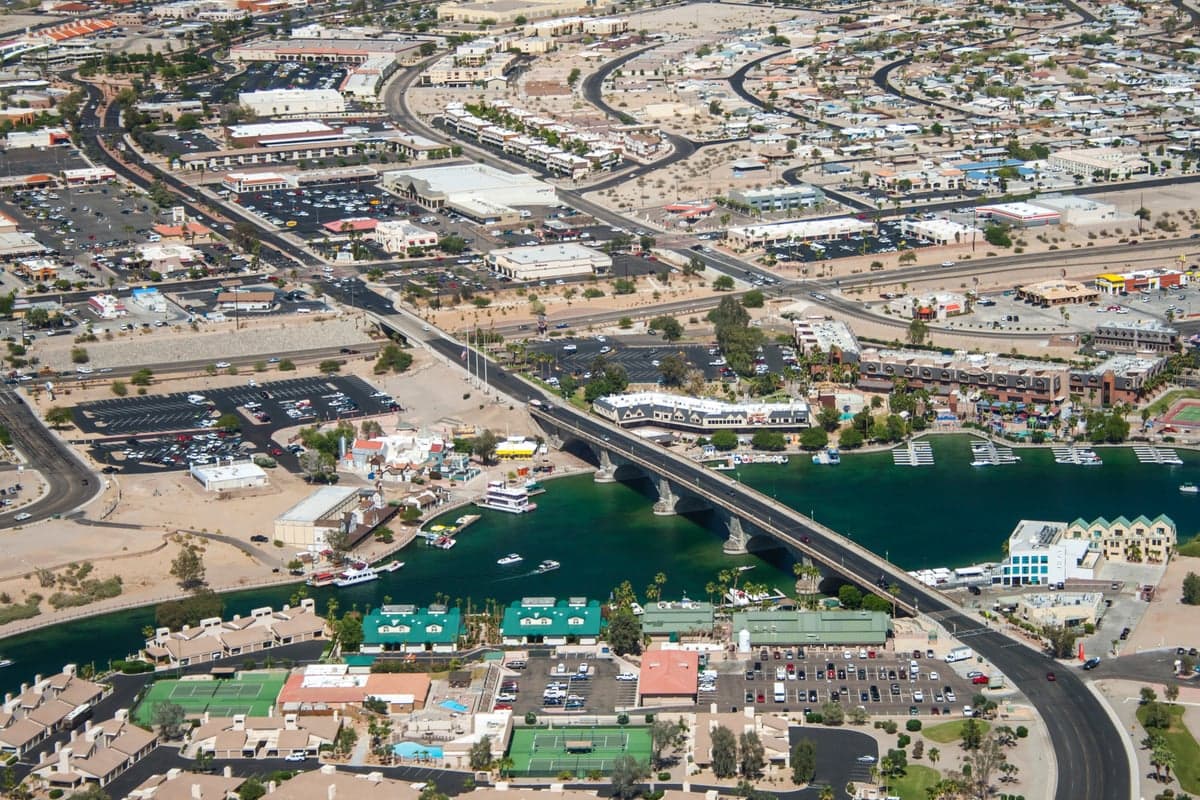
Lake Havasu City has no colonial or 19th-century settlement history; it is a planned community founded in 1963 by developer Robert P. McCulloch, who purchased 3,500 acres of desert along the Colorado River. The original population was drawn by McCulloch’s promise of jobs at his chain-saw manufacturing plant and by the appeal of a low-tax, warm-weather lifestyle. The first wave of residents were overwhelmingly white, middle-class families from the Midwest and California, many of whom moved into the Island neighborhood—the original planned residential district built around the now-famous London Bridge, relocated here in 1968. A second wave in the 1970s and 1980s consisted of retirees and seasonal “snowbirds,” who concentrated in the Pueblo del Sol and Bunker Bay areas, drawn by waterfront lots and golf-course communities. The city’s growth was almost entirely domestic in-migration; there was no significant immigrant labor force during these decades, as the local economy relied on tourism and light manufacturing rather than agriculture.
Modern era (post-1965)
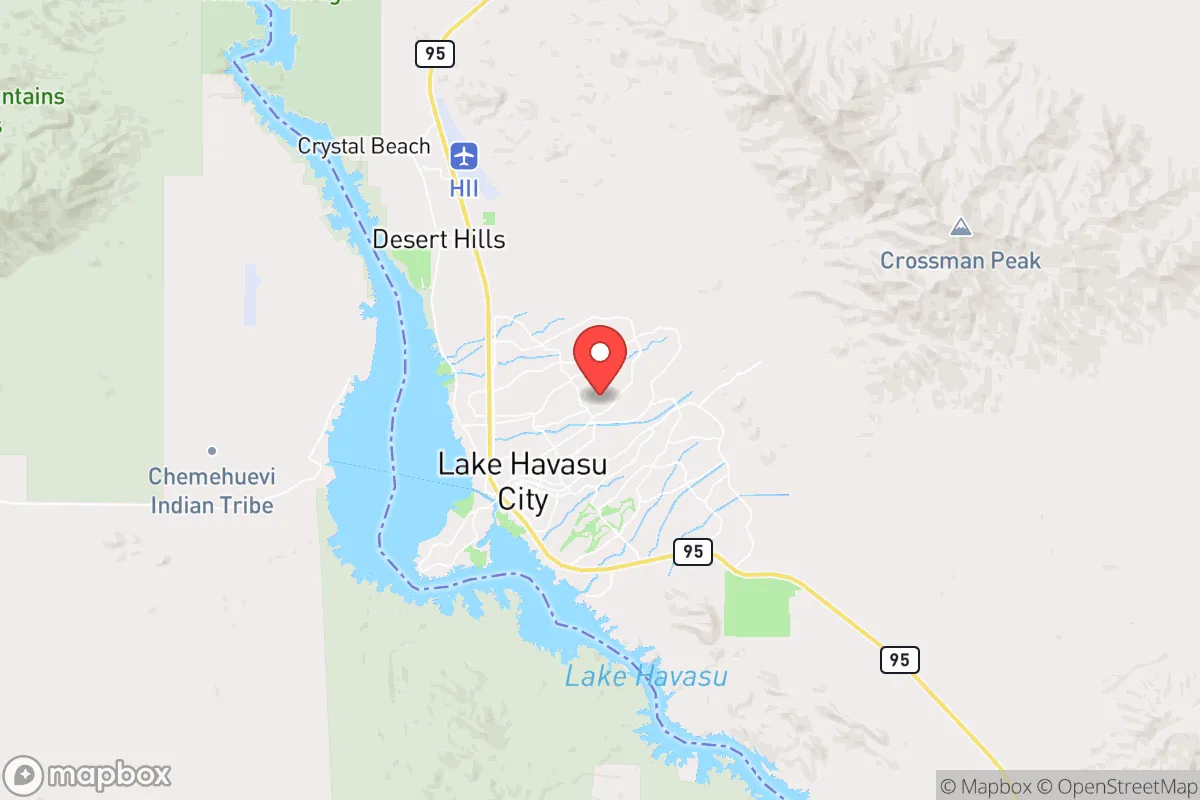
After the 1965 Hart-Cellar Act, Lake Havasu City saw virtually no influx of immigrants from Asia, Africa, or Latin America, unlike many other Sun Belt cities. The foreign-born population remains at just 2.3%, and the Hispanic share of 15.5% is largely the result of natural increase and internal migration from other Arizona cities, not recent immigration. The Hispanic population is concentrated in the Pueblo del Sol West and Desert Hills neighborhoods, where lower home prices attracted younger families working in construction and hospitality. The white population, meanwhile, dominates the Island and Bunker Bay areas, which feature higher property values and a higher concentration of retirees. The Black and East/Southeast Asian populations remain negligible—0.5% and 0.4% respectively—and are scattered without forming distinct ethnic enclaves. The Indian subcontinent population (0.1%) is almost entirely composed of professionals in healthcare, with a small cluster near the Lake Havasu Regional Medical Center in the central part of the city. The city’s demographic profile has changed little since 2000, with the white share declining only slightly as the Hispanic share has grown from roughly 10% to 15.5%.
The future
Lake Havasu City’s population is projected to grow modestly, reaching roughly 65,000 by 2035, but the demographic composition is likely to remain stable. The Hispanic share may rise to 18-20% through natural increase and continued domestic migration from southern Arizona, but the foreign-born share is unlikely to climb above 3-4% given the lack of entry-level jobs in agriculture or manufacturing that typically attract immigrants. The white population will continue to age in place, with the Island and Bunker Bay neighborhoods seeing increasing turnover as retirees sell to younger white families from California and the Pacific Northwest. The city is not tribalizing into distinct ethnic enclaves; rather, it is slowly homogenizing as the small Hispanic population assimilates into the broader community. The Black, East/Southeast Asian, and Indian subcontinent populations will likely remain below 1% each, as the city lacks the professional job base or university presence that attracts these groups to larger metros.
For someone moving in now, Lake Havasu City is becoming a slightly more diverse but still overwhelmingly white, older, and politically conservative community where the dominant culture is rooted in outdoor recreation and a slow pace of life. The low foreign-born share and high racial homogeneity mean that newcomers from outside the Southwest will find little ethnic or cultural friction, but also limited exposure to the diversity found in larger Arizona cities like Phoenix or Tucson. The city’s future is one of gradual, incremental change rather than transformation—a place where the population will grow older and slightly more Hispanic, but remain fundamentally the same in character as the planned community McCulloch built in the 1960s.

* Values derived from national, state, county, city and local statistics and may differ in a specific area. Last updated: 2026-04-22T09:27:24.000Z
Narrative content on this page is AI-generated and may contain mistakes. Verify any details that matter before acting on them.
ReloMaps may earn a commission from affiliate links at no extra cost to you.

