Photo: Wikipedia
Personal Sovereignty in Lake Havasu City, AZ
Viable for self-reliance. Generally workable, though some barriers may limit total independence.
What does Personal Sovereignty tell us?
Personal Sovereignty measures your capacity for self-reliance and independence with minimal government friction. Higher scores mean fewer barriers between you and the way you want to live... but it assumes you have the space you need and good neighbors.
What does this tell us?
Personal Sovereignty measures your capacity for self-reliance and independence with minimal government friction. Higher scores mean fewer barriers between you and the way you want to live... but it assumes you have the space you need and good neighbors.
State Policy
Energy independence: Importer (20% of energy produced in-state)
Personal Liberty
Homesteading

Personal Liberty Analysis
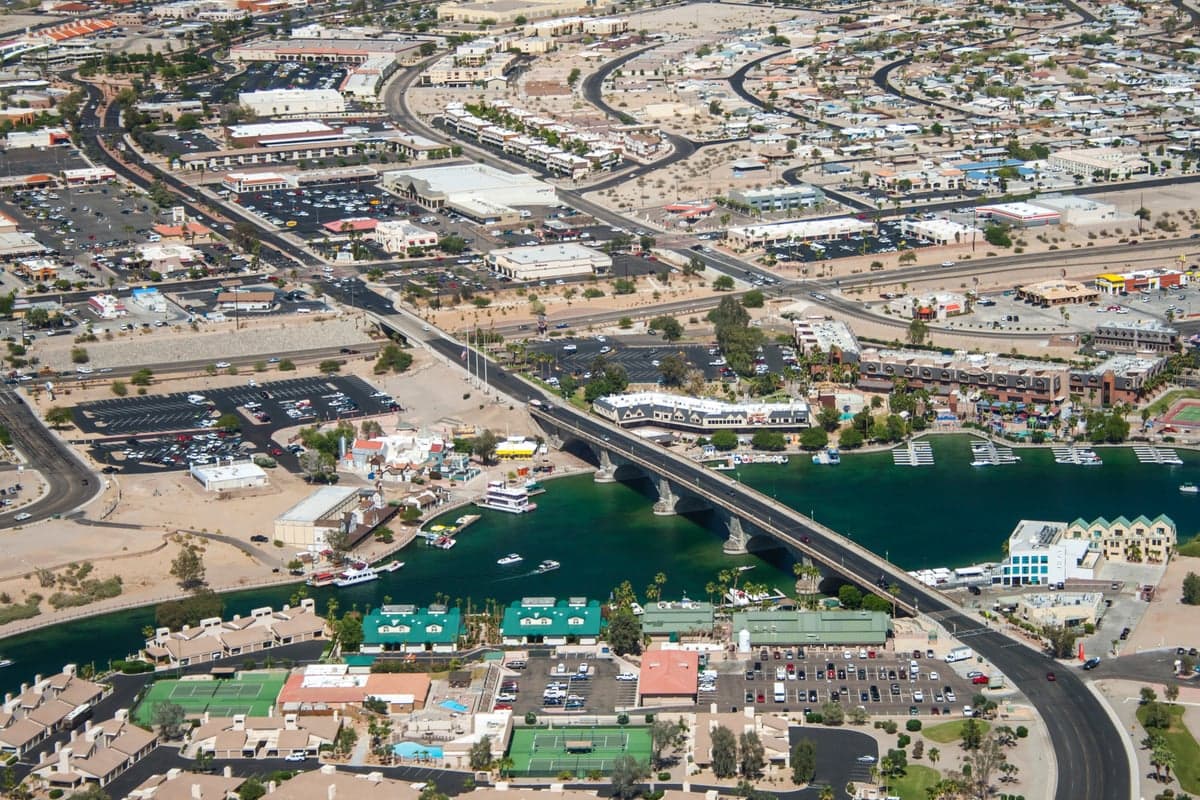
Lake Havasu City offers a notably high degree of personal sovereignty compared to many urban centers on the West Coast, largely due to Arizona’s constitutional framework and the city’s own cultural resistance to overregulation. For single individuals and parents who prioritize autonomy over their lives, property, and decisions, this desert community provides a legal and social environment where government overreach is minimized. The city’s location in Mohave County, combined with state-level preemption laws, creates a buffer against the kind of municipal micromanagement common in California or Oregon. However, sovereignty here is not absolute—it exists within the bounds of federal land management and state water law, which remain critical considerations for anyone serious about long-term self-reliance.
Tax burden and regulatory posture: how Arizona’s framework protects your wallet and choices
Arizona’s tax structure is a major pillar of personal sovereignty in Lake Havasu City. The state levies a flat income tax rate of 2.5% as of 2025, with no progressive brackets that penalize higher earners. Property taxes are among the lowest in the nation, with Mohave County’s effective rate hovering around 0.6% of assessed value—roughly half the national average. There is no state-level estate or inheritance tax, meaning wealth transfers to children or heirs remain untouched by government claims. Sales tax in Lake Havasu City totals 8.35% (state + county + city), but essentials like groceries and prescription drugs are exempt. More importantly, Arizona’s regulatory posture is aggressively pro-freedom: the state has preempted local governments from enacting rent control, plastic bag bans, and most business licensing schemes that would choke entrepreneurial autonomy. For a prepper or survivalist, this means you can stockpile supplies, run a home-based business, or modify your property without navigating a labyrinth of permits. The city’s zoning code is relatively permissive, though homeowners’ associations (HOAs) in some subdivisions can impose restrictions—so buyers should verify deed covenants before purchasing.
Self-defense and gun law specifics: what the Second Amendment looks like in practice
Lake Havasu City sits in one of the most firearm-friendly states in the country. Arizona is a constitutional carry state, meaning no permit is required to carry a concealed or open firearm for anyone 21 or older who can legally possess a gun. There is no state-level waiting period, no universal background check requirement for private sales, and no magazine capacity restrictions. The city itself has no local gun ordinances that exceed state law, thanks to Arizona’s strong preemption statute (ARS §13-3108), which prohibits municipalities from regulating firearms more strictly than the state. Stand-your-ground and castle-doctrine laws are fully codified, giving residents the legal backing to use deadly force in self-defense without a duty to retreat, both inside and outside the home. For parents, this means the legal environment supports training children in firearm safety and marksmanship without fear of overzealous prosecution. The nearest gun ranges—including the Lake Havasu Shooting Range on Cienega Springs Road—are within a 15-minute drive. However, federal land (BLM and national forest) surrounds much of the area, and shooting on public land is legal but subject to seasonal fire restrictions and distance-from-roads rules. Anyone planning to bug out into the desert should familiarize themselves with BLM shooting regulations to avoid federal trespass or fire-related citations.
Self-reliance and homesteading viability: lot sizes, zoning, and off-grid feasibility
For those seeking true self-reliance, Lake Havasu City presents a mixed but workable landscape. Residential lots in the city proper average 7,000 to 10,000 square feet, but outlying areas—particularly north of the city toward the Bill Williams River and south toward Parker—offer parcels of 1 to 5 acres at prices well below Phoenix metro levels. Zoning in Mohave County allows for agricultural uses on parcels as small as 2.5 acres, including livestock, gardens, and rainwater catchment. Off-grid living is legally feasible but requires navigating Arizona’s water laws: the state operates under prior appropriation, meaning you must have a valid water right to drill a well or capture runoff. In practice, many rural properties come with grandfathered well rights, but new wells require a permit from the Arizona Department of Water Resources, and the process can take months. Solar power is unregulated at the county level, and net metering is available through UniSource Energy (the local utility), though rates have become less favorable since 2023. Composting toilets and greywater systems are permitted under state building codes, but any permanent structure must meet minimum square footage and setback requirements. The biggest constraint is fire risk: the Bureau of Land Management and local fire districts enforce strict vegetation clearance around structures, which limits the kind of dense, camouflaged homestead some preppers envision. Still, for a disciplined operator, Lake Havasu City offers a viable base for food production, water storage, and energy independence—especially compared to coastal states where such practices are effectively banned.
Personal liberties: parental rights, medical autonomy, speech, and property
Arizona has become a stronghold for parental rights in education. State law (ARS §15-102) guarantees parents the right to direct their children’s education, including opting out of any curriculum or activity without penalty. Lake Havasu City’s school district—Lake Havasu Unified School District #1—has not adopted the kind of critical race theory or gender-identity curricula that have sparked conflicts elsewhere, and school board meetings remain civil and focused on academics. Medical autonomy is similarly robust: Arizona does not mandate COVID-19 or childhood vaccines for school attendance (only the standard MMR, DTaP, and polio shots are required, with broad exemption options). The state has banned vaccine passports and prohibits employers from mandating vaccines as a condition of employment. For speech, Arizona’s constitution provides stronger protections than the First Amendment in some areas, including a specific prohibition on prior restraint. Local law enforcement in Lake Havasu City has not engaged in the kind of social-media monitoring or protest suppression seen in larger cities. Property rights are protected by Arizona’s Private Property Rights Protection Act, which requires the government to compensate landowners for any regulatory taking that reduces property value by more than 20%. This makes eminent domain abuse and overzealous zoning enforcement far less common than in states like California. The one caveat is the city’s floodplain regulations near the Colorado River, which can restrict building and modifications on certain lots—so due diligence on FEMA flood maps is essential before purchasing river-adjacent land.
In the broader landscape of American personal sovereignty, Lake Havasu City ranks among the top tier for individuals and families who value minimal government intrusion. The combination of low taxes, strong Second Amendment protections, permissive zoning for self-reliance, and robust parental and medical rights creates an environment where a determined person can live largely on their own terms. The primary limitations are water rights (which require careful legal navigation) and the presence of federal land management (which imposes seasonal restrictions on activities like shooting and fire-building). Compared to the Pacific Northwest, the Northeast, or the Front Range of Colorado, Lake Havasu City offers a far more hospitable legal climate for the survivalist or prepper mindset. It is not a libertarian utopia—no place is—but for those willing to learn the local regulatory landscape and invest in property with clear water and mineral rights, it provides a solid foundation for building a life of genuine autonomy.

* Values derived from national, state, county, city and local statistics and may differ in a specific area. Last updated: 2026-04-22T09:27:24.000Z
Narrative content on this page is AI-generated and may contain mistakes. Verify any details that matter before acting on them.
ReloMaps may earn a commission from affiliate links at no extra cost to you.

