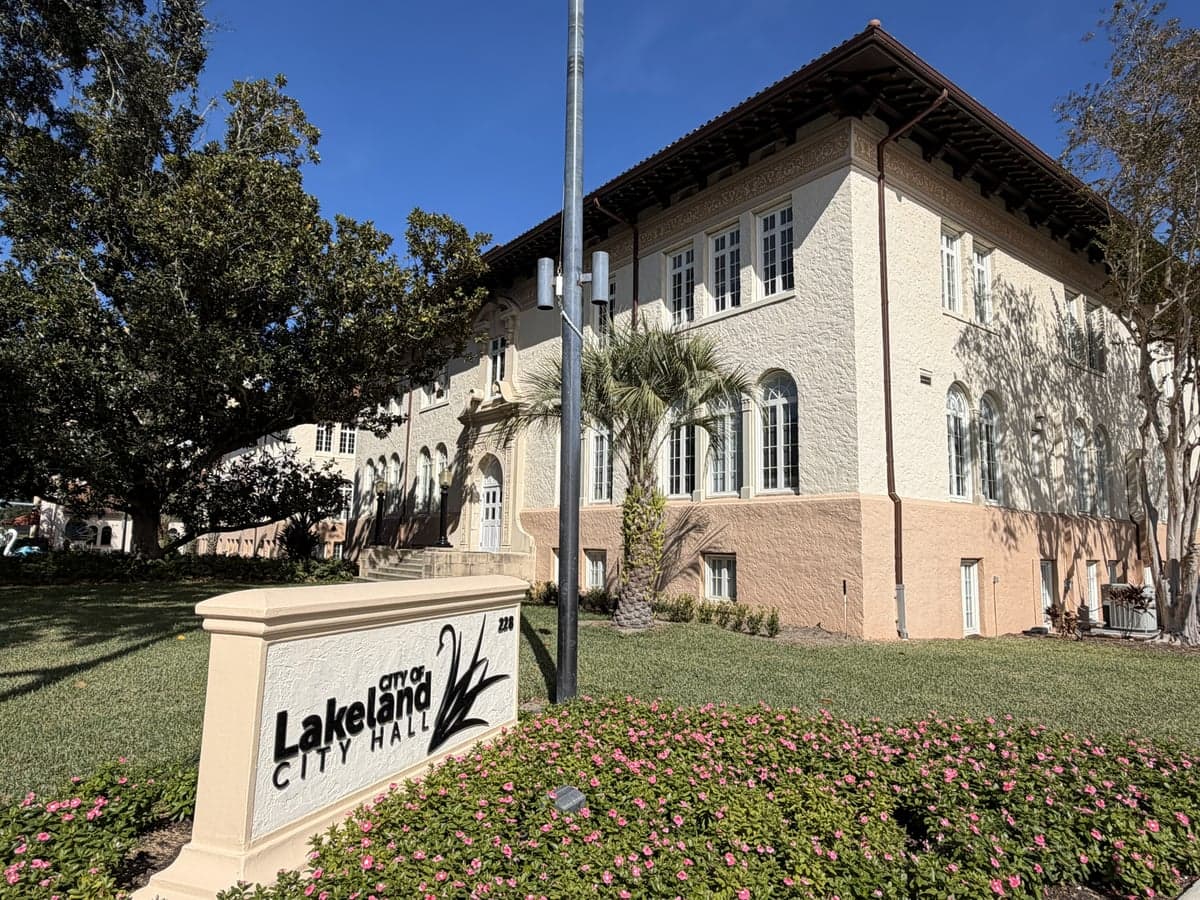
Photo: Wikipedia
Demographics of Lakeland, FL
Affluence Level in Lakeland, FL
A middle-class area roughly in line with national averages across income, home values, education, and employment.
People of Lakeland, FL
The people of Lakeland, Florida, today number 117,030, forming a city that is majority-white (57.0%) but notably diverse, with a Hispanic population of 19.2% and a Black population of 17.7%. The city’s character is shaped by its historic role as a citrus and railroad hub, a legacy that still anchors its older neighborhoods, while newer subdivisions reflect a steady influx of domestic migrants from the Northeast and Midwest. With a foreign-born share of just 5.2%—well below the national average—Lakeland remains a predominantly native-born, family-oriented community where college attainment (27.7%) trails the state average, signaling a workforce rooted in trades, logistics, and healthcare rather than tech or finance.
How the city was settled and grew
Lakeland’s founding population arrived after the Civil War, drawn by the promise of cheap land and a subtropical climate suited to citrus. The city was formally incorporated in 1885, and its early growth was powered by the railroad—specifically the South Florida Railroad, which connected Lakeland to Tampa and the Atlantic coast. The original settlers were mostly white Anglo-Saxon Protestants from Georgia, the Carolinas, and Tennessee, who established the city’s first grid of streets around Lake Mirror and Lake Morton. These families built the historic Dixieland neighborhood, a walkable district of early-20th-century bungalows and Craftsman homes that remains a white, middle-class enclave today. By the 1910s, Black laborers—many formerly enslaved or the children of enslaved people—arrived to work the citrus groves and railroad yards, settling in the Moorehead neighborhood, a historically Black community east of downtown that still retains a strong African American identity. A smaller wave of Greek immigrants came in the 1910s and 1920s, opening restaurants and sponge-diving supply shops, and they concentrated around the Downtown commercial core, where a few Greek-owned businesses remain. The city’s population grew steadily through the 1950s, reaching about 41,000 by 1960, with the white majority living in neighborhoods like Lake Hollingsworth—an affluent area of large homes and waterfront estates—while Black residents were largely confined to Moorehead and the Combee Settlement area, a rural Black community that later became a suburban subdivision.
Modern era (post-1965)
After the 1965 Immigration and Nationality Act, Lakeland saw only modest foreign-born growth, unlike coastal Florida cities. The city’s Hispanic population began to rise in the 1980s and 1990s, driven primarily by Puerto Rican and Mexican migrants who came for agricultural and construction work. These families settled in the South Lakeland area, particularly around the Kathleen Road corridor, where a cluster of Hispanic-owned businesses and churches now anchors a growing Latino community. The Black population, which had been stable at roughly 15-18% since the 1970s, began to suburbanize out of Moorehead and Combee Settlement into newer subdivisions like Crystal Lake and Winston, where homeownership rates are higher and schools are more integrated. The white population, meanwhile, shifted westward: the Southwest Lakeland master-planned communities—such as Bridgewater and Grasslands—attracted domestic migrants from the Northeast and Midwest, drawn by lower taxes and a slower pace of life. These subdivisions are overwhelmingly white and middle-to-upper-middle-class, with home prices averaging $350,000-$500,000. The city’s East/Southeast Asian population (1.6%) is small but visible, with a concentration of Vietnamese and Filipino families in the North Lakeland area near the Lakeland Linder International Airport, many working in logistics and healthcare. The Indian-subcontinent population (0.6%) is even smaller, with most families living in the newer subdivisions of South Lakeland, often employed as doctors at Lakeland Regional Health or as engineers at the nearby Publix headquarters.
The future
Lakeland’s population is projected to grow to roughly 140,000 by 2035, driven almost entirely by domestic in-migration from the Northeast and Midwest. The city is not tribalizing into distinct ethnic enclaves—rather, it is homogenizing into a predominantly white, native-born, conservative-leaning suburb of Tampa, with Hispanic and Black populations growing slowly but remaining geographically dispersed. The Hispanic share is expected to rise to about 22-24% by 2040, driven by continued Puerto Rican migration and natural increase, while the Black share will likely plateau near 18%. The East/Southeast Asian and Indian communities are growing from a very small base and will remain niche populations, concentrated in professional-class subdivisions. The foreign-born share will likely stay below 8%, as Lakeland lacks the immigrant-heavy industries (hospitality, agriculture on a large scale) that drive foreign-born growth in other Florida cities. The city is becoming more suburban and car-dependent, with older neighborhoods like Dixieland and Moorehead seeing some gentrification from young families priced out of Tampa, but the dominant trend is the expansion of master-planned communities on the western and southern edges.
For a mover considering Lakeland, the bottom line is this: you are joining a city that is becoming whiter and more suburban, with a stable but not growing Black community and a slowly expanding Hispanic population. The city’s identity remains rooted in its citrus-and-railroad past, but its future is as a bedroom community for Tampa and Orlando. If you value a low-crime, family-oriented environment with a strong sense of local history and a conservative political culture, Lakeland offers that—but with limited ethnic diversity and a workforce that is more blue-collar than college-educated. The neighborhoods to watch are South Lakeland for new construction and Dixieland for historic charm, while Moorehead and Combee Settlement remain affordable but economically stagnant.

* Values derived from national, state, county, city and local statistics and may differ in a specific area. Last updated: 2026-04-22T06:35:35.000Z
Narrative content on this page is AI-generated and may contain mistakes. Verify any details that matter before acting on them.
ReloMaps may earn a commission from affiliate links at no extra cost to you.

