Demographics of Lakeway, TX
Affluence Level in Lakeway, TX
A wealthy area with high-earning, well-educated households. Incomes, home values, and educational attainment meaningfully outpace national averages.
People of Lakeway, TX
The people of Lakeway, Texas, today form a predominantly white, highly educated, and affluent community of roughly 19,130 residents, with a notably low foreign-born share of just 2.8%. The city is characterized by its master-planned suburban character, a strong retiree and second-home presence drawn to Lake Travis, and a family-oriented culture centered on golf, boating, and top-rated schools. Distinctive identity markers include a median household income well above the state average, a 73.7% college-educated rate, and a population that is 79.1% white, with smaller but visible East/Southeast Asian (3.2%) and Indian-subcontinent (3.8%) communities, and a Hispanic share of 8.9%.
How the city was settled and grew
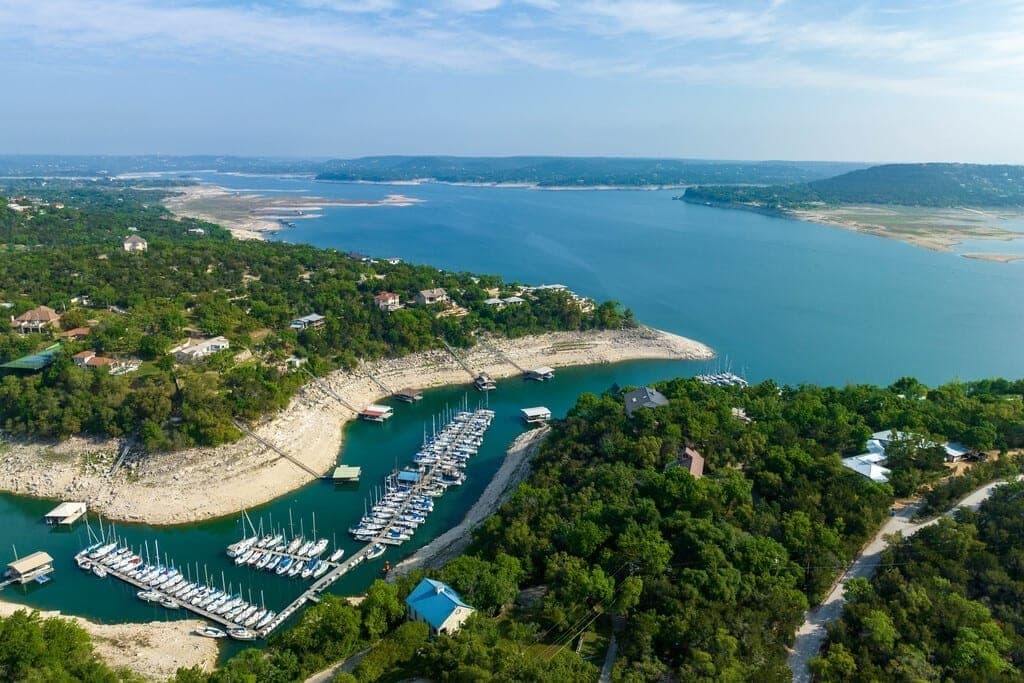
Lakeway is a genuinely post-1960s planned community, not a historic settlement. The land was originally part of the 19th-century ranching and farming economy of Travis County, with sparse Anglo-American homesteaders working the Hill Country terrain. The transformative event was the construction of Mansfield Dam on the Colorado River (completed 1941), which created Lake Travis. In 1963, a group of investors led by developer John B. Connally (later Texas governor) purchased 4,000 acres of ranchland and began building a recreational and retirement community centered on the new lake. The first wave of residents were affluent white professionals and retirees from Houston and Dallas, drawn by lakefront lots and the promise of a gated, country-club lifestyle. The original core neighborhoods—The Hills of Lakeway and Lakeway Village—were platted in the mid-1960s, with homes built around the Lakeway Golf Course and the Lakeway Marina. These areas remain the historic heart of the city, with many original ranch-style homes now replaced by larger custom builds. A second wave in the 1970s and 1980s brought more families and second-home buyers, expanding into Rough Hollow and Lago Vista (the latter technically a separate city but part of the same development corridor). Throughout this period, the population remained overwhelmingly white and native-born, with little ethnic diversity.
Modern era (post-1965)
After the 1965 Hart-Cellar Act, Lakeway saw virtually no direct immigration wave—its foreign-born share today is just 2.8%, far below the national average. Instead, the city’s modern growth has been driven by domestic in-migration from other parts of Texas and the United States, particularly from California and the Northeast, as remote work and corporate relocations accelerated after 2010. The 2000s and 2010s saw a surge of families moving into newer master-planned sections like Rough Hollow (a 1,200-acre development with its own marina and school) and Lakeway Highlands, both of which attracted a slightly more diverse mix. The East/Southeast Asian community (3.2%) and Indian-subcontinent community (3.8%) are concentrated in these newer neighborhoods, drawn by the highly rated Lake Travis Independent School District and the tech-employment corridor along State Highway 71 to Austin. The Hispanic share (8.9%) is largely composed of service-sector workers and their families, many living in older, smaller homes in the Lakeway Village area or in adjacent unincorporated pockets of Travis County. The Black population remains very small at 1.1%, with no distinct neighborhood concentration. The city’s racial and ethnic landscape is thus one of a white-majority core with small, affluent Asian and Indian enclaves in newer subdivisions, and a modest Hispanic service workforce living in older, less expensive parts of town.
The future
The population of Lakeway is likely to continue homogenizing at the top end of the income scale, rather than tribalizing into distinct ethnic enclaves. The city’s high housing costs (median home values above $700,000) and restrictive zoning (minimum lot sizes, no multifamily development) will keep the foreign-born share low and the white share dominant. The East/Southeast Asian and Indian-subcontinent communities are expected to grow slowly, primarily through in-migration of tech professionals from Austin, but they will likely assimilate into the broader affluent culture rather than forming separate ethnic neighborhoods. The Hispanic share may plateau or decline slightly as service workers are priced out and move to more affordable suburbs like Kyle or Buda. The next 10-20 years will see Lakeway become slightly older (the 65+ cohort is already above 25%) and more homogeneous in income and education, with little change in racial composition. The city’s character as a wealthy, white, lake-oriented enclave is self-reinforcing: high property taxes and HOAs filter for residents who prioritize schools, golf, and water access over diversity.
For someone moving in now, Lakeway offers a stable, low-crime, high-amenity environment with excellent schools and a strong sense of community among its affluent, mostly white population. The trade-off is minimal ethnic or economic diversity, a high cost of entry, and a social fabric that rewards participation in country-club and lake-sports culture. It is a place where the population is not changing much—and that stability is precisely what draws many residents here.

* Values derived from national, state, county, city and local statistics and may differ in a specific area. Last updated: 2026-04-14T23:45:58.000Z
Narrative content on this page is AI-generated and may contain mistakes. Verify any details that matter before acting on them.
ReloMaps may earn a commission from affiliate links at no extra cost to you.

