Strategic Assessment of Lakeway, TX
Multiple tactical vulnerabilities. Population density, target proximity, or disaster risk are likely compounding. A retreat property and exit planning is required.
What does the Strategic Assessment tell us?
Our Strategic Assessment grades tactical survivability of an area. Major population centers, military targets, fallout zones, natural disasters, and border exposure all drive risk — lower exposure means a more defensible position in a crisis.
This is heavily inspired by Joel Skousen's Strategic Relocation book. Highly recommended you checkout the book ($)What does this tell us?
Our Strategic Assessment grades tactical survivability of an area. Major population centers, military targets, fallout zones, natural disasters, and border exposure all drive risk — lower exposure means a more defensible position in a crisis.
This is heavily inspired by Joel Skousen's Strategic Relocation book. Highly recommended you checkout the book ($)Strategic Pillars

Key Distances
Regional Safe Places
Below is our recommended "safe zones" in Texas and the surrounding area based on our strategic heuristics. For most people, it's unrealistic to live in a “safe zone” full-time due to work, family or other personal reasons. They tend to be more rural. However, many of these areas are perfect for second homes and retreat properties that double as a vacation home or even a short-term rental.

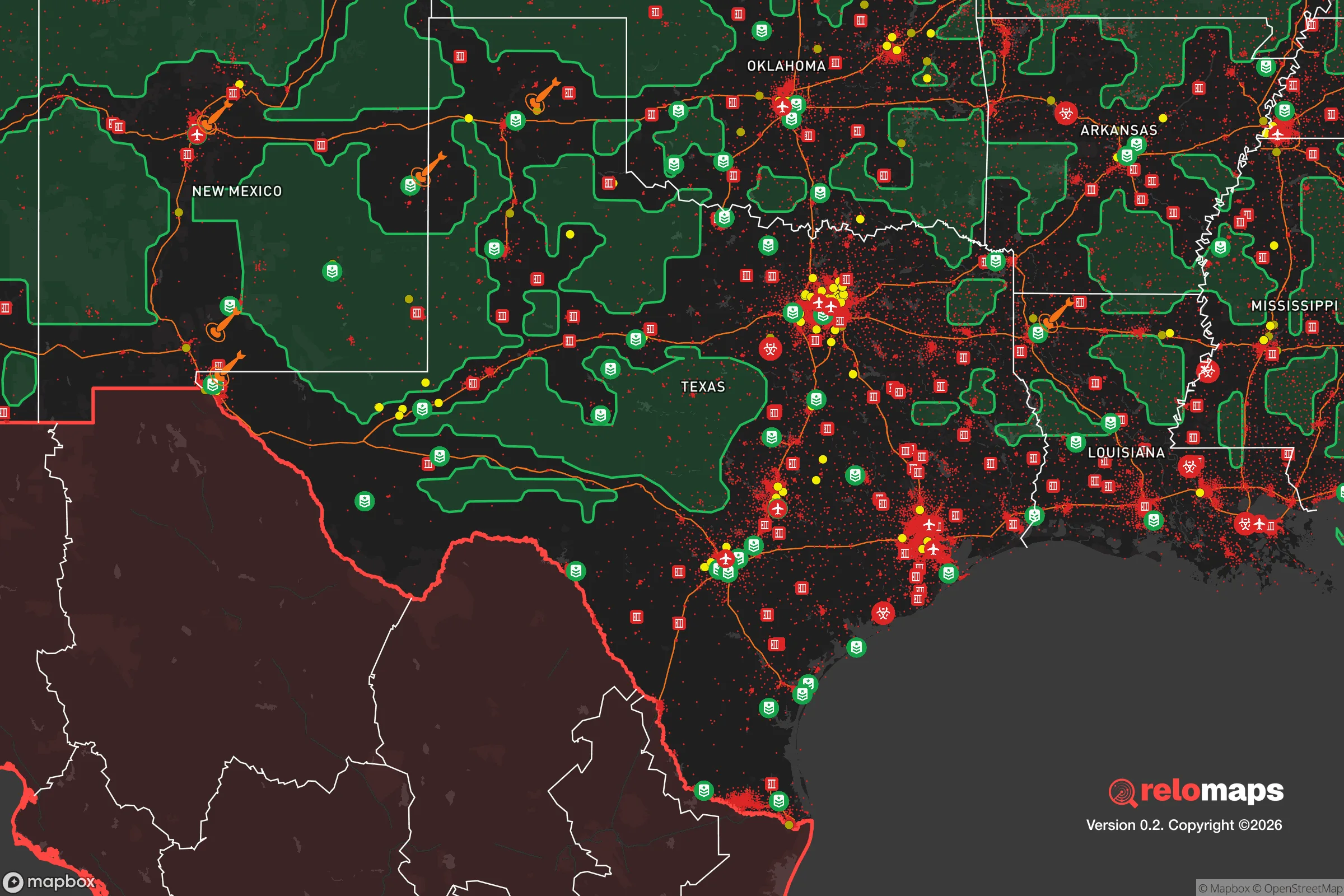


Important Note: For informational purposes only. This does not mean nothing bad ever happens in the green zones. Please use common sense. This is based on public data and modeled with AI. We tried to take a conservative approach but mistakes happen. We update this regularly as new information becomes available.
Solar Generator Recommendations
Backup power matters more here than in safer locations. We've picked three solar generators across budgets and capacity tiers — start with the budget unit if you only need a few essentials, or step up if you want to run a fridge and HVAC for days at a time.

Jackery Portable Power Station Explorer 300
Budget OptionPower on the Go: Weighing only 11 lbs, it's convenient to set up and store with book-sized foldable solar panels

BLUETTI Portable Power Station AC180
Designed for both indoor and outdoor scenarios, AC180 is highly capable as it has a robost capacity and continuous output power.

EF ECOFLOW DELTA Pro Ultra Power Station
Upgraded PickEcoFlow DELTA Pro Ultra is a whole-home energy system designed to grow with your family. Integrated with the Smart Home Panel 2, it scales to meet your evolving energy needs — keeping your home powered, intelligent, and secure through every stage of life.
We earn a commission, at no additional cost to you.
Strategic Assessment Analysis
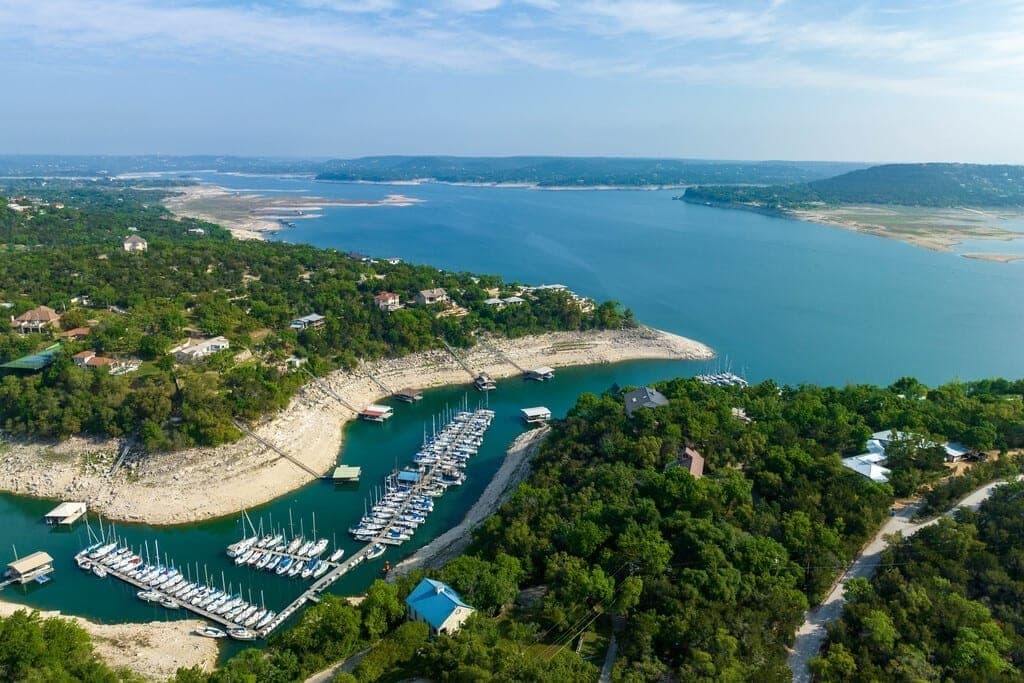
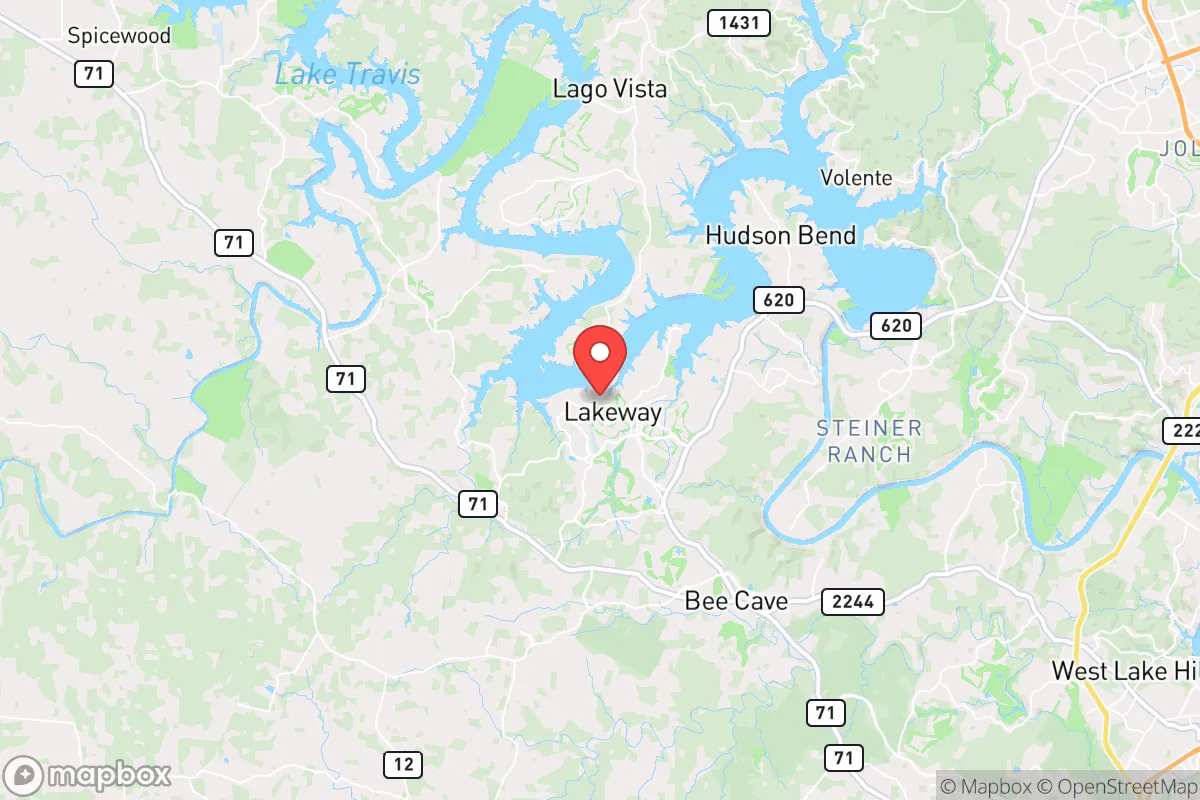
Lakeway, Texas, offers a compelling strategic position for those prioritizing resilience and self-sufficiency, but it is not without significant trade-offs. Situated on the Colorado River in the Texas Hill Country, roughly 25 miles west of downtown Austin, the area provides a buffer from the immediate chaos of a major urban center while remaining close enough to monitor and, if necessary, exploit its resources. The community’s topography—rolling hills, limestone bluffs, and Lake Travis—creates natural chokepoints and defensible terrain, but its proximity to Austin’s population density and critical infrastructure introduces real vulnerabilities. For a relocator with a prepper mindset, Lakeway is a mixed bag: a strong base for a retreat, but one that demands constant awareness of the risks that come with being within striking distance of a major metro area.
Geographic position and natural advantages for a retreat
Lakeway’s geography is its primary strategic asset. The area sits atop the Balcones Escarpment, a fault line that creates a natural rise above the surrounding plains, offering elevated vantage points and limited approach routes. The Colorado River and Lake Travis provide a reliable water source—critical for long-term survival—and the surrounding Hill Country offers ample cover, with dense cedar and oak forests that can obscure movement and provide raw materials. The terrain is rugged enough to slow vehicular traffic, forcing any potential threat into predictable corridors like RM 620 and RM 2222, which can be monitored or blocked. The local limestone is also a practical resource: it can be used for construction, filtration, and even as a heat sink for passive solar designs. For a relocator, this means a defensible position with natural resources that reduce dependence on external supply chains. The area’s elevation also provides a slight cooling effect compared to the flatlands, which is a minor but real advantage during heat waves or grid failures.
Risks, exposures, and proximity to fallout-relevant landmarks
The most glaring vulnerability is Lakeway’s proximity to Austin, a city of over 1 million people that is a prime target for civil unrest, mass casualty events, or infrastructure collapse. In a crisis, the 25-mile corridor between Lakeway and Austin—particularly along RM 620 and Highway 71—would become a funnel for refugees fleeing the city. This creates a double-edged sword: the same chokepoints that can be defended can also be overwhelmed by a desperate, mobile population. Additionally, Lakeway is within 50 miles of the Austin-Bergstrom International Airport, a potential target for aerial or ground-based attacks, and within 100 miles of the Texas Gulf Coast, which includes the Port of Houston and the Strategic Petroleum Reserve—both high-value targets in a national emergency. The area is also within the fallout zone of the South Texas Nuclear Generating Station (Bay City), roughly 150 miles away, though prevailing winds typically push fallout eastward. More immediately, the region’s reliance on the Texas Interconnection power grid—which has already demonstrated fragility during Winter Storm Uri—means that a grid-down scenario would leave Lakeway without power, water (pumps fail), and communications. The local government’s emergency plans are adequate for short-term events but lack the redundancy needed for prolonged crises.
Practical resilience for a relocator: food, water, energy, and defensibility
For a relocator serious about self-sufficiency, Lakeway offers a mixed but workable baseline. Water is the strongest asset: Lake Travis is a massive reservoir (over 1.1 million acre-feet at full pool) that can sustain a household indefinitely with proper filtration and storage. The Colorado River is a secondary source, though it requires more treatment due to agricultural runoff. Rainwater catchment is viable, as the area averages 32 inches of rainfall annually, but the limestone terrain makes cistern installation straightforward. Food production is more challenging. The soil is thin and rocky, making traditional gardening difficult without raised beds or imported topsoil. However, the region supports deer, feral hogs, and turkey, providing a protein source for those with hunting skills. Local orchards and farms (e.g., nearby Sweet Berry Farm) offer seasonal produce, but these are not reliable in a collapse. Energy resilience is a weak point. The grid is unreliable, and solar is the most practical backup, but the Hill Country’s frequent cloud cover and tree canopy reduce efficiency. A propane generator with a 500-gallon tank is a more dependable option, though fuel resupply becomes a concern. Defensibility is decent: the area’s winding roads and natural barriers make it hard to approach unseen, but the suburban layout—with many homes on large lots but close to neighbors—means that a determined group could isolate a property. The local police and fire departments are well-funded but would be overwhelmed in a widespread event. The community itself is a mixed bag: many residents are affluent and unprepared, which could make them a liability or a target, but there are also pockets of like-minded preppers and veterans who form informal networks.
The overall strategic picture for Lakeway is one of calculated risk. It is not a remote, off-grid sanctuary—it is a suburban enclave with a strong natural foundation but significant exposure to urban collapse. For a single individual or family willing to invest in water storage, solar or propane backup, and a defensible property layout, it can serve as a viable base for weathering short-to-medium-term disruptions. The key is to treat Lakeway as a forward operating base rather than a final redoubt: maintain a low profile, build relationships with neighbors who share your mindset, and have a secondary retreat plan for a full societal breakdown. The area’s advantages—water, terrain, and proximity to resources—are real, but they come with the constant risk of being overrun by the very population you sought to escape. If you can manage that tension, Lakeway is a solid choice. If not, look farther west, past the Hill Country, where the population thins and the risks diminish.

* Values derived from national, state, county, city and local statistics and may differ in a specific area. Last updated: 2026-04-14T23:45:58.000Z
Narrative content on this page is AI-generated and may contain mistakes. Verify any details that matter before acting on them.
ReloMaps may earn a commission from affiliate links at no extra cost to you.

