Photo: Wikipedia
Demographics of Lancaster, OH
Affluence Level in Lancaster, OH
A below-average socioeconomic profile. Incomes, home values, and educational attainment trail the U.S., with higher poverty and unemployment.
People of Lancaster, OH
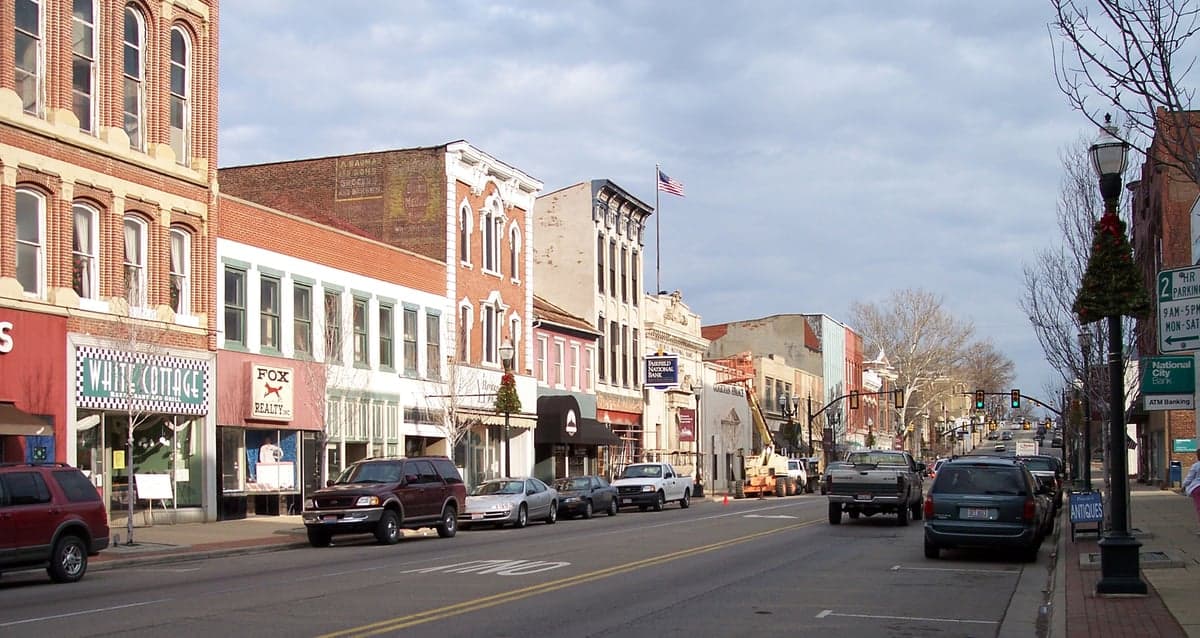
The people of Lancaster, Ohio, today form a predominantly white, working-to-middle-class community of roughly 40,900 residents, characterized by a strong sense of local identity rooted in manufacturing and family heritage. With a foreign-born population of just 0.9% and a 90.7% white share, the city remains one of Ohio's least ethnically diverse metro anchors, though a small but growing Hispanic community (3.0%) and tiny East/Southeast Asian (0.6%) and Indian (0.1%) populations add modest variety. The city's distinctive marker is its deep, multi-generational attachment to local glass and manufacturing industries, with many residents tracing family lines back to 19th-century German and Irish immigrants who built the town's industrial backbone. Lancaster feels more like a stable, slow-changing county seat than a dynamic exurb, with a college attainment rate of 21.3% that reflects a workforce oriented toward trades and local industry rather than professional services.
How the city was settled and grew
Lancaster was founded in 1800 by German-speaking settlers from Pennsylvania and Maryland, drawn by the fertile Hocking River valley and the promise of cheap land under the Ohio Company's land grants. The original settlement clustered around what is now Downtown Lancaster, where the first log courthouse and taverns served as the civic core. By the 1830s, the arrival of the Ohio and Erie Canal spurred a second wave of Irish immigrants who dug the canal and later settled in the West Side neighborhoods near the waterway, establishing St. Mary's Catholic Church as their anchor. The city's defining industrial boom came after 1850 with the discovery of natural gas, which fueled a massive glassmaking industry. German and Eastern European glassworkers—many from Bohemia and Poland—flooded in, building dense, modest homes in the East End around the Anchor Hocking glass plants. These neighborhoods remain heavily white and working-class today, with surnames and parish loyalties still reflecting those 19th-century origins. A smaller wave of African American workers arrived during the World War I era to work in the glass factories, settling in a pocket near the rail yards on the South Side, but their numbers never grew large; the Black population today is just 1.7%.
Modern era (post-1965)
After the 1965 Hart-Cellar Act, Lancaster saw virtually no new immigration—its foreign-born share has never risen above 1.5%—making it an outlier among Ohio cities. Instead, the post-1965 story is one of domestic white flight from nearby Columbus and internal suburbanization. From the 1970s through the 1990s, middle-class families moved from older city neighborhoods to newer subdivisions on the city's north and east edges, particularly around River Valley and North Columbus Street, where larger ranch homes and cul-de-sacs replaced the dense worker cottages of the East End. The Hispanic population, now 3.0%, began growing slowly after 2000, driven by Mexican and Central American families working in agriculture and light manufacturing; they have concentrated in the West Side near the old canal corridor, where rental housing is cheaper. The East/Southeast Asian population (0.6%) is tiny and consists mostly of a few dozen families employed by local hospitals or Ohio University-Lancaster, living scattered across the newer subdivisions rather than forming an ethnic enclave. The Indian subcontinent population (0.1%) is negligible—likely a handful of professionals at the local hospital or university. The city's overall racial composition has barely shifted since 1990: white share has declined only from 95% to 90.7%, mostly due to Hispanic growth, not Black or Asian in-migration.
The future
Lancaster's population is projected to remain flat or grow very slowly (0–3% over the next decade), with no major demographic disruption on the horizon. The Hispanic share may rise to 4–5% as families grow and a trickle of new arrivals from Central America continues, but the city lacks the job base or housing stock to attract significant immigrant communities. The white population will slowly age and shrink, as younger adults continue to leave for Columbus suburbs or Sun Belt states. The city is not tribalizing into distinct ethnic enclaves—it is too small and too white for that—but it is geographically sorting by income: the East End and South Side are becoming poorer and older, while the north-side subdivisions (River Valley, North Columbus Street) hold the remaining middle class. For a conservative-leaning mover, Lancaster offers a stable, low-diversity environment where neighborhood character is defined by income and homeownership status, not ethnicity. The city is becoming a quieter, more insular version of its industrial self—a place where the population is slowly graying and the next generation is more likely to move away than to arrive.
In short, Lancaster is a predominantly white, slow-growing manufacturing town that has resisted the demographic diversification seen across much of Ohio. Its population is aging, its immigrant presence is negligible, and its future lies in retaining the families who remain rather than attracting newcomers. For someone moving in now, the city offers a predictable, low-crime environment where neighbors have deep roots and change comes slowly.

* Values derived from national, state, county, city and local statistics and may differ in a specific area. Last updated: 2026-04-21T19:45:18.000Z
Narrative content on this page is AI-generated and may contain mistakes. Verify any details that matter before acting on them.
ReloMaps may earn a commission from affiliate links at no extra cost to you.

