Photo: Wikipedia
Demographics of Laredo, TX
Affluence Level in Laredo, TX
A below-average socioeconomic profile. Incomes, home values, and educational attainment trail the U.S., with higher poverty and unemployment.
People of Laredo, TX
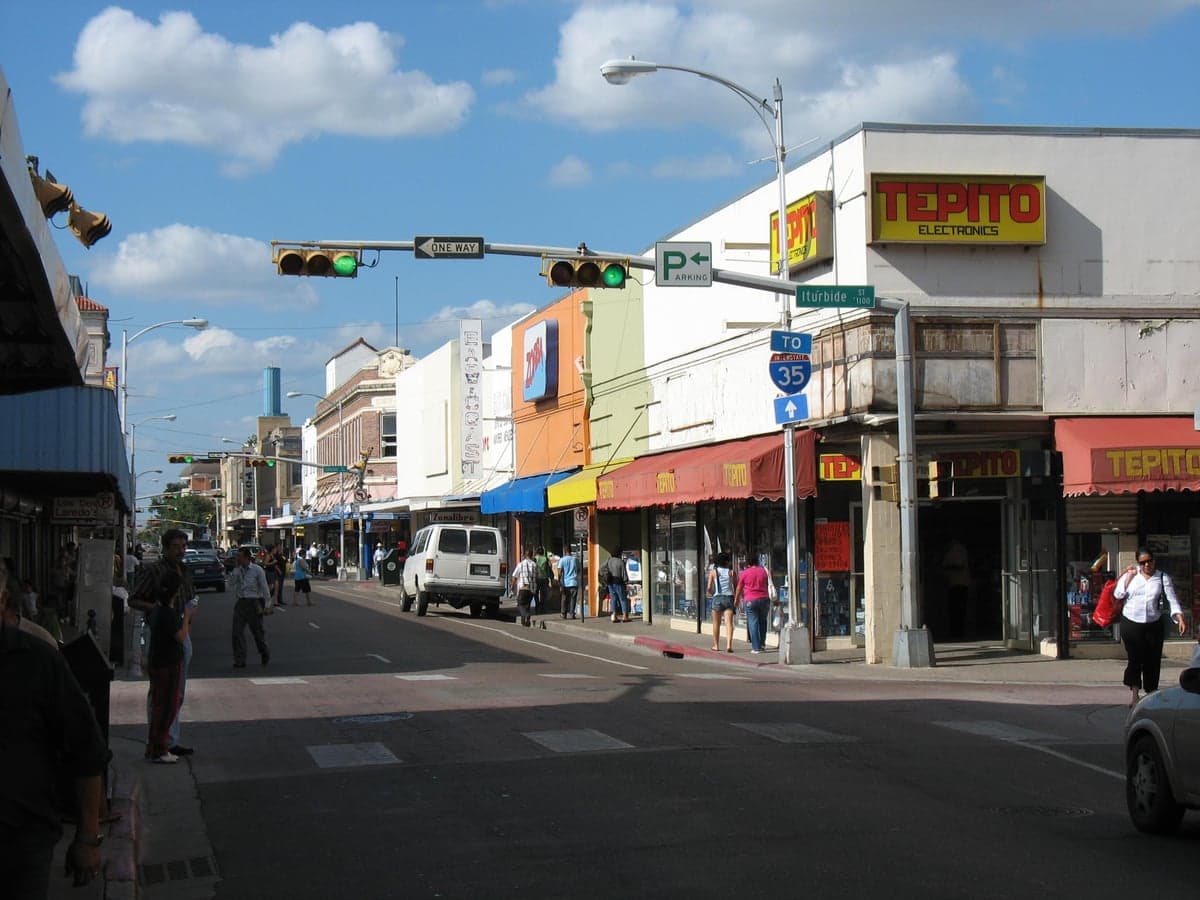
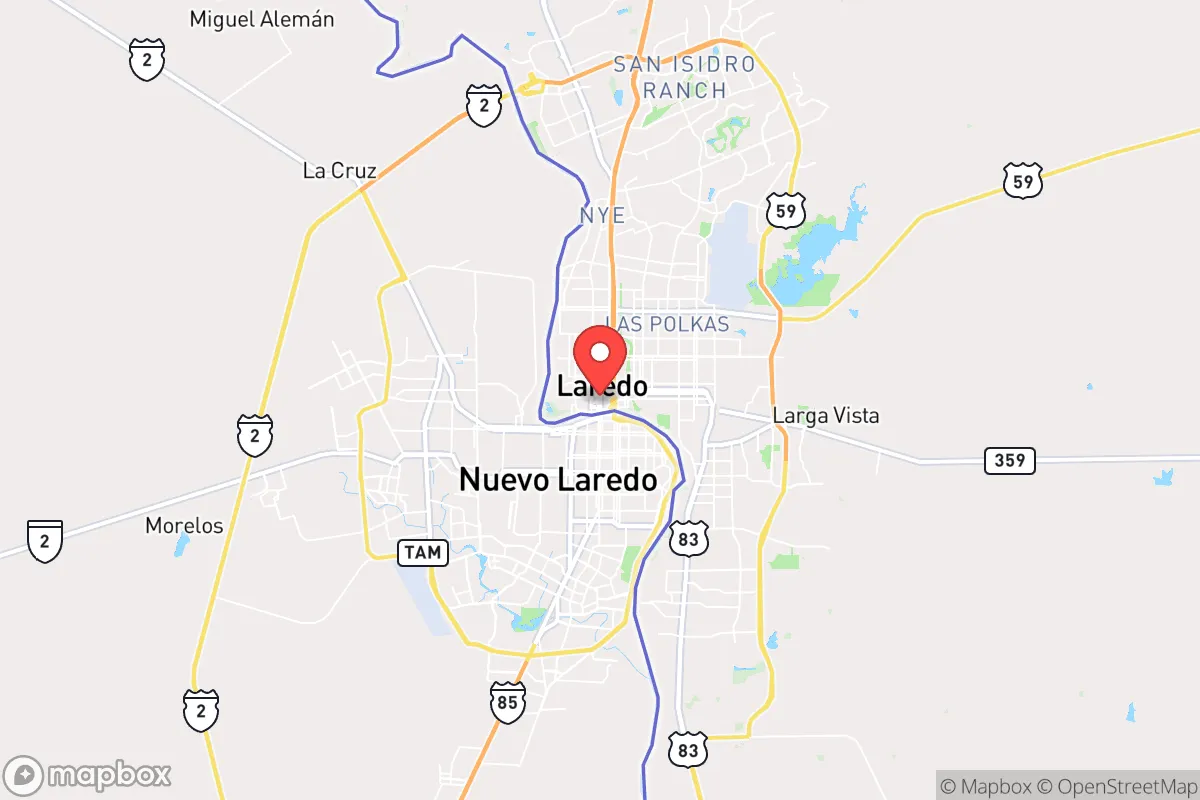
The people of Laredo, Texas today form one of the most culturally cohesive major cities in the United States: 95.2% of its 255,949 residents identify as Hispanic, a share that has held steady for decades. The city is overwhelmingly native-born (83.0% U.S.-born), with a foreign-born population of 17.0% that is almost entirely of Mexican origin. Laredo’s identity is defined by its deep binational character—Spanish is the dominant language of daily commerce, and the city’s economy, politics, and social life are inextricably linked to the twin city of Nuevo Laredo, Mexico, just across the Rio Grande.
How the city was settled and grew
Laredo was founded in 1755 by Spanish colonist Tomás Sánchez under a land grant from the Spanish crown, making it one of the oldest European settlements in Texas. The original settlers were Spanish soldiers, ranchers, and their families who established the Villa de San Agustín de Laredo along the north bank of the Rio Grande. After the Mexican War of Independence (1821) and later the Texas Revolution, Laredo’s population remained overwhelmingly Mexican-heritage, with the city serving as the capital of the short-lived Republic of the Rio Grande in 1840. The arrival of the railroad in the 1880s spurred a second wave: Anglo-American merchants, European immigrants (primarily from Germany and Italy), and Mexican laborers drawn by railroad construction and the booming cattle trade. These groups settled in distinct areas: the original Spanish-Mexican families concentrated in Barrio El Azteca and Barrio El Hoyo near the downtown plaza, while Anglo and European newcomers built homes in the St. Peter’s District around the Episcopal church and along Santa Maria Avenue. By 1900, Laredo’s population was roughly 70% Mexican-heritage and 30% Anglo and European, a ratio that held through the mid-20th century as the city grew from 14,000 (1910) to 60,000 (1960). The dominant industries remained cross-border trade, ranching, and later oil and gas exploration in the Webb County area.
Modern era (post-1965)
The 1965 Hart-Cellar Immigration Act and subsequent immigration reforms had a profound effect on Laredo, though not in the way it reshaped other Texas cities. Rather than diversifying the population with new Asian or European arrivals, the post-1965 period accelerated the city’s Hispanic consolidation. Mexican immigration—both legal and undocumented—surged, and the small Anglo and European communities that had dominated Laredo’s business and political leadership began a steady out-migration to San Antonio and other Texas cities. By 1980, the Hispanic share had risen above 90%, where it has remained. The foreign-born share peaked at roughly 22% in the 1990s and has since declined to 17.0% as second- and third-generation Mexican-Americans have become the dominant demographic. Suburbanization reshaped the city’s geography: middle-class Mexican-American families moved from historic barrios into newer subdivisions in Del Mar Hills and North Central Laredo near the Mall del Norte, while wealthier professionals settled in Regency Village and the Miraflores area along McPherson Road. The historic downtown barrios—El Azteca, El Hoyo, and Barrio La Bota—became increasingly lower-income and densely packed with recent immigrants and non-citizens. The non-Hispanic population today is tiny: White non-Hispanic residents make up just 3.4%, Black residents 0.4%, and East/Southeast Asian communities 0.4%. Indian-subcontinent residents are statistically zero. Laredo is effectively a single-ethnicity city, unique among U.S. metro areas of its size.
The future
Laredo’s demographic trajectory points toward continued Hispanic homogeneity, not diversification. The foreign-born share is slowly declining as immigration from Mexico has plateaued and as younger generations are born in the U.S. The city’s college-educated share is just 21.5%, well below the Texas average of 31%, which limits the in-migration of highly skilled workers from other states or countries. The small Anglo and Asian populations are not growing; they are aging and not being replaced. The most likely scenario for the next 10–20 years is a city that remains 94–96% Hispanic, with a slowly shrinking foreign-born share and a growing native-born middle class. The geographic pattern will likely continue: wealthier Mexican-American families will push further north into newer subdivisions along the I-35 corridor toward the new World Trade International Bridge, while the historic barrios near the river will remain the entry point for lower-income immigrants. Laredo is not tribalizing into distinct ethnic enclaves—it is too homogeneous for that—but it is stratifying by class, with the North Laredo neighborhoods (Regency Village, Miraflores) becoming more affluent and the southside barrios (El Azteca, La Bota) remaining poorer.
For someone moving to Laredo now, the bottom line is this: you are entering a city with a single, deeply rooted cultural identity that shows no sign of fragmenting. The population is stable, young (median age 30.4), and overwhelmingly Spanish-speaking in daily life. The lack of racial or ethnic diversity means that newcomers who are not Hispanic will be a statistical anomaly, but the city’s long history of binational commerce means that English-speaking professionals are welcomed in the trade and logistics sectors. Laredo is not becoming more diverse—it is becoming more of what it already is.

* Values derived from national, state, county, city and local statistics and may differ in a specific area. Last updated: 2026-05-03T04:47:33.000Z
Narrative content on this page is AI-generated and may contain mistakes. Verify any details that matter before acting on them.
ReloMaps may earn a commission from affiliate links at no extra cost to you.

