Photo: Wikipedia
Strategic Assessment of Las Vegas, NV
Multiple tactical vulnerabilities. Population density, target proximity, or disaster risk are likely compounding. A retreat property and exit planning is required.
What does the Strategic Assessment tell us?
Our Strategic Assessment grades tactical survivability of an area. Major population centers, military targets, fallout zones, natural disasters, and border exposure all drive risk — lower exposure means a more defensible position in a crisis.
This is heavily inspired by Joel Skousen's Strategic Relocation book. Highly recommended you checkout the book ($)What does this tell us?
Our Strategic Assessment grades tactical survivability of an area. Major population centers, military targets, fallout zones, natural disasters, and border exposure all drive risk — lower exposure means a more defensible position in a crisis.
This is heavily inspired by Joel Skousen's Strategic Relocation book. Highly recommended you checkout the book ($)Strategic Pillars

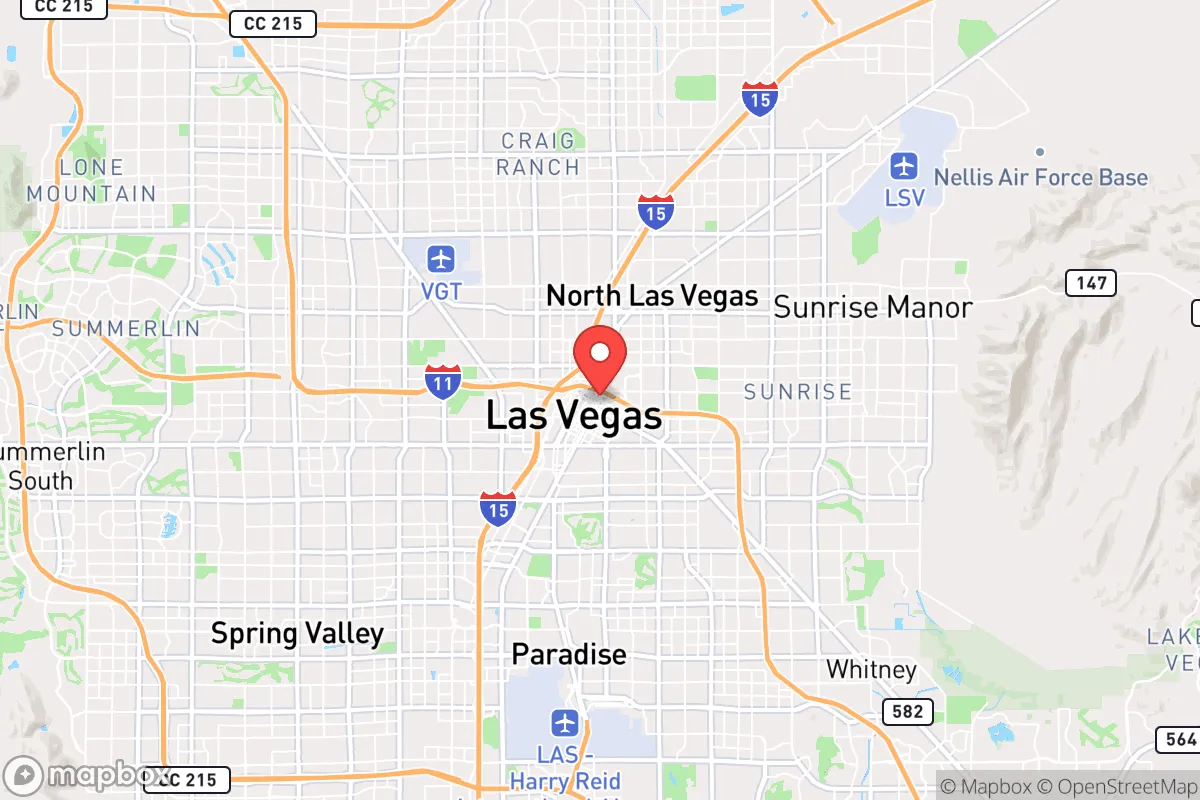
Key Distances
Regional Safe Places
Below is our recommended "safe zones" in Nevada and the surrounding area based on our strategic heuristics. For most people, it's unrealistic to live in a “safe zone” full-time due to work, family or other personal reasons. They tend to be more rural. However, many of these areas are perfect for second homes and retreat properties that double as a vacation home or even a short-term rental.
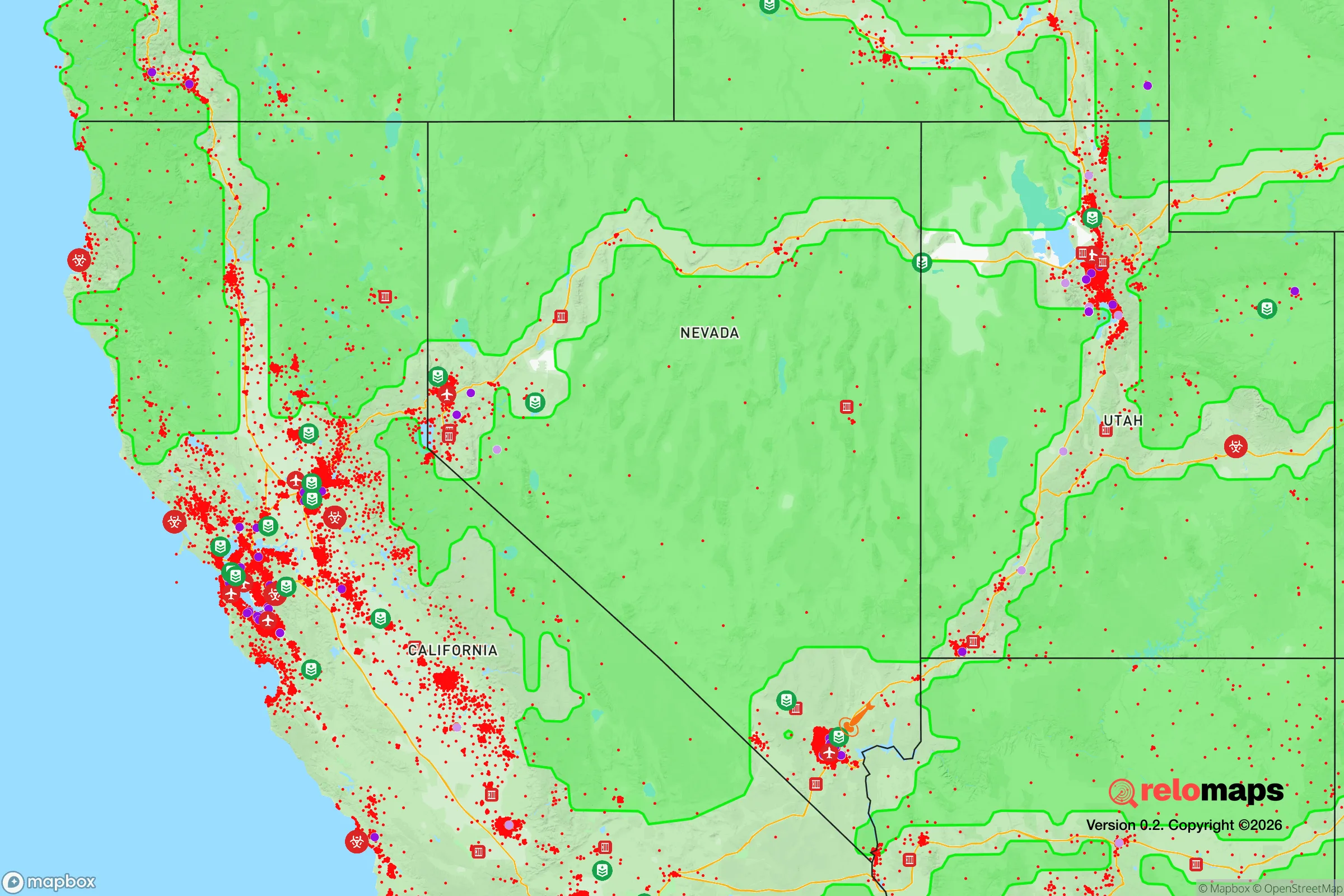
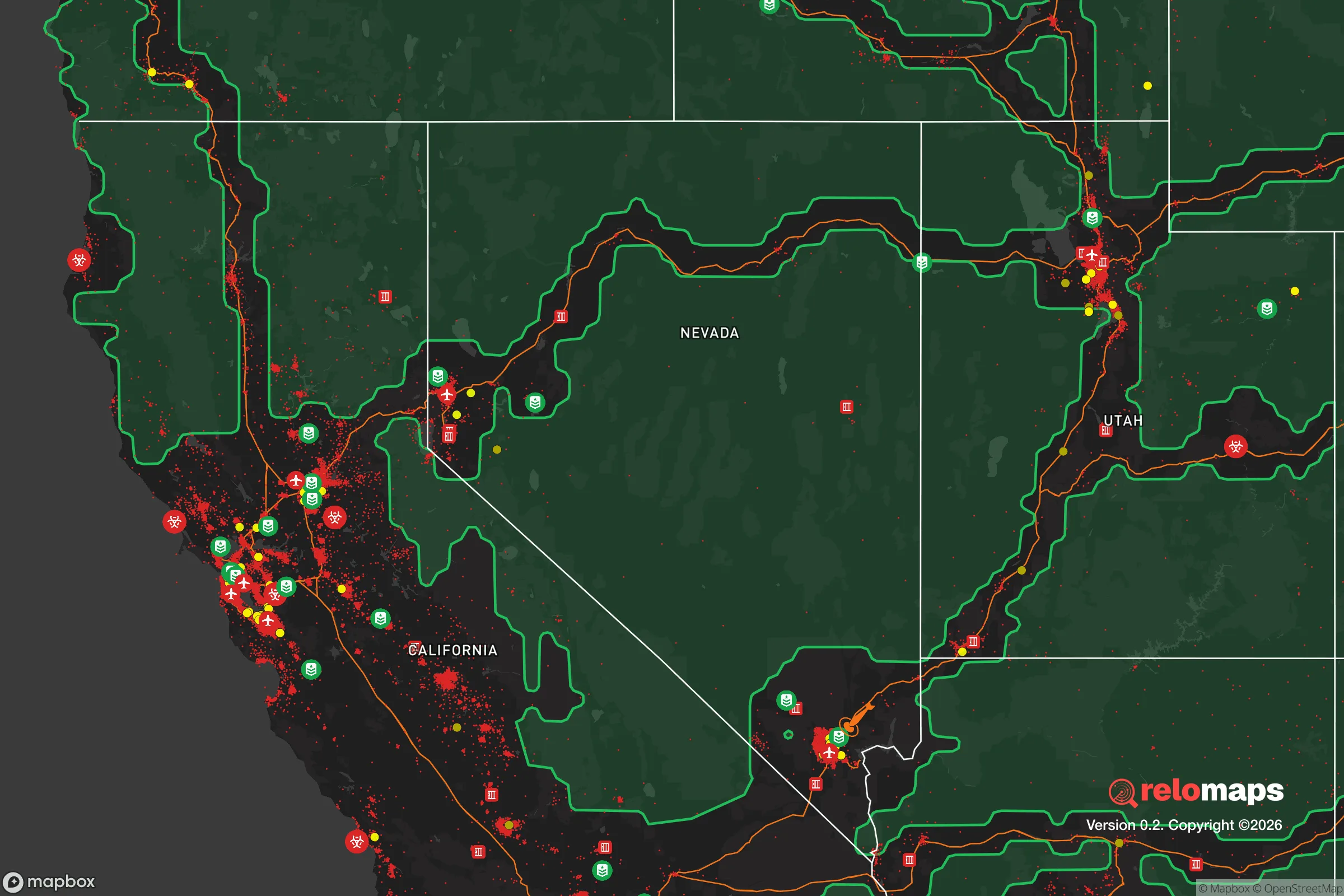


Important Note: For informational purposes only. This does not mean nothing bad ever happens in the green zones. Please use common sense. This is based on public data and modeled with AI. We tried to take a conservative approach but mistakes happen. We update this regularly as new information becomes available.
Solar Generator Recommendations
Backup power matters more here than in safer locations. We've picked three solar generators across budgets and capacity tiers — start with the budget unit if you only need a few essentials, or step up if you want to run a fridge and HVAC for days at a time.

Jackery Portable Power Station Explorer 300
Budget OptionPower on the Go: Weighing only 11 lbs, it's convenient to set up and store with book-sized foldable solar panels

BLUETTI Portable Power Station AC180
Designed for both indoor and outdoor scenarios, AC180 is highly capable as it has a robost capacity and continuous output power.

EF ECOFLOW DELTA Pro Ultra Power Station
Upgraded PickEcoFlow DELTA Pro Ultra is a whole-home energy system designed to grow with your family. Integrated with the Smart Home Panel 2, it scales to meet your evolving energy needs — keeping your home powered, intelligent, and secure through every stage of life.
We earn a commission, at no additional cost to you.
Strategic Assessment Analysis
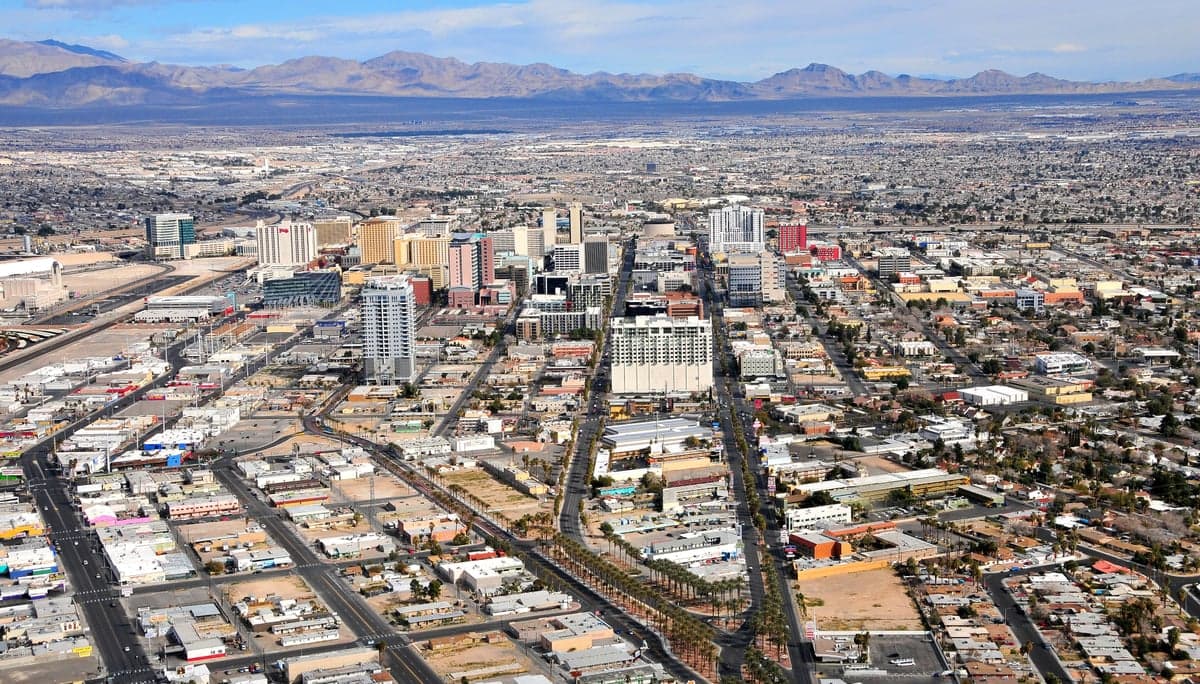
Las Vegas presents a deeply contradictory picture for the conservative prepper. On one hand, its location in the Mojave Desert offers a degree of natural isolation from the coastal chaos zones and major fault lines that threaten California. On the other, it is a dense, water-scarce, tourism-dependent city with a single major highway artery, making it a high-risk target for both natural and man-made disruptions. For the relocator thinking in terms of long-term resilience, Las Vegas is not a bunker—it is a forward operating base with serious logistical vulnerabilities that must be understood before committing.
Geographic position and natural advantages for long-term survival
Las Vegas sits in a basin surrounded by the Spring Mountains and Red Rock Canyon, providing a natural defensive perimeter against easy overland approach—a fact not lost on those who study terrain for security. The valley floor sits at roughly 2,000 feet elevation, offering a dry climate that slows corrosion, mold, and biological decay, which is a practical advantage for long-term food and equipment storage. The region experiences over 300 days of sunshine per year, making solar power a highly viable primary or backup energy source. The surrounding desert, while harsh, also means that large-scale population movement into the area is physically difficult without significant logistical support. For the prepper, this natural buffer is a double-edged sword: it keeps casual wanderers out, but it also makes resupply and evacuation a challenge if the roads are compromised.
Risks, exposures, and proximity to fallout-relevant landmarks
The most glaring vulnerability is water. Las Vegas draws roughly 90% of its water from the Colorado River via Lake Mead, a reservoir that has been in structural decline for decades. A major disruption to Hoover Dam—whether from sabotage, earthquake, or simply continued drought—would turn the valley into a ghost town within weeks. The city is also located just 65 miles from the Nevada National Security Site (formerly the Nevada Test Site), where above-ground nuclear tests were conducted. While no active testing occurs today, the area remains a federal security zone, and any major event involving that facility would place Las Vegas in a dangerous proximity zone. Additionally, the city sits within 100 miles of the proposed Yucca Mountain nuclear waste repository, a site that, if ever activated, would become a high-value target for any adversary seeking to cause mass contamination. For the conservative prepper, these are not abstract concerns—they are concrete, map-able risks that demand a clear evacuation plan and a secondary location outside the 100-mile radius.
Practical resilience for a relocator: food, water, energy, and defensibility
For daily life, Las Vegas offers a surprisingly robust infrastructure for the prepared individual. The city has multiple large-scale water storage facilities, but individual rainwater harvesting is limited by low annual precipitation (roughly 4 inches per year). A serious prepper would need to invest in deep well access or contract with a water delivery service for bulk storage. The energy grid is connected to the Hoover Dam and the broader Western Interconnection, meaning a grid-down scenario would likely affect the entire region simultaneously. Solar with battery backup is not optional here—it is a necessity. Food storage is complicated by high summer temperatures; a standard basement is rare, so underground root cellars or climate-controlled storage units are the norm for long-term supplies. Defensibility at the neighborhood level varies wildly. The suburbs of Henderson and Summerlin offer more space and lower population density, while the central Strip corridor is a no-go zone for any serious prepper due to crime, transient populations, and the sheer number of people who would become desperate in a crisis. The city's reliance on tourism means that a major event—pandemic, economic collapse, or terror attack—would instantly collapse the local economy, leaving tens of thousands of service workers without income and potentially turning the city into a humanitarian crisis zone. For the relocator, the key is to live on the periphery, maintain a low profile, and have a bug-out location at least 200 miles away, preferably in a less-populated state like Utah or Idaho.
The overall strategic picture for the conservative relocator
Las Vegas is not a survivalist's paradise, but it is not a death trap either. It offers a unique combination of dry climate, solar potential, and geographic isolation that can be leveraged by a prepared individual who understands the risks. The city's biggest weakness is its dependence on a single water source and a single major highway (I-15) for supply and evacuation. The biggest strength is that most people moving here are not thinking about resilience—they are thinking about entertainment and cheap housing. That means a prepared family can quietly build a self-sufficient setup on the outskirts without drawing attention. However, anyone serious about long-term survival should view Las Vegas as a temporary base or a secondary location, not a final redoubt. The conservative prepper who moves here must do so with eyes wide open: stockpile water, invest in solar, establish a network outside the valley, and have a plan to leave within 72 hours if the Colorado River or the power grid fails. In a world where the federal government's response to disaster has proven slow and unreliable, Las Vegas is a place where you can be comfortable—but only if you are ready to walk away at a moment's notice.

* Values derived from national, state, county, city and local statistics and may differ in a specific area. Last updated: 2026-04-15T23:42:23.000Z
Narrative content on this page is AI-generated and may contain mistakes. Verify any details that matter before acting on them.
ReloMaps may earn a commission from affiliate links at no extra cost to you.

