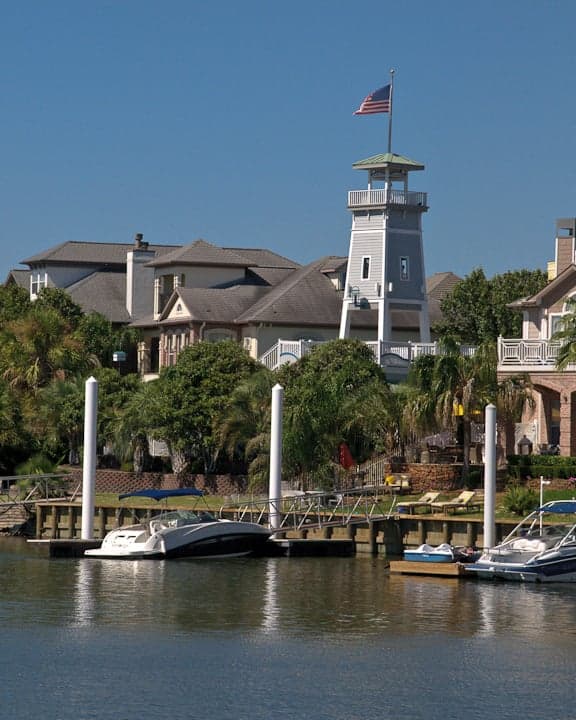
Photo: Wikipedia
Demographics of League City, TX
Affluence Level in League City, TX
An upper-middle-class area. Household wealth, education levels, and homeownership run ahead of national benchmarks.
People of League City, TX
League City, Texas, is a rapidly growing suburban city of 114,885 residents that blends a strong white-collar professional base with a notably diverse, family-oriented character. The city is predominantly white (63.5%) but has seen significant growth in Hispanic (19.3%), Black (6.8%), East/Southeast Asian (3.5%), and Indian-subcontinent (2.4%) populations, creating a mosaic of distinct neighborhoods. With a low foreign-born share of just 4.7% and a high college-educated rate of 48.0%, League City’s population is largely composed of native-born professionals and their families who have moved here for jobs, schools, and space. The city’s identity is defined by its master-planned subdivisions, strong school system, and a sense of being a safe, upwardly mobile alternative to Houston’s urban core.
How the city was settled and grew
League City’s human history begins not with Spanish missions or cotton plantations, but with the railroad. Founded in the 1890s as a stop on the Galveston, Houston and Henderson Railroad, the city was named after a local landowner, John C. League. The original population was overwhelmingly white and Anglo-American, drawn by the promise of land for farming and ranching in the coastal prairie. The first wave of settlers clustered around the railroad depot in what is now Historic League City, a small grid of streets near the intersection of Main Street and FM 518. These early residents were farmers, ranchers, and merchants who served the surrounding agricultural economy. The city remained a tiny, homogeneous farming hamlet through the first half of the 20th century, with a population that barely reached 1,000 by 1950. There was no significant non-white population during this period, as Jim Crow-era segregation and the area’s rural economy attracted few immigrants or Black families.
Modern era (post-1965)
The transformation of League City began in earnest after the 1960s, driven by two forces: the expansion of NASA’s Johnson Space Center in nearby Clear Lake and the construction of Interstate 45. The 1965 Hart-Cellar Act had little direct effect on League City itself—the foreign-born share remains low—but the domestic migration it spurred reshaped the city. White-collar professionals, many of them engineers and scientists working at NASA and its contractors, began moving into new subdivisions carved out of former ranchland. The first major master-planned community, South Shore Harbour, was developed in the 1970s along Clear Lake, attracting affluent white families and a small number of East/Southeast Asian professionals, particularly Vietnamese and Chinese engineers. In the 1980s and 1990s, Westwood and Bay Colony emerged as family-oriented subdivisions, drawing middle-class white and Hispanic families from Houston’s southeast side. The Hispanic population grew steadily during this period, rising from under 5% in 1990 to 19.3% today, concentrated in older neighborhoods like Countryside and the area around FM 518. The Black population, now 6.8%, began to increase in the 2000s, settling primarily in Victory Lakes and newer sections of South Shore Harbour. The Indian-subcontinent community, while small at 2.4%, has clustered in the newer, higher-end subdivisions like Marina Bay and Harbor Pointe, drawn by tech and medical jobs in the Texas Medical Center and Clear Lake area. East/Southeast Asian residents (3.5%) are concentrated in South Shore Harbour and Westwood, often in homes near the top-rated schools of Clear Creek Independent School District.
The future
League City’s population is heading toward greater diversity, but not toward the kind of hyper-diverse, immigrant-heavy mix seen in Houston proper. The foreign-born share (4.7%) is low and stable, meaning future growth will come almost entirely from domestic migration and natural increase. The white share (63.5%) is declining slowly as Hispanic, Black, and Asian families move in, but the city is not tribalizing into stark ethnic enclaves. Instead, neighborhoods are becoming more mixed, with Victory Lakes and South Shore Harbour showing the most integration. The Indian-subcontinent community, while small, is growing faster than the East/Southeast Asian group, driven by professionals in medicine and technology. The Hispanic population is likely to continue rising, possibly reaching 25-30% by 2040, as families from the Houston area seek affordable suburban homes. The city’s high college-education rate (48.0%) and low crime will continue to attract white-collar families of all backgrounds, but the overall character will remain that of a predominantly native-born, English-speaking, family-oriented suburb.
For someone moving in now, League City is becoming a more diverse but still cohesive suburban community where neighborhood identity matters less than school quality and commute times. The city is not fragmenting into isolated ethnic enclaves; rather, it is homogenizing around a middle-class, professional lifestyle. The key decision for a new resident is not which ethnic group to live near, but whether to choose a waterfront home in South Shore Harbour, a newer lot in Victory Lakes, or a more established, affordable home in Countryside. The population trajectory points toward continued growth, moderate diversification, and a stable, family-first culture that appeals to conservative-leaning buyers seeking a safe, well-educated community.

* Values derived from national, state, county, city and local statistics and may differ in a specific area. Last updated: 2026-05-03T20:33:08.000Z
Narrative content on this page is AI-generated and may contain mistakes. Verify any details that matter before acting on them.
ReloMaps may earn a commission from affiliate links at no extra cost to you.

