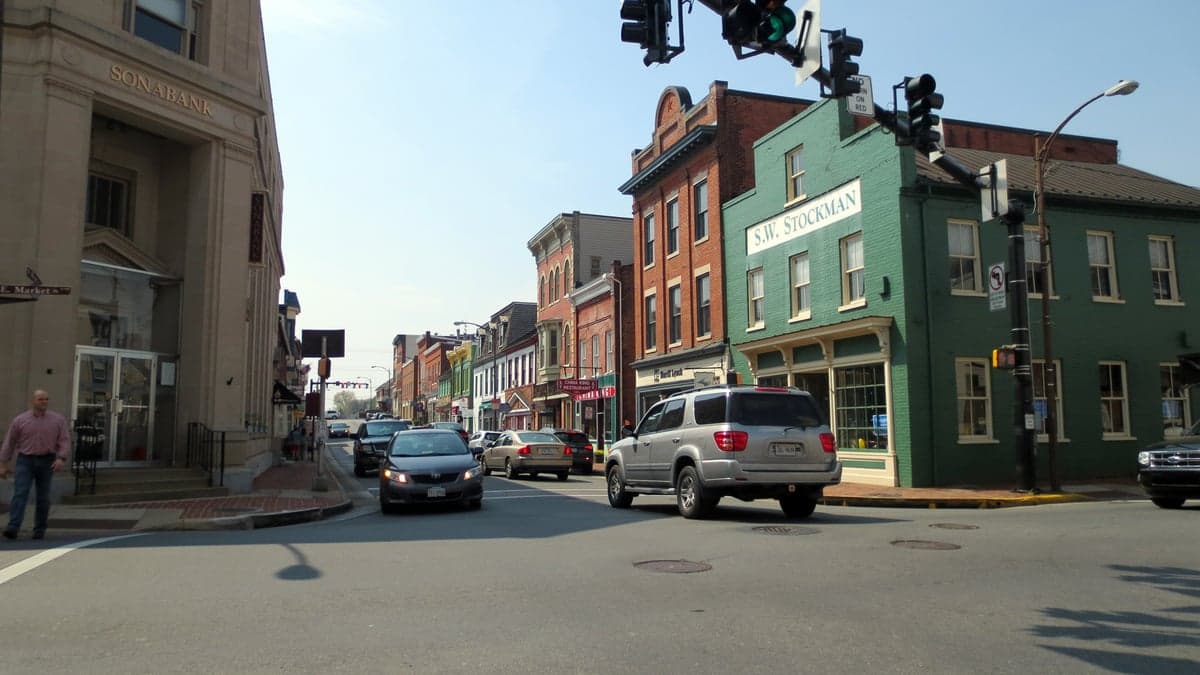
Photo: Wikipedia
Demographics of Leesburg, VA
Affluence Level in Leesburg, VA
An upper-middle-class area. Household wealth, education levels, and homeownership run ahead of national benchmarks.
People of Leesburg, VA
Leesburg, Virginia, is a rapidly diversifying historic town of 48,788 residents, where a white majority (56.0%) coexists with substantial Hispanic (18.5%), Black (9.9%), Indian-subcontinent (6.2%), and East/Southeast Asian (4.1%) communities. The city retains a distinctly Virginian character—rooted in its role as the Loudoun County seat—while its population has more than doubled since 2000, driven by Washington, D.C. exurban growth and tech-sector employment. Today, Leesburg blends old-money equestrian estates with new-money tech professionals, creating a politically mixed but culturally traditional environment that appeals to conservative-leaning families seeking space and community.
How the city was settled and grew
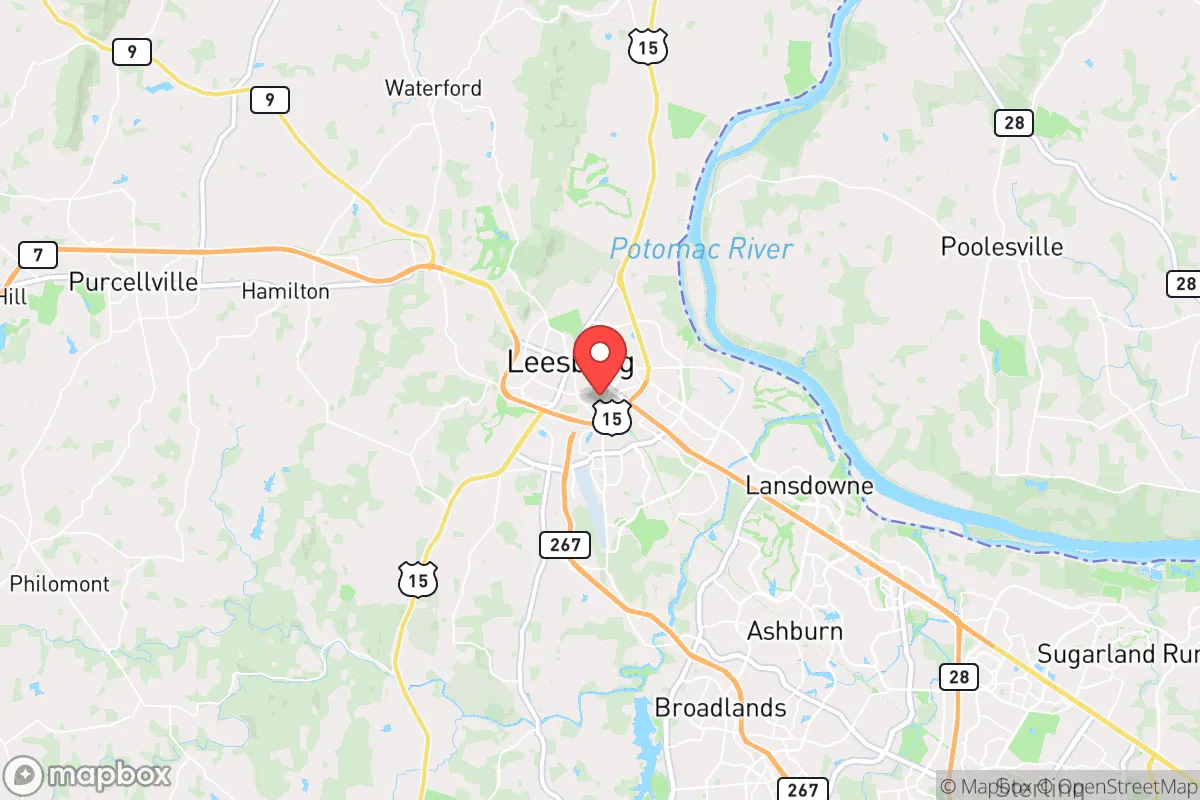
Leesburg was founded in 1758 as the seat of Loudoun County, named after the influential Lee family of Virginia. The original population was overwhelmingly English and Scots-Irish, drawn by the fertile Piedmont soil and the promise of tobacco and wheat farming. The town's early growth centered on the historic downtown grid around King Street and Market Street, where merchants, millers, and lawyers built brick Federal-style homes and storefronts. The Catoctin Creek and the Potomac River provided water power for gristmills and sawmills, anchoring a small but stable population of free white farmers and a significant enslaved Black workforce—by 1860, roughly one-third of Loudoun County's population was enslaved. After the Civil War, freedmen established communities on the town's periphery, notably in the Waterford area (a Quaker-founded village northwest of Leesburg) and along the Old Waterford Road corridor, where Black families built churches, schools, and homesteads. The arrival of the Washington & Old Dominion Railroad in the 1870s spurred modest growth, but Leesburg remained a sleepy agricultural county seat through the 1950s, with a population hovering around 5,000.
Modern era (post-1965)
The 1965 Hart-Cellar Immigration Act and the 1970s expansion of the federal government in D.C. transformed Leesburg from a rural backwater into a booming exurb. The construction of Dulles International Airport (1962) and the Dulles Greenway toll road (1995) made the town accessible to professionals working in the D.C. metro area. The first major wave of newcomers were white-collar white families from Northern Virginia and Maryland, who settled in master-planned subdivisions like Lansdowne on the Potomac (developed from the 1980s onward), a golf-course community that attracted executives and government contractors. Simultaneously, Hispanic immigrants—primarily from El Salvador, Guatemala, and Mexico—began arriving in the 1990s to work in construction, landscaping, and the hospitality industry tied to the region's growth. They concentrated in the Plaza Street and South King Street corridor, where affordable rental housing and Spanish-language businesses formed a visible ethnic enclave. The 2000s and 2010s saw a surge of Indian-subcontinent professionals—engineers, IT managers, and physicians—drawn by tech jobs at firms like Orbital ATK (now Northrop Grumman) and the broader Dulles Technology Corridor. These families gravitated toward newer subdivisions such as Kincaid Forest and Ashburn Village (technically in Ashburn but overlapping Leesburg's eastern edge), where large single-family homes and top-rated Loudoun County public schools were key draws. East/Southeast Asian communities (Chinese, Korean, Vietnamese) also grew, though more slowly, settling in the Edwards Ferry Road area and near the Leesburg Premium Outlets retail hub. By 2020, Leesburg's foreign-born share had reached 8.2%, and the white share had fallen from 75% in 2000 to 56%.
The future
Leesburg's population is trending toward greater diversity, but not toward a single melting pot. The Hispanic share (18.5%) is the fastest-growing segment, driven by both immigration and higher birth rates, and is likely to approach 25-30% within 15 years. The Indian-subcontinent community (6.2%) is plateauing as the tech job market matures, but remains concentrated in affluent subdivisions where property values exceed $700,000. East/Southeast Asian and Black populations are growing slowly, largely through domestic migration from other U.S. metro areas. The white population, while still a majority, is aging and declining in share as younger white families choose farther-out exurbs or return to D.C. proper. The city is not tribalizing into hostile enclaves—schools, sports leagues, and civic life are broadly integrated—but distinct residential patterns persist: Lansdowne remains overwhelmingly white and affluent, Plaza Street remains predominantly Hispanic and working-class, and Kincaid Forest is heavily Indian-subcontinent. The next decade will likely see continued infill development along the Route 7 and Route 15 corridors, with new townhome and apartment projects absorbing moderate-income families of all backgrounds.
For a conservative-leaning mover today, Leesburg offers a stable, family-oriented environment where traditional values coexist with genuine demographic change. The schools are excellent, the crime rate is low, and the local economy is resilient. The city is becoming more diverse, but not in a way that erodes its historic character—rather, it is adding layers of community that, for now, remain largely self-contained. A newcomer should expect a place where neighbors are polite but not intrusive, where church attendance is still common, and where the biggest local debates revolve around development density and school capacity, not ideological conflict.

* Values derived from national, state, county, city and local statistics and may differ in a specific area. Last updated: 2026-05-01T15:31:00.000Z
Narrative content on this page is AI-generated and may contain mistakes. Verify any details that matter before acting on them.
ReloMaps may earn a commission from affiliate links at no extra cost to you.

