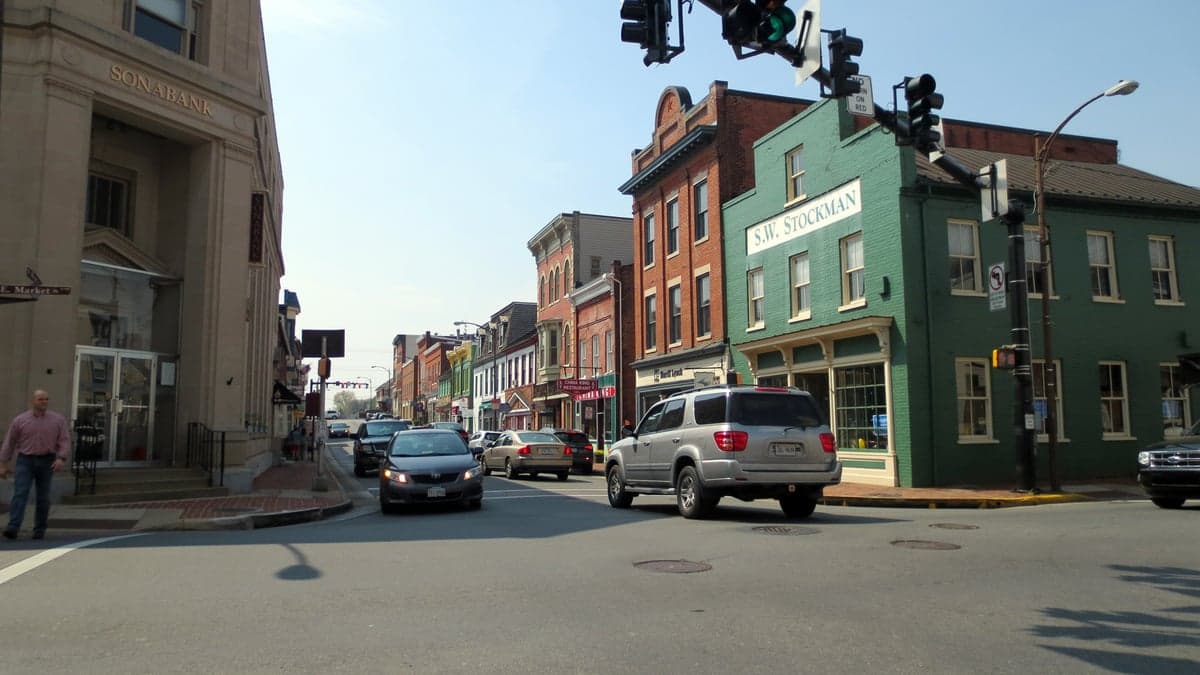
Photo: Wikipedia
Political ClimatePolitical Climate in Leesburg, VA
District shown is the primary district for this city’s centroid. Cities may span multiple districts.
Local Political AnalysisPolitical Analysis of Leesburg, VA
Leesburg, Virginia, has shifted noticeably to the left over the past decade, with a Cook Partisan Voting Index of D+6 that reflects a political landscape far removed from the conservative stronghold it once was. While Loudoun County as a whole has trended blue, Leesburg itself has become a bellwether for the broader changes—where a Republican could once count on winning local races, now Democrats hold most of the county-level seats and the town council leans progressive. If you’ve lived here as long as I have, you’ve watched the old farm families sell out to developers, and with them came a wave of transplants from D.C. and Northern Virginia who brought a very different set of values.
How it compares
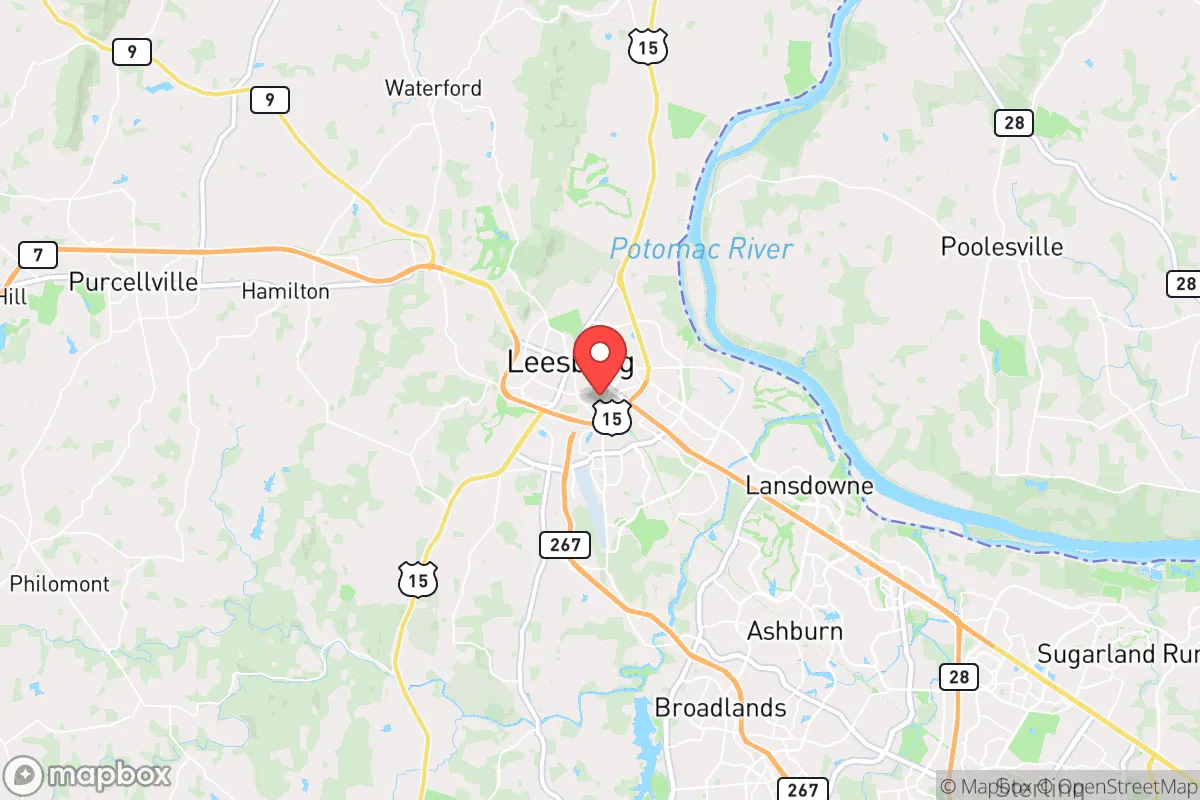
Drive ten miles west to Purcellville or twenty miles southwest to Middleburg, and you’ll find a completely different political reality. Those towns still vote reliably Republican, with Purcellville’s town council often split but leaning conservative, and Middleburg holding onto its horse-country traditions and small-government ethos. Even nearby Hamilton and Round Hill feel more like the Leesburg of the 1990s—where folks worry more about property taxes and school zoning than about climate resolutions or diversity equity initiatives. The contrast is stark: Leesburg’s D+6 rating puts it in the same league as Arlington or Alexandria, while the surrounding rural areas are more like the red parts of Fauquier or Clarke counties. That split means you can’t assume your neighbor shares your views anymore, and local elections have become battlegrounds over growth, school curriculum, and public safety funding.
What this means for residents
For longtime residents, the most visible change is in local governance—there’s a growing appetite for government involvement in things that used to be left to families and communities. The county school board has pushed for more centralized control over what kids learn, and the town council has entertained zoning changes that prioritize high-density housing over single-family neighborhoods, often citing “equity” goals that feel like a backdoor to telling you how to live. Property taxes have crept up faster than inflation, and new regulations on everything from short-term rentals to home-based businesses make you wonder if the county trusts you to run your own life. If you value personal freedom—like the right to build a shed without a permit or keep a few chickens in your backyard—you’ll find Leesburg’s progressive tilt increasingly at odds with that. The long-term trajectory suggests more of the same: more density, more rules, and a political class that sees itself as the solution rather than the servant.
Culturally, Leesburg still has its charms—the historic downtown, the Friday night lights at Loudoun County High School, and the occasional farm stand—but the policy direction is unmistakable. The push for “Vision Zero” street redesigns, the embrace of sanctuary policies, and the quiet removal of traditional holiday displays from public spaces all signal a shift away from the community’s roots. If you’re considering a move here, understand that the political climate is not what it was even five years ago, and it’s unlikely to swing back anytime soon. For those who value limited government and local control, the surrounding towns to the west may offer a better fit—but in Leesburg itself, you’ll be living in a place where the government’s hand feels heavier every year.

State Political ClimatePolitical Climate in Virginia
State Political AnalysisPolitical Environment in the State
Virginia has shifted from a reliably purple swing state to a solidly blue one over the past 15 years, driven largely by the explosive growth of Northern Virginia’s D.C. suburbs. The state now leans Democratic by about 10 points in presidential elections, with the party controlling both chambers of the legislature and the governor’s mansion. This wasn’t always the case—as recently as 2009, Republicans held all three levers of power—but a combination of in-migration from blue states, demographic change, and suburban realignment has fundamentally altered the political landscape.
Urban vs. rural divide
The political map of Virginia is a tale of two states. The urban crescent—Arlington, Alexandria, Fairfax County, and Richmond—votes overwhelmingly Democratic, often by margins of 60-70% or more. These areas are home to federal employees, defense contractors, and a highly educated, diverse population that has moved leftward rapidly. In contrast, rural and exurban Virginia—places like Lynchburg, Roanoke, and the Shenandoah Valley—remains deeply Republican. The real battleground has been the suburbs of Richmond (Henrico and Chesterfield counties) and the Hampton Roads area (Virginia Beach, Chesapeake). These once-competitive regions have trended blue, with Chesterfield County flipping to Democrats in 2020 after decades of GOP dominance. The result is a state where Democrats can win statewide without carrying a single rural county, simply by running up the score in NoVA and Richmond.
Policy environment
Virginia’s policy environment has shifted sharply left since Democrats took full control in 2020. The state’s income tax is a flat 5.75%, but property taxes vary wildly—Loudoun County has some of the highest in the state, while rural counties like Giles are much lower. The regulatory posture has become increasingly burdensome, with the Virginia Clean Economy Act mandating a 100% carbon-free grid by 2050, driving up energy costs. Education policy has been a flashpoint: the state eliminated its charter school cap in 2021 but has seen little growth, while parental rights battles erupted over transgender policies in schools like Fairfax County Public Schools. Election laws have been loosened significantly—no-excuse absentee voting, same-day registration, and a permanent absentee voter list are now law, which conservatives argue reduces election integrity. Healthcare expansion under Medicaid was adopted in 2019, but the state has also moved to codify abortion access up to viability, making it a destination for out-of-state patients.
Trajectory & freedom
On the freedom front, Virginia has been a mixed bag trending negative. The most significant contraction of personal liberty came with the 2020 gun control package—universal background checks, a red flag law, and a one-handgun-per-month limit—which passed after the 2019 Democratic sweep. Virginia Beach and Roanoke saw massive Second Amendment Sanctuary resolutions in response, with over 100 counties declaring themselves sanctuaries. Parental rights took a hit with the 2021 law requiring schools to adopt policies that affirm transgender students’ gender identity without parental notification, though Governor Youngkin’s 2022 executive order rolled back some of that. Medical autonomy was curtailed by vaccine mandates for state employees and school staff during COVID, though these have since been lifted. Property rights remain relatively strong, but the state’s land use policies in NoVA have become increasingly restrictive, with zoning changes pushing higher density. The tax burden has increased—the gas tax was raised in 2020, and a new regional traffic tax was imposed on Northern Virginia and Hampton Roads. The overall trajectory is one of expanding government control, particularly in urban centers.
Civil unrest & political movements
Virginia has been a national flashpoint for political movements. The 2017 Unite the Right rally in Charlottesville and the subsequent removal of Confederate statues sparked years of protests and counter-protests, culminating in the 2020-21 statue removals in Richmond. The 2020 Black Lives Matter protests in Richmond were among the largest per capita in the country, leading to the dismantling of Monument Avenue. On the right, the Second Amendment Sanctuary movement was the most organized grassroots effort, with massive rallies at the state capitol in 2020 that drew tens of thousands. Immigration politics have been contentious—Prince William County and Fairfax County have sanctuary policies limiting cooperation with ICE, while rural counties have passed resolutions opposing them. Election integrity remains a hot-button issue: the 2020 election saw no major fraud, but the 2021 gubernatorial race (won by Youngkin) was marked by Republican concerns over ballot drop boxes and same-day registration. A new resident in NoVA will see political yard signs year-round, while in rural areas, the culture war is quieter but deeply felt.
Projection
Over the next 5-10 years, Virginia is likely to continue its leftward drift, but at a slower pace. The biggest wildcard is in-migration: the state is gaining about 60,000 new residents annually, mostly from blue states like New York and California, who settle in NoVA and Richmond. This demographic shift will reinforce Democratic dominance in those areas. However, the rural-urban divide may widen further, with rural counties becoming even more Republican as they lose population. The state’s tax and regulatory climate will likely become more progressive—expect a push for a graduated income tax and stricter environmental regulations. The 2025 gubernatorial election will be a key test: if a Republican wins, it could slow the trend, but the underlying demographics favor Democrats. For a conservative moving in now, the realistic expectation is that Virginia will be a blue state for the foreseeable future, with pockets of red in the west and south. The best bet for like-minded community is Lynchburg (home to Liberty University) or the Roanoke Valley, where conservative values still dominate local politics.
For a new resident, the bottom line is this: Virginia offers beautiful landscapes, strong schools in the suburbs, and a robust economy, but the political climate is increasingly hostile to conservative values. If you’re moving here, choose your county carefully—Loudoun and Fairfax are deep blue, while Bedford and Augusta counties remain reliably red. Expect higher taxes, more regulation, and a culture war that plays out in school boards and local elections. It’s not Texas or Florida, but with the right local strategy, you can find your tribe.
* Values derived from national, state, county, city and local statistics and may differ in a specific area. Last updated: 2026-05-01T15:31:00.000Z
Narrative content on this page is AI-generated and may contain mistakes. Verify any details that matter before acting on them.
ReloMaps may earn a commission from affiliate links at no extra cost to you.

