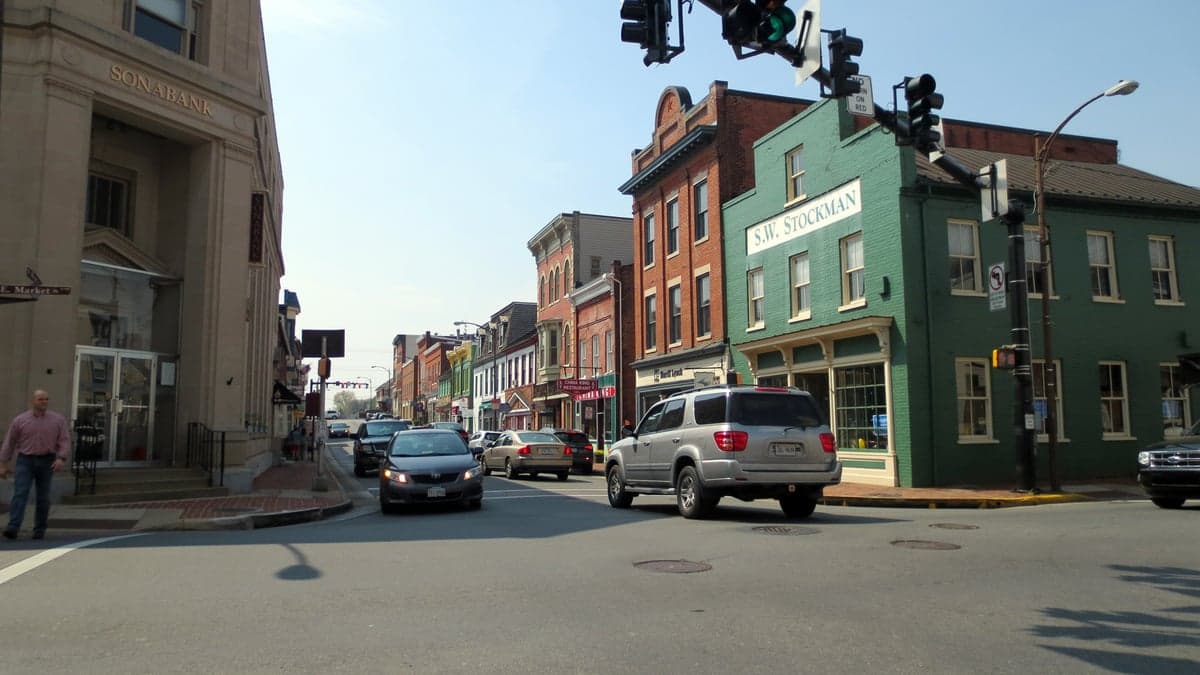
Photo: Wikipedia
Personal Sovereignty in Leesburg, VA
Viable for self-reliance. Generally workable, though some barriers may limit total independence.
What does Personal Sovereignty tell us?
Personal Sovereignty measures your capacity for self-reliance and independence with minimal government friction. Higher scores mean fewer barriers between you and the way you want to live... but it assumes you have the space you need and good neighbors.
What does this tell us?
Personal Sovereignty measures your capacity for self-reliance and independence with minimal government friction. Higher scores mean fewer barriers between you and the way you want to live... but it assumes you have the space you need and good neighbors.
State Policy
Energy independence: Importer (20% of energy produced in-state)
Personal Liberty
Homesteading

Personal Liberty Analysis
Leesburg, Virginia, offers a mixed bag for those prioritizing personal sovereignty, where the state’s increasingly assertive regulatory posture clashes with a historically independent-minded county. While Loudoun County is not a free-for-all, its rural western fringes and the town’s own zoning quirks provide more breathing room than the dense, heavily regulated suburbs closer to D.C. For the survivalist or prepper, the key question is whether the area’s advantages—like lower population density and some agricultural zoning—outweigh the creeping state-level mandates that can feel like a slow-motion erosion of autonomy. The answer depends heavily on where you land within the county and how much you’re willing to navigate a system that is not hostile, but certainly not friendly, to self-reliance.
Tax burden and regulatory posture in Loudoun County
Virginia’s tax structure is relatively favorable compared to neighboring Maryland or D.C., with a flat state income tax rate of 5.75% and no state-level property tax on vehicles or business equipment. However, Loudoun County’s real estate tax rate—hovering around $1.185 per $100 of assessed value—is among the highest in the state, driven by demand for top-tier schools and infrastructure. For a prepper, this means a larger chunk of your income goes to services you may not fully use, especially if you’re homeschooling or relying on private water and septic. The county’s regulatory posture is also notable: Loudoun enforces strict stormwater management, erosion control, and building codes that can complicate off-grid projects like rainwater catchment or solar panel installations. Permitting for a detached garage or workshop can take months, and the county’s zoning ordinance explicitly limits “accessory structures” on smaller lots, making it harder to build a dedicated root cellar or armory without jumping through hoops. That said, the county’s Agricultural and Rural (AR-1 and AR-2) zoning districts—covering much of the western half—allow for larger outbuildings, livestock, and even limited commercial activity like selling produce or firewood, which is a significant win for self-sufficiency.
Self-defense and gun law specifics in Virginia
Virginia is a “shall-issue” state for concealed carry permits, meaning the sheriff’s office in Loudoun must issue one if you meet basic criteria—no subjective “good cause” requirement. The state also preempts local gun ordinances, so Leesburg cannot ban open carry or restrict magazine capacities beyond state law. However, the state-level landscape has shifted: since 2020, Virginia has enacted a “one handgun per month” purchase limit, universal background checks for private sales, and a “red flag” law that allows law enforcement to petition for temporary firearm seizure based on vague “dangerousness” standards. For the prepper, this is a direct threat to stockpiling and privacy. The red flag law, in particular, is a tool that can be abused by disgruntled neighbors or ex-spouses, and Loudoun County’s courts have been willing to issue these orders. On the positive side, Virginia remains a castle doctrine state with no duty to retreat in your home or vehicle, and the state’s “stand your ground” law applies in public spaces. Open carry is legal without a permit, though in practice, doing so in downtown Leesburg will attract police attention. For those building a defensive capability, the key workaround is to buy firearms in bulk from private sellers in neighboring states (where legal) or to rely on the state’s preemption to keep your collection off local radar.
Self-reliance and homesteading viability in western Loudoun
The viability of a self-reliant lifestyle in Leesburg is almost entirely a function of lot size and zoning. Inside the town limits, most residential lots are under half an acre, making serious homesteading—gardens large enough to preserve food, chickens for eggs, or a woodlot for heating—impractical. The town also bans backyard chickens on lots under 10,000 square feet, and beekeeping requires a permit. But move just 10 miles west into the AR-1 zone, and you can find 3- to 10-acre parcels where you can keep horses, goats, and up to 50 chickens without a special exception. These areas also allow for “agricultural accessory uses” like roadside stands, hay storage, and even limited timber harvesting. Off-grid feasibility is limited: Virginia’s building code requires connection to the electrical grid for new construction, though you can install solar panels as a supplement. Rainwater collection for irrigation is allowed, but using it as a primary water source for a dwelling requires a permit and a treatment system. Septic systems are standard, and composting toilets are not recognized for full-time residences. For the prepper, the best bet is to buy a property with an existing well and septic, then add solar and a backup generator—all of which are legal and common in the rural west. The county’s Right to Farm Act also protects you from nuisance complaints if you run a small farm operation, which is a critical buffer against suburbanite neighbors who might object to roosters or the smell of manure.
Personal liberties: parental rights, medical autonomy, speech, and property
Virginia’s legal framework for personal liberties is a patchwork. On parental rights, the state has a strong “parental involvement” law for minors’ abortions, but it does not have a broad “parental bill of rights” like Florida or Texas. In Loudoun County Public Schools, the school board has been a flashpoint for debates over critical race theory, transgender policies, and mask mandates—meaning parents must be vigilant and vocal to protect their children from ideological instruction. Homeschooling is legal and relatively straightforward: you file a notice of intent, provide a curriculum description, and submit annual assessments or test scores. No home visits or state approval is required. Medical autonomy is weaker: Virginia has not expanded scope of practice for naturopaths or direct-primary-care models, and the state’s vaccine mandates for schoolchildren are strict, with only medical and religious exemptions (no philosophical exemption). The COVID-era emergency powers gave the governor broad authority to mandate masks and vaccines, which was a red flag for many preppers. On speech and property, Virginia is a “right-to-work” state, meaning you cannot be forced to join a union as a condition of employment. Property rights are protected by the state’s “eminent domain” restrictions that limit takings for private economic development, but Loudoun County has aggressively used zoning to restrict short-term rentals and home-based businesses. For the prepper, the biggest property-rights concern is the county’s ability to enforce “nuisance” codes on unkempt lots, junk vehicles, or unpermitted structures—so keeping a low profile is essential.
Overall, Leesburg and western Loudoun offer a moderate-to-high level of personal sovereignty compared to the D.C. suburbs or Maryland, but it falls short of the libertarian-leaning enclaves in the Shenandoah Valley or rural West Virginia. The tax burden is real, the red flag law is a genuine risk, and the county’s regulatory appetite can be frustrating. But the availability of AR-zoned land, the state’s castle doctrine, and the relative ease of homeschooling make it a viable option for the strategic prepper who is willing to work the system. If you can afford a 5-acre parcel west of town, keep your head down, and build relationships with like-minded neighbors, Leesburg provides a solid foundation for self-reliance—just don’t expect the county to make it easy.

* Values derived from national, state, county, city and local statistics and may differ in a specific area. Last updated: 2026-05-01T15:31:00.000Z
Narrative content on this page is AI-generated and may contain mistakes. Verify any details that matter before acting on them.
ReloMaps may earn a commission from affiliate links at no extra cost to you.

