
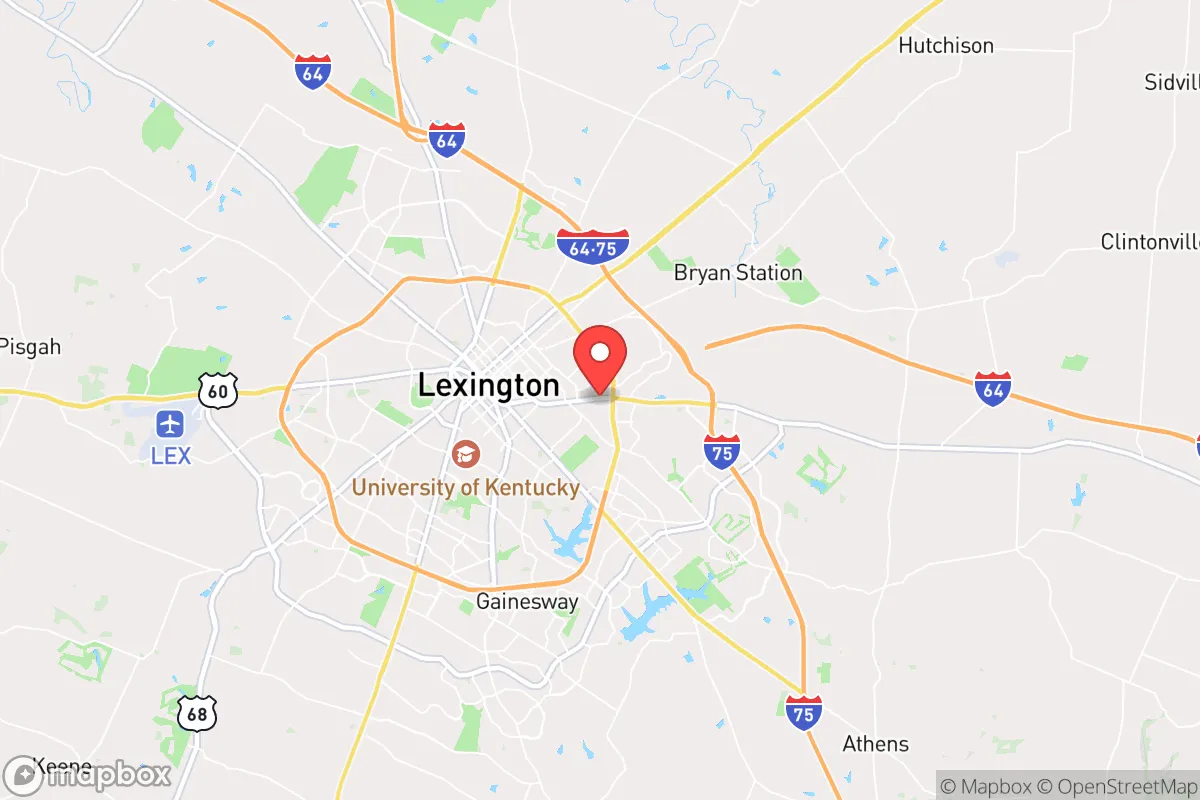
Photo: Wikipedia
Personal Sovereignty in Lexington, KY
Viable for self-reliance. Generally workable, though some barriers may limit total independence.
What does Personal Sovereignty tell us?
Personal Sovereignty measures your capacity for self-reliance and independence with minimal government friction. Higher scores mean fewer barriers between you and the way you want to live... but it assumes you have the space you need and good neighbors.
What does this tell us?
Personal Sovereignty measures your capacity for self-reliance and independence with minimal government friction. Higher scores mean fewer barriers between you and the way you want to live... but it assumes you have the space you need and good neighbors.
State Policy
Energy independence: Importer (60% of energy produced in-state)
Personal Liberty
Homesteading

Personal Liberty Analysis
Lexington, Kentucky offers a mixed bag for those prioritizing personal sovereignty, with a state-level legal framework that generally supports individual rights but a local government that leans more interventionist than the surrounding countryside. For the survivalist or prepper, the key takeaway is that while Kentucky’s constitution and statutes provide strong protections for gun rights, property use, and medical autonomy, Fayette County’s urban planning and tax policies can feel like a slow creep of overreach. You’ll find more breathing room in the rural counties ringing Lexington, but the city itself is a trade-off: access to resources and community networks versus a municipal code that doesn’t always trust you to make your own decisions.
Tax burden and regulatory posture: How Lexington compares to the rest of Kentucky
Kentucky’s overall tax burden is moderate, ranking around the middle of states, but Lexington’s local add-ons make it pricier than its neighbors. The state income tax is a flat 4.5% as of 2026, and property taxes are relatively low—averaging about 0.85% of assessed value statewide. However, Fayette County imposes a higher property tax rate than most rural counties, and the city’s occupational license fee (a payroll tax) hits both employees and self-employed individuals at roughly 2.25%. For a prepper running a small homestead business or remote work, that’s a noticeable bite. Regulatory posture is where Lexington diverges sharply from the state’s libertarian streak. The city enforces stricter building codes, noise ordinances, and business licensing than unincorporated areas. If you’re looking to set up a workshop, keep livestock, or run a home-based survival gear operation, expect more paperwork and inspections than you’d face in, say, Jessamine or Woodford County. The state’s right-to-work laws and lack of universal zoning outside cities are assets, but Lexington’s local bureaucracy can feel like a thumb on the scale against self-reliance.
Self-defense and gun law specifics: What the Second Sanctuary status means for you
Kentucky is a constitutional carry state, meaning no permit is required to carry a concealed firearm for anyone 21 or older who can legally possess one. Lexington, however, is not a “Second Amendment Sanctuary” city—unlike many smaller Kentucky towns that passed symbolic resolutions against federal overreach. The city does have some local restrictions: firearms are prohibited in government buildings, parks during special events, and on public transit. But these are relatively light compared to blue-state enclaves. Stand-your-ground laws are fully in effect, and there’s no duty to retreat in any place you have a legal right to be. Castle doctrine protections extend to vehicles and occupied structures. For the prepper, the practical concern isn’t the law itself—it’s the political climate. Lexington’s city council has occasionally floated gun storage ordinances and “red flag” proposals, though none have passed as of 2026. The surrounding counties (Scott, Bourbon, Clark) are more reliably pro-2A, so if you’re serious about building a defensive network, consider a property just outside the urban growth boundary. Ammunition and firearm retailers are plentiful, and private sales between individuals remain unregulated at the state level.
Self-reliance and homesteading viability: Lot sizes, zoning, and off-grid feasibility
Within Lexington proper, homesteading is constrained by zoning that favors suburban density. Minimum lot sizes in the urban service area are typically 6,000 to 10,000 square feet, which limits space for gardens, chicken coops, or rainwater catchment systems. The city’s code enforcement actively pursues complaints about “unkept” properties, tall grass, and visible storage—so stockpiling supplies or letting a food forest grow wild can draw fines. Off-grid living is effectively illegal inside city limits: you must connect to municipal water and sewer, and solar panels require permits with strict grid-tie requirements. The real opportunity lies in the rural fringe, particularly in southern Fayette County or adjacent areas in Jessamine and Woodford counties. There, lot sizes of 1 to 5 acres are common, and zoning is far looser. You can install septic, drill a well, and set up off-grid solar without much hassle. The urban growth boundary (UGB) is a double-edged sword: it preserves farmland and limits sprawl, but it also drives up land prices inside the boundary and restricts where you can build. For a serious homestead, look at properties outside the UGB where you can legally keep goats, bees, and even a few head of cattle. The local extension office offers soil testing and canning workshops, which is a plus for building long-term food security.
Personal liberties: Parental rights, medical autonomy, speech, and property
Kentucky has strong parental rights on paper—state law affirms that parents have the fundamental right to direct the upbringing, education, and healthcare of their children. In practice, Lexington’s public school system has adopted some controversial curricula and policies, including LGBTQ+ inclusive materials and social-emotional learning programs that some parents view as overreach. School board meetings have been tense, and there’s an active homeschool community (estimated at 8-10% of school-age children in Fayette County) for those who want to opt out entirely. Medical autonomy is a bright spot: Kentucky has no state-level vaccine mandate for adults, and while some employers in Lexington require COVID-19 shots, the state legislature has passed bills limiting such mandates for public employees. Natural health remedies, herbalism, and alternative medicine are legal, though the state medical board keeps a close eye on unlicensed practitioners. Free speech is protected, but Lexington’s city council has considered “hate speech” ordinances and permit requirements for large gatherings—so political assembly requires some planning. Property rights are generally strong, with no statewide rent control and relatively low eminent domain usage, but the city’s historic preservation board can restrict modifications to older homes in designated districts. For the prepper, the biggest property concern is the lack of a state-level “right to farm” law that explicitly protects small-scale agriculture from nuisance lawsuits—though Kentucky’s agricultural district program offers some buffer.
Overall, Lexington sits in a middle zone for personal sovereignty compared to other mid-sized American cities. It’s far freer than Portland or Austin in terms of gun laws and medical choice, but noticeably more regulated than rural Kentucky towns or states like Idaho or Montana. The state’s constitutional protections and legislative trends are on your side, but the local government’s appetite for control is higher than the surrounding counties. For a single individual or family serious about autonomy, the smart play is to locate just outside the urban growth boundary—close enough to access Lexington’s hospitals, hardware stores, and prepper meetups, but far enough to avoid the city’s zoning and tax reach. If you’re willing to navigate the bureaucracy, the city itself can work, but it requires constant vigilance against the next ordinance or fee that chips away at your freedom.

* Values derived from national, state, county, city and local statistics and may differ in a specific area. Last updated: 2026-05-07T10:56:38.000Z
Narrative content on this page is AI-generated and may contain mistakes. Verify any details that matter before acting on them.
ReloMaps may earn a commission from affiliate links at no extra cost to you.

