Photo: Wikipedia
Demographics of Lima, OH
Affluence Level in Lima, OH
A low-income area with significant economic hardship. Household wealth and educational attainment are well below national averages.
People of Lima, OH
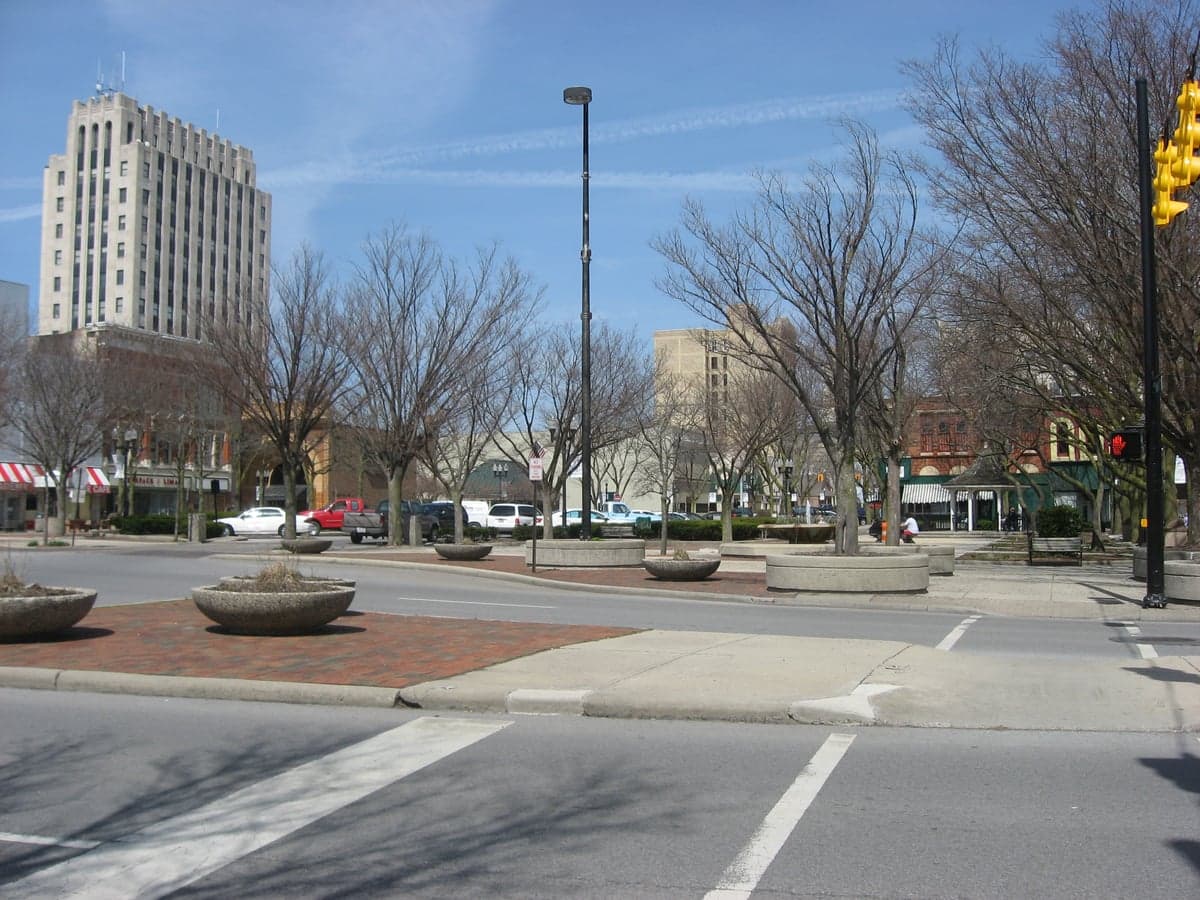
The people of Lima, Ohio today form a predominantly native-born, working-class community of 35,304, distinguished by a demographic profile that is roughly 62% White, 23% Black, and 5% Hispanic, with a foreign-born population of less than 1%. The city carries a distinct Rust Belt identity—shaped by a history of industrial boom and decline—and is notably less diverse than Ohio as a whole, with a college attainment rate of just 11.8% that reflects its blue-collar character. Residents are concentrated in established neighborhoods like the South Side and Westwood, where family roots often stretch back several generations, creating a tight-knit but economically cautious atmosphere.
How the city was settled and grew
Lima’s population history begins with its 1831 founding as a county seat on land ceded by the Shawnee and Wyandot tribes, but the city’s real growth spurt came after the 1885 discovery of oil and natural gas in the region. The Ohio Oil Company (later Marathon Petroleum) drew thousands of workers, including a wave of German and Irish immigrants who settled in the South Side near the refineries and rail yards. By 1900, the population had surged past 8,000, and the city’s industrial base expanded to include locomotive manufacturing and steel fabrication. A second major wave arrived during the Great Migration (1910–1940), when Black families from the Deep South—primarily Alabama and Mississippi—moved north for factory jobs, forming the core of what became the West Market Street corridor and the Elm Street neighborhood. These early Black residents built churches and mutual-aid societies that remain community anchors today. The post-World War II boom brought Appalachian migrants from Kentucky and West Virginia, who clustered in the Shawnee Township fringe and the North Side, working at the Lima Army Tank Plant and Ford engine plant. By 1960, the city peaked at roughly 51,000 residents, a number that has since declined by nearly a third.
Modern era (post-1965)
After the 1965 Hart-Cellar Act, Lima saw negligible new immigration—its foreign-born share remains below 1%—but experienced significant domestic demographic shifts. White flight to outlying townships like Bath and American began in the 1970s, accelerating after the 1978 closure of the Lima Locomotive Works. The Black population, which had been concentrated in the Elm Street and West Market Street areas, expanded into the South Side as older White residents departed, creating a more racially mixed but economically strained corridor. The Hispanic population, now 4.8%, grew slowly from Mexican-origin families who arrived in the 1990s for work at the remaining manufacturing plants, settling primarily in the Westwood and South Side neighborhoods. The East/Southeast Asian population (0.5%) is tiny and largely tied to professional roles at Mercy Health-St. Rita’s Medical Center, with no distinct ethnic enclave. The Indian-subcontinent population is effectively zero. The city’s overall population dropped from 45,549 in 2000 to 35,304 in 2020, a 22% decline driven by job losses at the Ford plant and Marathon’s headquarters relocation to Findlay in 2015.
The future
Lima’s population is projected to continue shrinking slowly, with the Allen County Planning Commission estimating a further 5–8% decline by 2035. The city is not homogenizing into a single identity but rather tribalizing into distinct enclaves: the Westwood and Shawnee Township areas are becoming more White and older, while the South Side and Elm Street neighborhoods are growing more Black and Hispanic. Immigrant communities are not growing—the foreign-born share has been flat for two decades—and the small Hispanic population is assimilating into the broader working class rather than forming a distinct cultural district. The college-educated share (11.8%) is half the national average, and out-migration of young adults to Columbus and Dayton continues. The next decade likely sees a continued aging of the White population, a stable Black population, and a slight uptick in Hispanic share as families move in for affordable housing (median home value ~$85,000).
For someone moving in now, Lima is becoming a smaller, more racially defined, and economically stagnant city where neighborhood choice strongly correlates with demographic identity. The Westwood and Shawnee Township areas offer stability and lower crime rates for families, while the South Side and Elm Street neighborhoods provide affordable entry points but face higher poverty and vacancy rates. The city’s future is one of managed decline rather than revival, making it a place for those who value low cost of living and deep community roots over economic dynamism or diversity.

* Values derived from national, state, county, city and local statistics and may differ in a specific area. Last updated: 2026-04-21T18:47:16.000Z
Narrative content on this page is AI-generated and may contain mistakes. Verify any details that matter before acting on them.
ReloMaps may earn a commission from affiliate links at no extra cost to you.

