
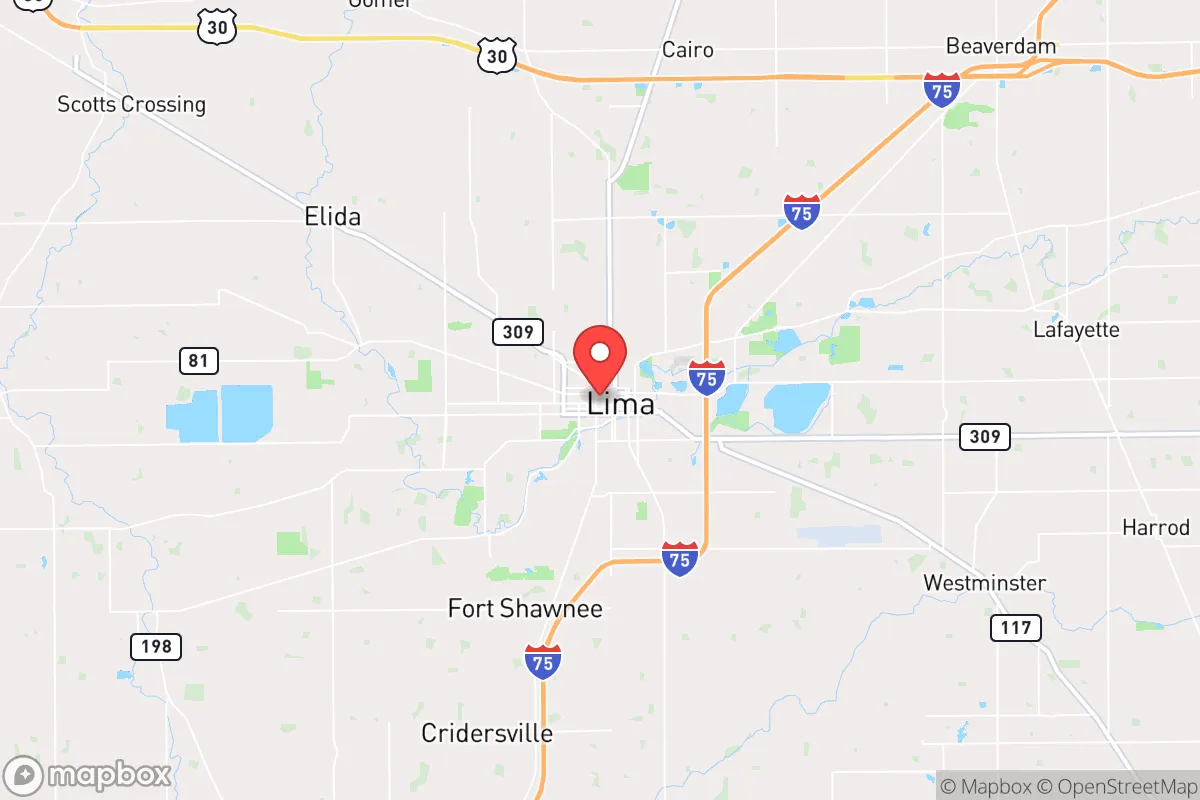
Photo: Wikipedia
Political ClimatePolitical Climate in Lima, OH
District shown is the primary district for this city’s centroid. Cities may span multiple districts.
Local Political AnalysisPolitical Analysis of Lima, OH
Lima, Ohio, sits deep in reliably conservative territory, with a Cook PVI of R+18 that reflects decades of consistent Republican voting in both local and national elections. The city and surrounding Allen County have long been a stronghold for traditional values, with most residents favoring limited government, personal responsibility, and a healthy skepticism of federal overreach. While the area has historically leaned red, there's a growing unease among locals about creeping progressive influences from larger cities like Columbus and Toledo, which are starting to ripple into state-level policies that feel out of step with Lima's way of life.
How it compares
Lima's political climate is noticeably more conservative than nearby cities like Findlay to the north, which leans R+12, or even Bowling Green, which has a more moderate R+8 tilt. The contrast is stark when you look south toward Dayton or east toward Columbus—both of which have shifted left in recent years, with Columbus now sitting at D+20. Lima residents often joke that you can feel the political shift as soon as you hit I-75 heading south. The surrounding rural townships—like Bath, Shawnee, and Perry—are even more conservative than Lima proper, with many precincts voting 70-80% Republican in recent cycles. This isn't a purple area; it's a place where conservative values are the baseline, and any move toward progressive ideology is met with serious pushback at the ballot box.
What this means for residents
For folks living here, the conservative lean translates into a government that generally stays out of your business—low taxes, fewer regulations, and a school system that hasn't been hijacked by radical curriculum changes. Property taxes in Allen County are among the lowest in the state, and there's no city income tax on top of that, which is a big deal for families trying to stretch a paycheck. But there's a growing concern that state-level mandates from Columbus—like recent pushes for electric vehicle mandates and diversity quotas in public contracting—are starting to trickle down. Locals see this as government overreach into personal freedoms, and it's fueling a stronger turnout in local elections to keep the county commission and school board seats filled with people who remember what limited government actually means. The Second Amendment is still taken seriously here; you won't find the same restrictions you see in Cuyahoga or Franklin counties.
On the cultural side, Lima has managed to hold onto a sense of community that's increasingly rare in Ohio. Churches are still central to social life, and the annual Allen County Fair feels more like a family reunion than a commercial event. The biggest political fights in recent years haven't been about national culture wars—they've been about local control: zoning ordinances, school funding, and keeping the city's police department fully staffed. That said, there's a quiet worry that the progressive wave washing over the rest of the state will eventually reach here, especially as younger residents move away for jobs and are replaced by transplants from bluer areas. For now, though, Lima remains a place where a conservative worldview isn't just tolerated—it's expected, and any politician who forgets that won't last long.

State Political ClimatePolitical Climate in Ohio
State Political AnalysisPolitical Environment in the State
Ohio has long been the quintessential bellwether state, but over the past 10-20 years, its political center of gravity has shifted noticeably rightward, even as it remains a competitive battleground. The state’s overall partisan lean is now a solid +8 Republican in federal races, driven by a powerful coalition of rural conservatives, suburban ex-urbanites fleeing blue states, and a working-class base that has soured on progressive economic and cultural policies. While Democrats still hold sway in the major metros, the state’s trajectory since 2010 has been one of steady reddening, with the GOP controlling the governorship, both legislative chambers, and the state supreme court. For a conservative-leaning individual or family, Ohio offers a policy environment that is increasingly aligned with traditional values, though the urban-rural divide means you’ll want to pick your county carefully.
Urban vs. rural divide
The political map of Ohio is a study in stark contrasts. The three major metros—Cleveland, Columbus, and Cincinnati—are Democratic strongholds, with Cuyahoga County (Cleveland) delivering a +40-point margin for Biden in 2020. Columbus, home to Ohio State University and a growing tech sector, has become a progressive island, with Franklin County voting +30 Democratic. Cincinnati’s Hamilton County is more moderate but still leans blue, driven by the city’s urban core and northern suburbs. However, the real story is the vast rural and exurban landscape that surrounds these cities. Counties like Mercer (west-central), Holmes (Amish country), and Brown (southwest) routinely vote +70 Republican. The suburbs that once were swing areas—places like Delaware County (north of Columbus) and Warren County (north of Cincinnati)—have flipped hard red, with Delaware County going from a 50-50 split in 2000 to +20 Republican in 2024. This rural and suburban coalition is what gives Ohio its red tint, and it’s only deepening as more families move out of the urban cores.
Policy environment
Ohio’s policy environment is a mixed bag for conservatives, but the trend is positive. The state has a flat income tax rate of 3.5% (down from 4.8% in 2020), and the GOP legislature has been aggressively cutting taxes, with a goal of eliminating the income tax entirely. Property taxes are moderate, though they vary wildly by county—expect higher rates in Cuyahoga and Franklin, lower in rural counties like Auglaize. The regulatory posture is business-friendly, with right-to-work laws (though not a full right-to-work state) and a tort reform system that caps non-economic damages. On education, Ohio has a robust school choice program, including the EdChoice scholarship, which allows parents to use state funds for private or charter schools—a major win for parental rights. Healthcare is a flashpoint: the state expanded Medicaid under Kasich, but the legislature has since added work requirements and is considering further restrictions. Election laws are solid, with voter ID requirements (photo ID needed since 2023) and a purge of inactive voters, though the state still allows early voting and no-excuse absentee ballots. For a conservative, the policy environment is generally favorable, but the urban counties still impose their own progressive taxes and regulations.
Trajectory & freedom
Ohio is becoming more free in several key areas, but the battle is ongoing. The biggest win for personal liberty was the passage of Constitutional Carry (HB 227) in 2022, which eliminated the need for a permit to carry a concealed firearm. This was a direct expansion of Second Amendment rights, and it passed with bipartisan support in the legislature. On parental rights, Ohio enacted the Parents’ Bill of Rights (HB 8) in 2023, which requires schools to notify parents of any medical or mental health services offered to their children and prohibits instruction on sexual orientation in grades K-3. This was a major victory against government overreach in education. However, there are concerning trends. The state’s medical autonomy took a hit with the passage of Issue 1 in 2023, which enshrined abortion rights in the state constitution—a direct result of out-of-state dark money and a well-funded campaign. This was a wake-up call for conservatives, showing that even a red-leaning state can be flipped on cultural issues if the opposition spends enough. Property rights remain strong, with no statewide rent control and limited eminent domain abuse, but local zoning in cities like Columbus is increasingly restrictive. The trajectory is positive on guns and education, but the abortion ruling shows that freedom is fragile and requires constant vigilance.
Civil unrest & political movements
Ohio has seen its share of political flashpoints, but the level of civil unrest is lower than in coastal states. The 2020 George Floyd protests in Columbus and Cleveland were significant, with property damage and curfews, but they were contained and did not spiral into the kind of sustained violence seen in Portland or Seattle. The state has a strong grassroots conservative movement, particularly in the Ohio Freedom Alliance and local Tea Party groups, which have been effective at pushing school board candidates and local ordinances. Immigration politics are relatively quiet, as Ohio is not a border state and has a smaller immigrant population, but there have been localized tensions in Dayton and Springfield over refugee resettlement. The sanctuary city issue is minimal—no major Ohio city has declared itself a sanctuary, though Columbus has a “welcoming city” policy that conservatives view with suspicion. Election integrity was a major concern after 2020, leading to the voter ID law and a purge of non-citizens from voter rolls (over 100 removed in 2024). There have been no major secession or nullification movements, but the state’s rural counties have floated the idea of forming a new state (the “State of Ohio” proposal) to escape urban control. Overall, the political climate is stable but alert, with conservatives feeling empowered but wary of urban encroachment.
Projection
Over the next 5-10 years, Ohio is likely to become more Republican at the state level, but the urban-rural divide will deepen. In-migration from blue states like California and Illinois is accelerating, but these newcomers are largely moving to exurban counties like Delaware and Warren, where they reinforce the conservative vote. The Democratic strongholds in Cleveland, Columbus, and Cincinnati will continue to shrink as a share of the state’s population, while the rural and suburban areas grow. The biggest wildcard is the 2026 gubernatorial election and the potential for a constitutional convention to address the abortion issue. If conservatives can flip the state supreme court (currently 4-3 Republican) and pass a parental notification law for minors, the trajectory will remain positive. However, the demographic shift in Columbus—driven by tech and university growth—could turn Franklin County into a permanent blue bastion, making statewide races tighter. For a new resident, expect Ohio to remain a red-leaning state with a strong conservative policy environment, but with ongoing cultural battles in the cities. The practical takeaway: choose your county wisely, and you’ll find a state that respects your freedoms, especially on guns and education.
For a conservative individual or family moving to Ohio, the bottom line is this: you’ll find a state that is broadly aligned with your values, with low taxes, strong gun rights, and a growing school choice system. The urban areas are a concern, but they are easy to avoid by settling in counties like Delaware, Warren, or Mercer. The political climate is active but not chaotic, and the trajectory is positive if you stay engaged. Ohio isn’t a perfect red state, but it’s a solid bet for anyone looking to escape the progressive overreach of the coasts. Just keep an eye on Columbus—that’s where the next fight will come from.
* Values derived from national, state, county, city and local statistics and may differ in a specific area. Last updated: 2026-04-21T18:47:16.000Z
Narrative content on this page is AI-generated and may contain mistakes. Verify any details that matter before acting on them.
ReloMaps may earn a commission from affiliate links at no extra cost to you.

