 Popular
Photo: Wikipedia
Demographics of Lindale, TX
Affluence Level in Lindale, TX
A middle-class area roughly in line with national averages across income, home values, education, and employment.
People of Lindale, TX
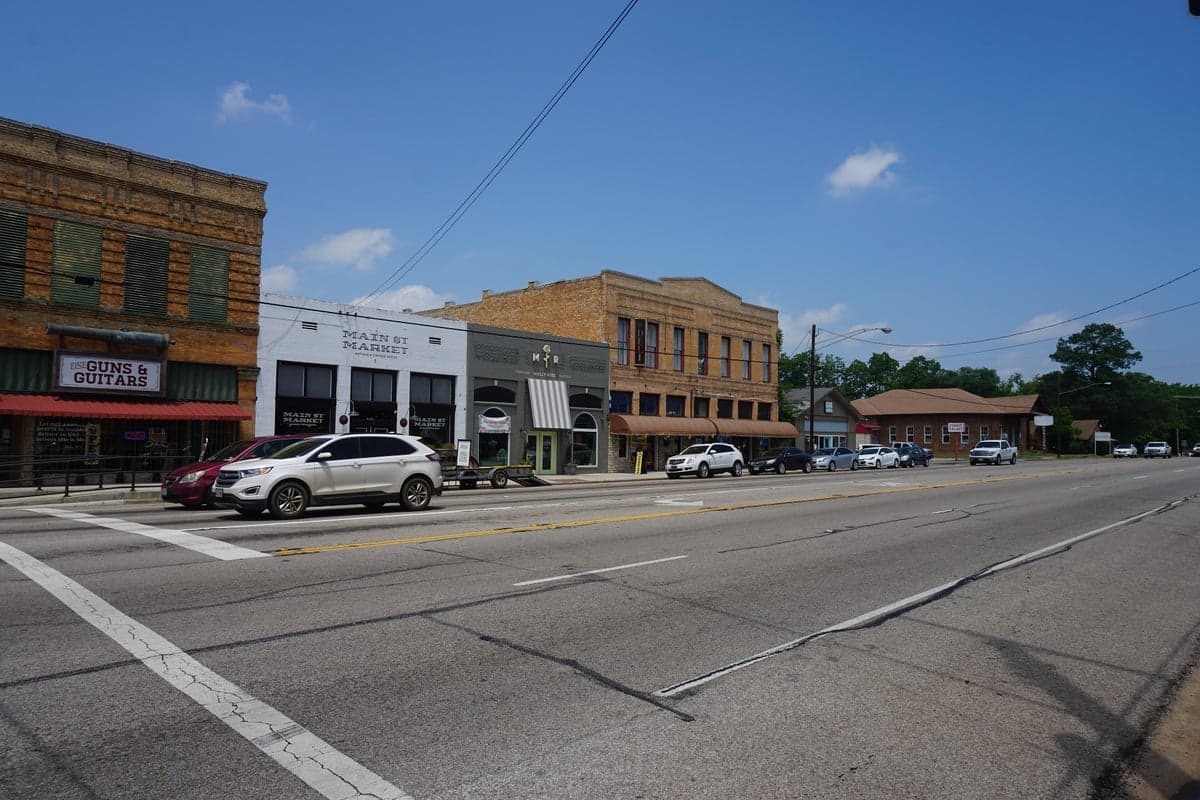
The people of Lindale, Texas, today number 6,389, forming a predominantly white (77.6%) community with a small but notable Black population (9.4%) and a growing Hispanic presence (8.4%). The city’s foreign-born share is just 1.5%, well below the national average, and its college-educated rate of 25.4% reflects a workforce rooted in local trades, agriculture, and commuting to Tyler. Lindale retains a distinct small-town identity—proudly conservative, family-oriented, and increasingly attractive to those seeking a quieter, more affordable alternative to the sprawl of the Dallas-Fort Worth metroplex.
How the city was settled and grew
Lindale’s human history begins with the arrival of the Texas and Pacific Railway in the 1870s, which transformed a sparse farming crossroads into a shipping point for cotton and timber. The original settlers were Anglo-American farmers from the Deep South—primarily from Tennessee, Alabama, and Mississippi—who were drawn by cheap land grants and the promise of cotton profits. These families built the first homes along what is now South Main Street and around the depot area, a neighborhood still referred to locally as Old Town Lindale. A second wave arrived in the early 1900s, when the East Texas oil boom brought speculators and laborers, though Lindale itself remained agricultural. By 1930, the population was nearly entirely white, with a small Black community concentrated in the Dixie Addition area, a historically African American neighborhood east of the railroad tracks. This pattern held through the mid-20th century, with growth slowing as cotton declined and young people left for larger cities.
Modern era (post-1965)
The post-1965 era brought modest demographic change. The Immigration and Nationality Act of 1965 had little immediate effect on Lindale—its foreign-born share remains tiny at 1.5%—but domestic migration reshaped the city. Beginning in the 1980s, white families from the Dallas suburbs began moving to Lindale for cheaper land and lower taxes, settling in new subdivisions like Hidden Creek Estates and Woodland Hills on the city’s north and west sides. The Black population, which had been stable at roughly 8-10% since the 1950s, saw slight growth as some families moved from Tyler into the Dixie Addition and newer developments like Lindale Meadows. The Hispanic share rose from near zero in 1990 to 8.4% today, driven by workers in construction, landscaping, and poultry processing—many settling in rental duplexes along West Hubbard Street and in the Oak Creek mobile home park. The Indian subcontinent population (1.9%) is a very recent arrival, largely professionals employed at Tyler’s hospitals or at the UT Health system, who tend to rent in newer apartment complexes near Highway 69. East/Southeast Asian communities remain absent (0.0%), a notable contrast to larger Texas cities.
The future
Lindale’s population is heading toward modest diversification, but the pace is slow. The white share is declining gradually (from roughly 85% in 2000 to 77.6% today), while the Hispanic share is the fastest-growing segment, projected to reach 12-14% by 2035 if current trends hold. The Black population is plateauing, with little new in-migration from outside the region. The Indian subcontinent population, while small, may grow as Tyler’s medical sector expands, but Lindale lacks the professional job base to attract large numbers. The city is not tribalizing into distinct ethnic enclaves—neighborhoods remain largely integrated by income rather than ethnicity—but Dixie Addition retains its historic Black identity, and West Hubbard Street is emerging as a Hispanic-concentrated corridor. The biggest driver of future growth will be continued white domestic migration from the Dallas-Fort Worth area, drawn by new master-planned subdivisions like Lindale Crossing, which are marketed to families seeking conservative values and good schools. This influx will likely keep the city’s overall character overwhelmingly white and culturally traditional, even as the Hispanic share rises.
For someone moving in now, Lindale is becoming a more economically diverse but culturally homogeneous small city—a place where newcomers from the suburbs will find familiar values, while the historic Black and newer Hispanic communities remain present but politically and socially peripheral. The city’s future is one of slow, steady growth, with demographic change arriving at a pace that reassures rather than unsettles its conservative majority.

* Values derived from national, state, county, city and local statistics and may differ in a specific area. Last updated: 2026-10-10T16:28:02.000Z
Narrative content on this page is AI-generated and may contain mistakes. Verify any details that matter before acting on them.
ReloMaps may earn a commission from affiliate links at no extra cost to you.

