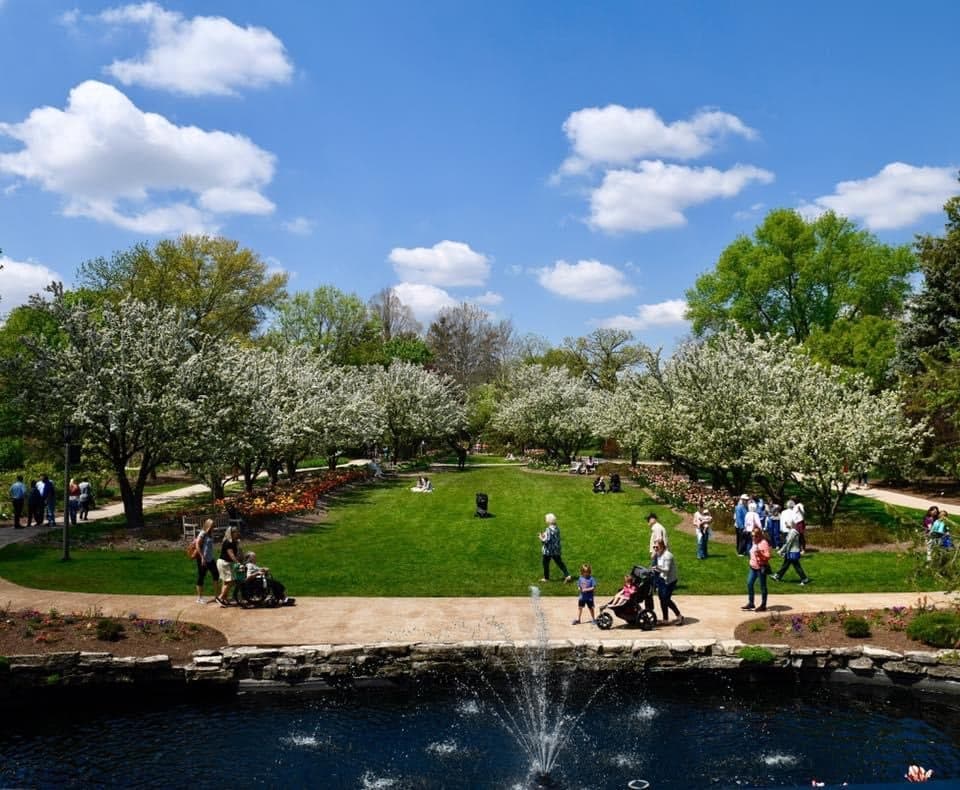
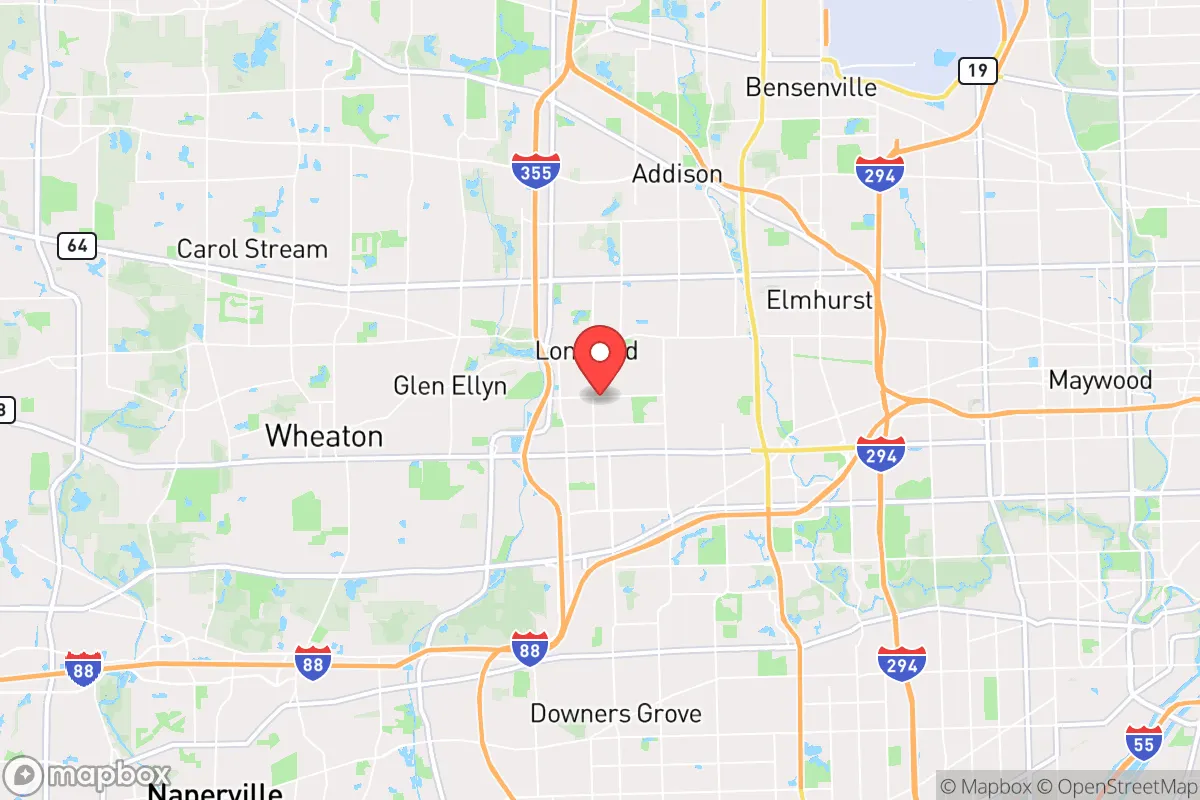
Photo: Wikipedia
Demographics of Lombard, IL
Affluence Level in Lombard, IL
A middle-class area roughly in line with national averages across income, home values, education, and employment.
People of Lombard, IL
Lombard, Illinois, is a densely settled western suburb of Chicago with 43,722 residents who form a predominantly white-collar, family-oriented community. The city is notably diverse for a DuPage County suburb, with a population that is 66.1% white, 13.2% Hispanic, 8.4% Indian (subcontinent), 5.5% Black, and 3.0% East/Southeast Asian, while 49.2% of adults hold a college degree. Its identity is shaped by a blend of historic single-family neighborhoods, a strong park district, and a growing professional class drawn by its position along the Metra Union Pacific West Line and proximity to the I-88 technology corridor.
How the city was settled and grew
Lombard’s original population was built by Yankee and German settlers who arrived in the 1830s and 1840s, drawn by fertile prairie land and the promise of the Galena and Chicago Union Railroad, which reached the area in 1849. The village was platted in 1869 around the railroad depot, and the early economy centered on agriculture—especially wheat and dairy—supplied to Chicago markets. The first major wave of European immigrants came from Germany and Ireland, who built homes in the Old Town district near Main Street and St. Charles Road, where many of the original 19th-century houses still stand. A second wave of Swedish and Italian families arrived between 1890 and 1920, settling in the South Lombard area around Elizabeth Street and the Lilac Park neighborhood, where they worked in local brickyards and the burgeoning nursery industry that gave Lombard its "Lilac Village" nickname. By 1950, Lombard was a largely white, Protestant and Catholic community of roughly 9,000 residents, with a strong small-town character centered on the downtown commercial strip along Main Street.
Modern era (post-1965)
After the Immigration and Nationality Act of 1965, Lombard began a gradual demographic shift that accelerated in the 1990s and 2000s. The most significant change has been the growth of the Indian (subcontinent) population, which now makes up 8.4% of residents—one of the highest shares in DuPage County. This community, largely composed of professionals in information technology, engineering, and healthcare, concentrated in the Westmoreland and North Terrace neighborhoods near the I-88 and I-355 interchange, drawn by the nearby East-West Tollway corridor and corporate employers like Fermi National Accelerator Laboratory in Batavia and the office parks in Lisle and Naperville. The Hispanic population, now 13.2%, grew steadily from the 1980s onward, with families settling in the Southwest Lombard area around Roosevelt Road and in the Highland Hills subdivision, working in construction, landscaping, and service industries. The Black population, at 5.5%, is concentrated in the Eastgate neighborhood near the Glen Ellyn border, reflecting broader suburban migration from Chicago’s West Side. The East/Southeast Asian community (3.0%) includes families of Chinese, Korean, and Filipino heritage, many of whom live in the Yorktown Center area and the newer townhome developments along Butterfield Road. The white population, while still the majority, has aged and declined from over 90% in 1980 to 66.1% today, as younger white families have moved to farther exurbs and older residents have aged in place.
The future
Lombard’s population is likely to continue diversifying, but at a slower pace than in the 1990s and 2000s. The Indian (subcontinent) community is the fastest-growing segment, driven by chain migration and the expansion of the technology sector along the I-88 corridor, and is expected to approach 12-15% of the population by 2040. The Hispanic share is stabilizing, as second-generation families assimilate and move to more affordable suburbs in Kane and Kendall counties. The white population will continue its gradual decline, but Lombard is not experiencing rapid racial turnover—rather, it is becoming a stable, multi-ethnic middle-class suburb. The city is not tribalizing into isolated enclaves; instead, neighborhoods like Westmoreland and North Terrace are becoming more mixed as Indian families move into previously white-dominated blocks. The main risk is housing affordability: with a median home value above $350,000, younger families of all backgrounds may be priced out, potentially slowing in-migration and leading to a slightly older, more affluent population over the next decade.
For a conservative-leaning individual or family considering a move, Lombard offers a stable, family-oriented environment with strong schools, low crime, and a growing professional class that values property rights and local governance. The city is becoming more diverse but remains predominantly white-collar and politically moderate, with a Republican-leaning DuPage County board and a local government focused on infrastructure and fiscal restraint. The bottom line: Lombard is a mature, well-established suburb where demographic change is gradual and orderly, not disruptive—a place where new residents can expect a safe, well-maintained community with a clear sense of its own history.

* Values derived from national, state, county, city and local statistics and may differ in a specific area. Last updated: 2026-04-30T01:22:31.000Z
Narrative content on this page is AI-generated and may contain mistakes. Verify any details that matter before acting on them.
ReloMaps may earn a commission from affiliate links at no extra cost to you.

