Photo: Wikipedia
Demographics of Long Beach, NY
Affluence Level in Long Beach, NY
An upper-middle-class area. Household wealth, education levels, and homeownership run ahead of national benchmarks.
People of Long Beach, NY
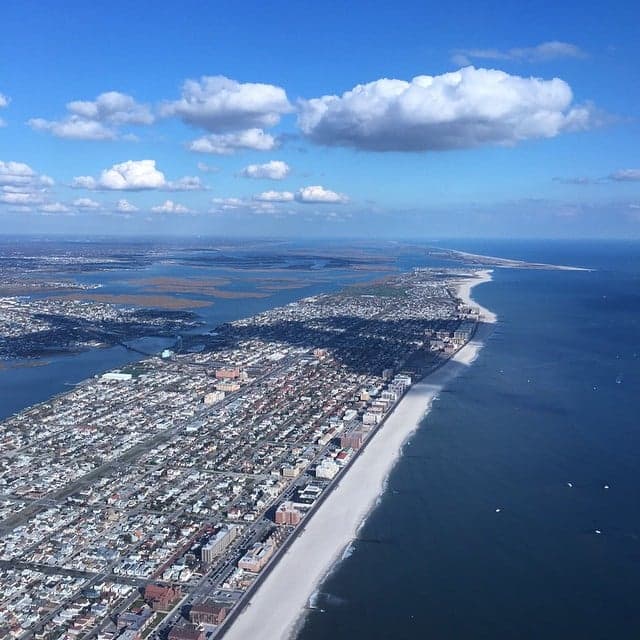
The people of Long Beach, New York, form a densely settled, majority-white city of 34,741 residents with a distinctly suburban-meets-beach-town character, where 51.7% hold college degrees and the foreign-born share sits at a modest 4.7%. The city is notably less diverse than neighboring Nassau County communities, with a 72.3% white population, a 14.3% Hispanic presence, and smaller East/Southeast Asian (4.4%) and Black (4.3%) communities. Its identity is shaped by a history of Jewish and Irish settlement, a mid-century resort boom, and a more recent wave of young professionals and families drawn to the barrier island lifestyle. For a conservative-leaning audience, Long Beach offers a stable, educated, and relatively homogeneous population base with clear neighborhood enclaves reflecting its layered past.
How the city was settled and grew
Long Beach was not a colonial settlement; its development began in earnest after 1880 when the Long Beach Land Company, led by Austin Corbin, purchased the barrier island and built a railroad connecting it to New York City. The original population was overwhelmingly white and Protestant, drawn by the promise of a seaside resort—the Long Beach Hotel opened in 1881, and the city incorporated in 1922. The first major demographic wave came in the early 20th century, when Jewish families from Brooklyn and the Lower East Side began buying summer bungalows and later year-round homes, particularly in the West End neighborhoods west of Long Beach Boulevard. By the 1930s, the city had a substantial Jewish population, and synagogues like Temple Emanu-El (founded 1923) anchored the community. A second wave of Irish Catholic families arrived during the same period, settling in the East End around Edwards Boulevard and the Canals area, where they worked in construction, city services, and the growing hospitality industry. The city’s population peaked at roughly 36,000 in the 1960s, with a character defined by tight-knit ethnic blocks, summer tourism, and a strong sense of local identity.
Modern era (post-1965)
After the 1965 Hart-Cellar Act, Long Beach saw modest diversification, but not the dramatic shifts seen in nearby Hempstead or Freeport. The Hispanic population grew from negligible to 14.3% by 2024, concentrated in the West End and along the Park Avenue corridor, where Puerto Rican and Dominican families arrived in the 1970s and 1980s, often working in service jobs tied to the beach and boardwalk. The East/Southeast Asian community (4.4%) is smaller and more dispersed, with a visible cluster of Chinese-American families in the East End near the Long Beach High School zone. The Black population (4.3%) has remained stable since the 1990s, with many families living in the West End and the North Park area near the Long Beach Bridge. The Indian subcontinent population (0.4%) is negligible, with no distinct enclave. A notable domestic in-migration wave began after Hurricane Sandy (2012), when young professionals and families from Brooklyn and Manhattan bought renovated homes in the West End and East End, drawn by lower prices relative to the city and the beach lifestyle. This influx has raised home values and shifted the city’s median age downward, but has not fundamentally altered its racial composition—the white share remains above 70%.
The future
The population of Long Beach is likely to remain stable or grow slowly, with the city’s built-out barrier island geography limiting new construction. The Hispanic share is expected to continue rising gradually, possibly reaching 18-20% by 2040, as younger families in the West End age in place and new arrivals from Central America settle in the Park Avenue area. The East/Southeast Asian community may grow modestly as Asian-American professionals from Queens and Brooklyn seek larger homes near the water, but the high cost of entry—median home prices exceed $700,000—will limit this trend. The white population will likely remain the majority, though its share may edge down to 68-70% as the city becomes slightly more diverse. The city is not tribalizing into hostile enclaves; rather, it is experiencing a gentle, market-driven diversification where neighborhoods like the West End become more mixed while the East End and Canals remain predominantly white and Jewish. The biggest demographic wildcard is the continued influx of ex-New York City families, who tend to be younger, more liberal, and more likely to have children, potentially shifting the city’s political leanings over time.
For someone moving to Long Beach now, the city offers a stable, educated, and predominantly white population with a strong sense of place, anchored by its beach, boardwalk, and historic neighborhoods. The Hispanic and Asian communities are present but small, and the city remains less diverse than the county average. The future points toward slow, incremental diversification driven by market forces rather than large-scale migration, making Long Beach a good fit for those seeking a predictable, family-oriented community with a distinct coastal identity.

* Values derived from national, state, county, city and local statistics and may differ in a specific area. Last updated: 2026-05-01T06:12:36.000Z
Narrative content on this page is AI-generated and may contain mistakes. Verify any details that matter before acting on them.
ReloMaps may earn a commission from affiliate links at no extra cost to you.

