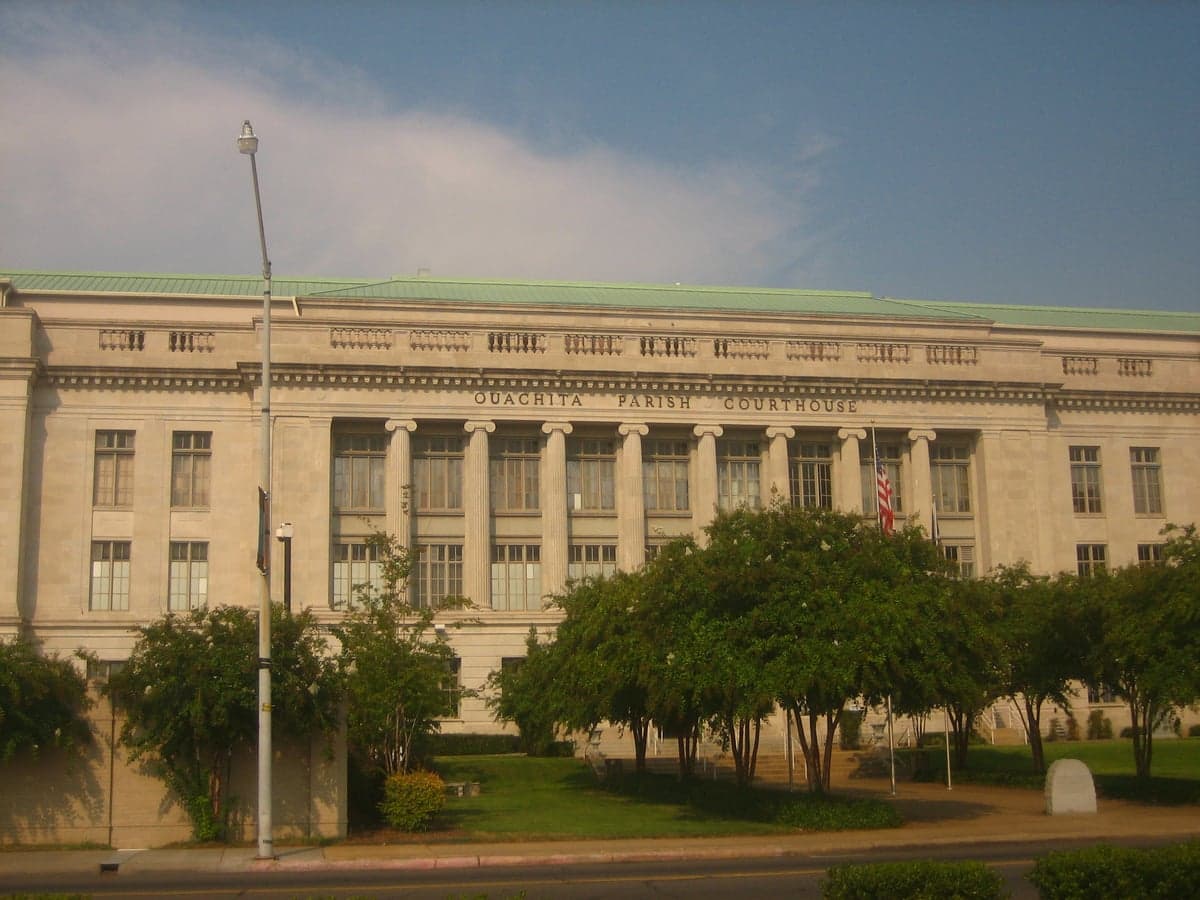
Photo: Wikipedia
Demographics of Ouachita County
Affluence Level in Ouachita County
A below-average socioeconomic profile. Incomes, home values, and educational attainment trail the U.S., with higher poverty and unemployment.
People of Ouachita County
The people of Ouachita Parish, Louisiana, are a predominantly native-born population shaped by a deep Southern heritage, with a demographic profile that is roughly 55.6% White and 37.0% Black, and a very small foreign-born share of just 1.2%. The parish’s identity is anchored in the city of Monroe, the region’s economic and cultural hub, alongside smaller communities like West Monroe, Sterlington, and Claiborne. With a population of 158,916, Ouachita Parish is characterized by a strong sense of local tradition, a significant Christian religious presence, and a relatively low college attainment rate of 27.5%, reflecting a workforce historically tied to manufacturing, healthcare, and education. The population is overwhelmingly American-born, with minimal recent international immigration, making it a culturally stable and insular community compared to fast-growing Sun Belt metros.
Settlement & growth (pre-1960)
Before American settlement, the area now known as Ouachita Parish was inhabited by the Caddo and Ouachita Native American tribes, who lived along the Ouachita River for centuries. French explorers and traders arrived in the late 1600s, followed by Spanish colonial rule after 1763, but permanent European settlement was sparse until the early 1800s. The United States acquired the territory through the Louisiana Purchase in 1803, and Ouachita Parish was officially established in 1807, named after the Ouachita River.
The first major wave of American settlers were Anglo-American pioneers, primarily of Scots-Irish and English descent, who moved into the region from the Upper South (Kentucky, Tennessee, and the Carolinas) between 1800 and 1840. They were drawn by fertile bottomlands along the Ouachita River and the promise of cotton cultivation. These early settlers established the first permanent communities, including the parish seat of Monroe (founded 1819) and the nearby settlement of Trenton (later absorbed into Monroe). The plantation economy, reliant on enslaved African labor, quickly took root, and by 1860, enslaved people made up a majority of the parish’s population. After the Civil War and emancipation, many freedmen remained in the area, forming the foundation of the Black communities that still exist today in neighborhoods like Monroe’s Southside and the rural areas around Claiborne and Swampers.
The late 19th and early 20th centuries brought a second wave: a modest influx of European immigrants, primarily German and Italian, who arrived between 1880 and 1910 to work in the region’s growing timber and railroad industries. These immigrants settled in small numbers in Monroe and the mill town of West Monroe, but they never formed large ethnic enclaves. The vast majority of the parish’s population remained native-born White and Black. The discovery of natural gas in the Monroe Gas Field in 1916 spurred an economic boom, drawing workers from across the South, but this was internal migration rather than international immigration. By 1960, Ouachita Parish was a biracial Southern society, with a population of roughly 65% White and 35% Black, concentrated in Monroe, West Monroe, and the smaller towns of Sterlington and Calhoun.
Modern era (post-1965)
The 1965 Hart-Cellar Act, which dramatically increased immigration from Asia, Latin America, and Africa, had a negligible effect on Ouachita Parish. Unlike major metropolitan areas, the parish did not attract significant numbers of new immigrants. The foreign-born population today stands at just 1.2%, far below the national average of roughly 14%. The small Hispanic population (3.6%) is largely composed of Mexican-American families who moved from Texas or other Southern states for work in construction, poultry processing, and agriculture, settling primarily in Monroe and West Monroe. The East/Southeast Asian community (0.6%) is tiny, with a few families of Vietnamese and Filipino descent, many connected to the University of Louisiana at Monroe or local healthcare. The Indian-subcontinent population (0.5%) is similarly small, mostly professionals in medicine and academia.
The most significant demographic shift since 1965 has been domestic: the gradual suburbanization of the White population from Monroe’s urban core to newer subdivisions in West Monroe, Sterlington, and the rural areas around Claiborne and Calhoun. This pattern, common across the South, has left Monroe’s inner city predominantly Black, while the surrounding suburbs and unincorporated areas are overwhelmingly White. The parish has also experienced a slow but steady out-migration of young adults seeking opportunities in larger metros like Baton Rouge, Dallas, and Houston, contributing to a relatively stagnant population growth rate. The Black population share has remained stable at around 37%, with little change from the 1960s, as both White and Black residents have left at similar rates.
The future
Ouachita Parish is likely to remain a demographically stable, predominantly native-born community over the next 10-20 years. The foreign-born population is not expected to grow significantly, as the parish lacks the large employers, ethnic networks, or immigration-friendly industries that drive international migration to other parts of Louisiana, such as New Orleans or Lafayette. The Hispanic population may increase modestly, driven by natural growth and some migration from Texas, but it will remain a small minority. The East/Southeast Asian and Indian communities will likely stay small and professional, concentrated in Monroe’s medical and academic sectors.
The most notable trend is the continued suburbanization of the White population, with new housing developments spreading into areas like Sterlington and Calhoun, while Monroe’s urban core faces population decline and aging infrastructure. The parish is not tribalizing into distinct ethnic enclaves in the way that larger metros are; instead, it is slowly homogenizing into a more uniformly suburban, car-dependent landscape. The cultural identity of the parish—rooted in Southern Protestant Christianity, a strong sense of local history, and a conservative political orientation—is likely to persist, as in-migration is overwhelmingly from other parts of the South and is absorbed into the existing culture rather than transforming it.
For someone moving to Ouachita Parish today, the area offers a stable, low-cost, and culturally cohesive environment with minimal ethnic or linguistic diversity. The population is overwhelmingly American-born, English-speaking, and rooted in the region’s history. New residents will find a community where the pace of change is slow, and where the demographic patterns of the 20th century continue to shape daily life in Monroe, West Monroe, and the surrounding towns.

* Values derived from national, state, county, city and local statistics and may differ in a specific area. Last updated: 2026-05-28T04:05:08.000Z
Narrative content on this page is AI-generated and may contain mistakes. Verify any details that matter before acting on them.
ReloMaps may earn a commission from affiliate links at no extra cost to you.

