
Photo: Wikipedia
Personal Sovereignty in Ouachita County
Strong independent fundamentals that actively favor personal liberty and low regulation.
What does Personal Sovereignty tell us?
Personal Sovereignty measures your capacity for self-reliance and independence with minimal government friction. Higher scores mean fewer barriers between you and the way you want to live... but it assumes you have the space you need and good neighbors.
What does this tell us?
Personal Sovereignty measures your capacity for self-reliance and independence with minimal government friction. Higher scores mean fewer barriers between you and the way you want to live... but it assumes you have the space you need and good neighbors.
State Policy
Energy independence: Net exporter (280% of energy produced in-state)
Personal Liberty
Homesteading

Personal Liberty Analysis
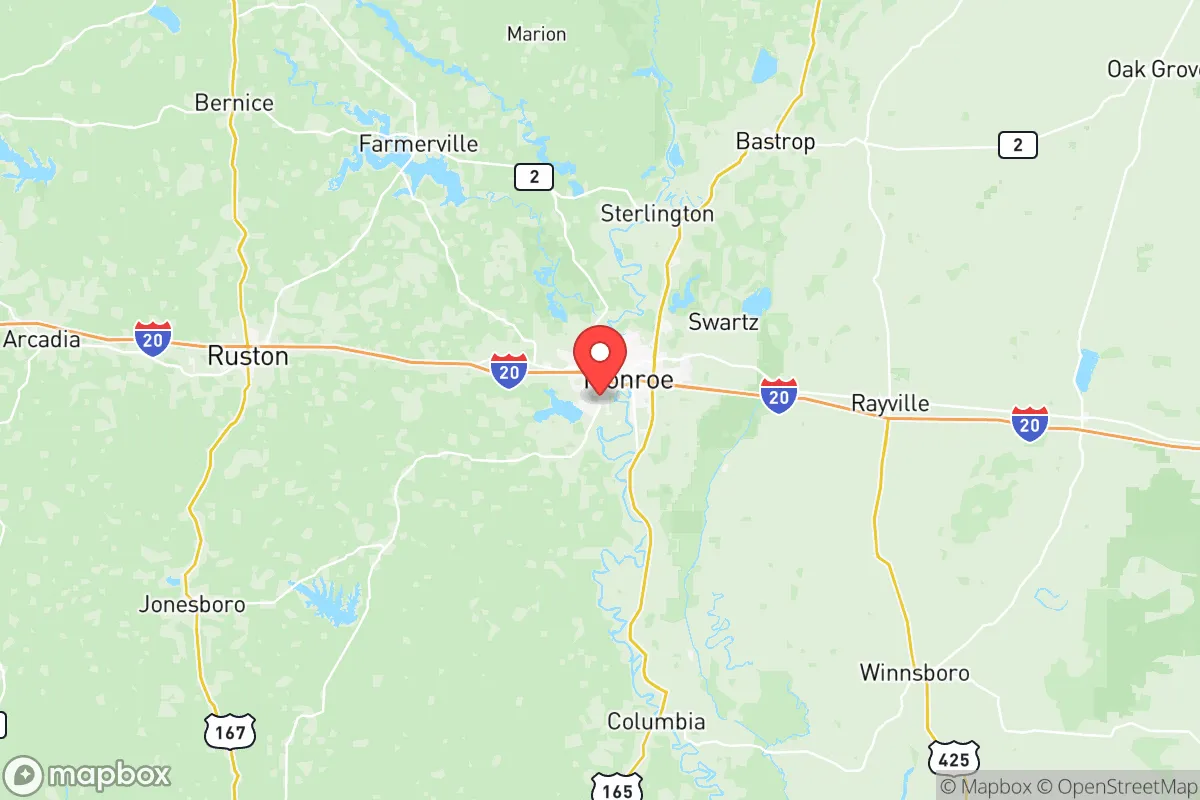
Ouachita County, Louisiana, offers a notably high degree of personal sovereignty compared to many coastal and urban jurisdictions, largely due to the state’s strong constitutional protections for individual rights and a deeply ingrained culture of self-reliance. For those concerned with government overreach, the area provides a legal and social environment where personal autonomy is the default, not the exception. The county’s mix of small cities like Monroe, West Monroe, and rural communities such as Sterlington, Swartz, and Calhoun creates a landscape where residents can exercise significant control over their lives, from how they defend their families to how they use their land. This analysis examines the specific factors that make Ouachita County a strategic relocation option for conservative individuals and parents prioritizing personal sovereignty.
Tax burden and regulatory posture in Ouachita County
Louisiana’s tax structure and regulatory approach in Ouachita County are generally favorable to personal autonomy, though not as extreme as some Western states. The state has no property tax on vehicles or business inventory, and the homestead exemption shields the first $75,000 of a home’s value from parish property taxes. In Ouachita Parish, the combined state and local sales tax rate is around 9.45%, which is moderate for the South but higher than in rural parishes like Union or Morehouse. However, the regulatory posture is notably light: there are no county-level building codes in unincorporated areas, meaning residents in communities like Calhoun or Swartz can build sheds, workshops, or even primary residences without government permits for most structures under 200 square feet. The state’s right-to-work laws and lack of state-level income tax on most retirement income further reduce government intrusion into personal finances. For preppers, this means less bureaucratic friction when establishing self-sufficient properties, though Monroe and West Monroe have stricter zoning for commercial activities within city limits.
Self-defense and gun law specifics in Ouachita Parish
Louisiana is a constitutional carry state, meaning no permit is required to carry a concealed firearm for anyone 21 or older who can legally possess a gun. Ouachita Parish fully embraces this, with sheriff’s deputies in Monroe and rural areas generally supportive of gun rights. The state’s “Stand Your Ground” law eliminates any duty to retreat before using deadly force in self-defense, and the “Castle Doctrine” extends this protection to vehicles and workplaces. For parents, this means the legal framework strongly favors individual judgment in defensive situations. The parish has no local gun ordinances that exceed state law, so restrictions are minimal. Gun ranges and firearms dealers are abundant in West Monroe and along Highway 165 near Sterlington. The only practical limitation is that carrying in churches or schools requires permission from the governing body, but this is rarely enforced against lawful carriers. For those concerned with government overreach, the absence of red-flag laws or waiting periods in Louisiana provides a significant buffer against federal or state interference.
Self-reliance and homesteading viability across Ouachita County
Homesteading and off-grid living are highly viable in Ouachita County, particularly outside the Monroe city limits. In unincorporated areas like Calhoun, Swartz, and rural parts of Sterlington, lot sizes commonly range from 1 to 20 acres, with many parcels available for under $5,000 per acre. Zoning is virtually nonexistent in these areas, allowing residents to keep livestock, build rainwater catchment systems, install solar panels, and construct outbuildings without permits. The county’s soil is fertile for gardening, and the long growing season (March to November) supports year-round food production. Off-grid feasibility is strong: well water is accessible at depths of 100-200 feet, and septic systems are permitted with a simple parish health department inspection. However, Monroe and West Monroe have stricter regulations—Monroe requires building permits for any structure over 120 square feet and has noise ordinances that could restrict generators or livestock. For preppers, the rural areas offer a genuine ability to live independently, with the caveat that the parish does enforce property maintenance codes on abandoned lots, so active stewardship is expected.
Personal liberties in Ouachita County: parental rights, medical autonomy, speech, and property
Ouachita County’s legal and cultural environment strongly supports parental rights, medical autonomy, free speech, and property rights. Louisiana law explicitly affirms parents’ “fundamental right to direct the upbringing, education, and care of their children,” including the right to opt out of public school curricula or vaccines. The parish has a robust homeschooling community, with groups in West Monroe and Sterlington offering co-ops and support. Medical autonomy is protected by state laws that allow direct primary care agreements and limit vaccine mandates for private businesses. Free speech is broadly protected, with no local hate speech ordinances or permit requirements for public gatherings outside Monroe’s downtown district. Property rights are reinforced by Louisiana’s “private property rights protection act,” which requires compensation for any regulatory taking. The only notable limitation is that the parish has a noise ordinance that could be used against political protests after 10 p.m., but this is rarely enforced. For those wary of federal overreach, Ouachita County’s culture of “live and let live” provides a buffer against progressive policy experiments seen in other regions.
Overall, Ouachita County ranks among the more sovereignty-friendly areas in the South, offering a balance of low taxes, strong gun rights, and practical homesteading opportunities that exceed most suburban or urban alternatives. While not as extreme as rural Idaho or Montana in terms of off-grid freedom, the county’s proximity to Monroe’s healthcare and supply infrastructure makes it a strategic choice for those who want self-reliance without total isolation. For conservative individuals and parents concerned with government overreach, the combination of constitutional carry, minimal zoning in rural areas, and strong parental rights creates an environment where personal autonomy is the norm. The key is choosing the right location within the county—Sterlington and Calhoun offer the most freedom, while Monroe and West Monroe require more compliance with city codes. For those prioritizing sovereignty, Ouachita County is a solid, practical option in a region that still respects individual choice.

* Values derived from national, state, county, city and local statistics and may differ in a specific area. Last updated: 2026-05-28T04:05:08.000Z
Narrative content on this page is AI-generated and may contain mistakes. Verify any details that matter before acting on them.
ReloMaps may earn a commission from affiliate links at no extra cost to you.

