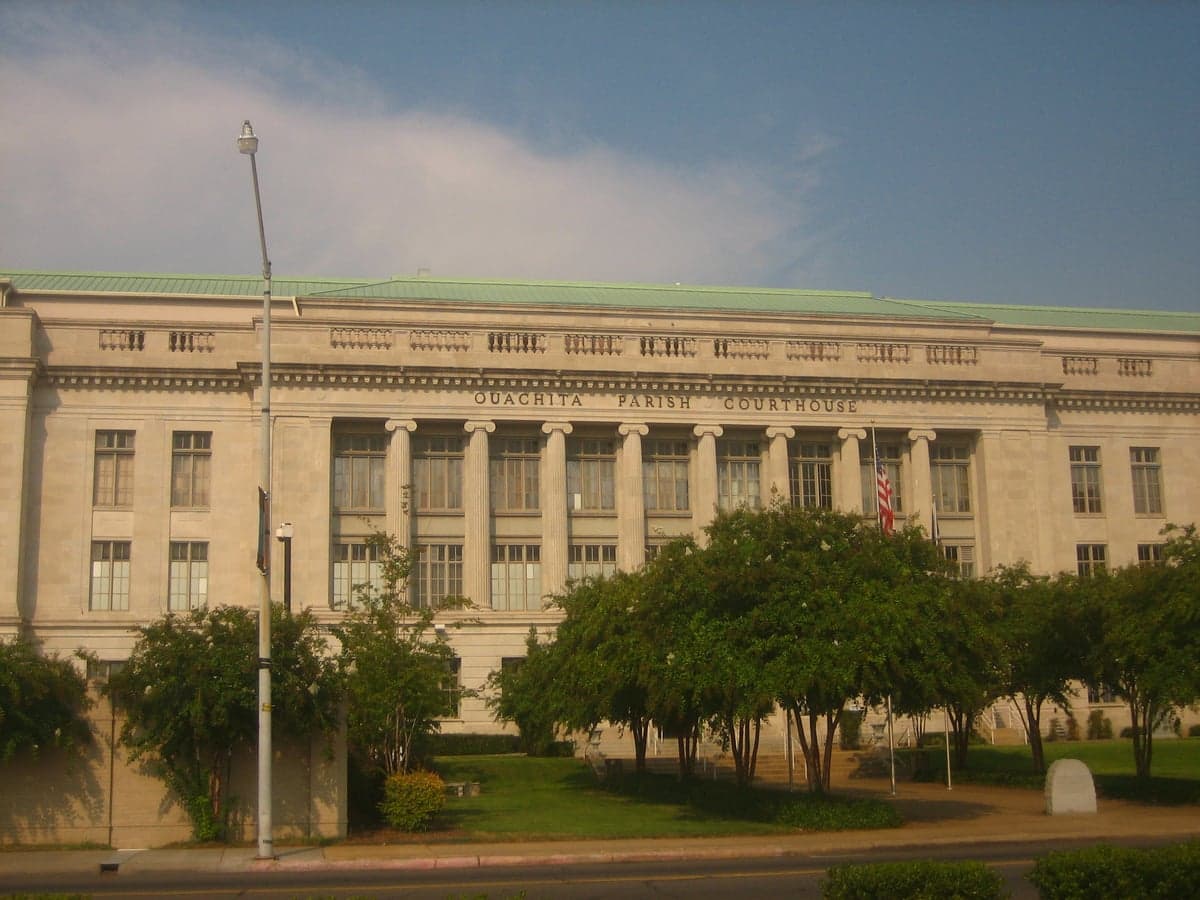
Photo: Wikipedia
Political ClimatePolitical Climate in Ouachita County
Showing district-level results — no local-only data available.
Local Political AnalysisPolitical Analysis of Ouachita County
Ouachita County is about as solidly red as they come in Louisiana, with a Cook PVI of R+18 that puts it well to the right of the state as a whole, which sits at R+10. That’s not just a number on a map—it’s a reflection of how folks around here have voted consistently for decades, and the trend isn’t really shifting. If anything, the rural parts of the county are getting redder, while the city of Monroe and a few of the smaller towns are where you’ll see the only real pockets of blue, and even those are shrinking.
How it compares
When you stack Ouachita County up against Louisiana as a whole, the difference is stark. The state’s R+10 PVI already leans conservative, but Ouachita is eight points further right, meaning it’s one of the most reliably Republican parishes in the state. In the 2024 presidential race, the county went for the GOP candidate by a margin closer to 30 points, while the state overall was closer to 15. The real split inside the county is between the city of Monroe and the surrounding towns like West Monroe, Sterlington, and Claiborne. Monroe itself has a few precincts that lean blue—especially around the University of Louisiana at Monroe campus and some of the older neighborhoods near downtown—but those are small and getting smaller. West Monroe, on the other hand, is deeply conservative, and places like Sterlington and Claiborne are even more so, with precincts that routinely vote 80% or more Republican. The swing precincts, if you can call them that, are in the unincorporated areas just outside Monroe, where you’ll see a mix of working-class families and retirees who still vote red but might split a ticket on local races. Compared to the state, Ouachita County is a fortress of traditional values, and that’s not changing anytime soon.
What this means for residents
For the people living here, the political climate means a government that mostly stays out of your business. You don’t see the kind of overreach you hear about in places like New Orleans or Baton Rouge—no heavy-handed mandates, no pushing of progressive agendas in schools or local ordinances. The county commission and city councils in towns like West Monroe and Sterlington are full of folks who believe in limited government, low taxes, and personal responsibility. That said, there’s a growing concern among long-time residents about the direction of the state as a whole. Louisiana’s R+10 PVI is still conservative, but the influence of bigger cities is creeping in, and you can feel it in things like state-level education policies and property tax debates. Locals here are watching closely, because they don’t want Ouachita County to end up like some of the more liberal parishes where government overreach has become the norm. The cultural vibe is still very much “live and let live,” but with a strong emphasis on traditional values—church, family, and community. If you’re looking for a place where your rights aren’t constantly under threat from progressive policies, this is it.
One thing that sets Ouachita County apart from the rest of Louisiana is the way local politics stays grounded. You won’t find the same level of corruption or backroom dealing that plagues some other parts of the state—it’s more about common-sense leadership and keeping things simple. The biggest cultural distinction is the strong sense of community in towns like Sterlington and Claiborne, where everyone knows each other and the local government is accessible. That’s a rare thing these days, and it’s worth holding onto. The trajectory here is stable, but folks are wary of any outside influence that might try to change the way things work. If the state keeps moving left, Ouachita County will likely dig in even harder, and that’s a good thing for anyone who values their freedoms.

State Political ClimatePolitical Climate in Louisiana
State Political AnalysisPolitical Environment in the State
Louisiana is a solidly Republican state with a Cook PVI of R+10, but don’t let that number fool you into thinking it’s a monolith. The state’s political lean is driven by a coalition of culturally conservative Cajun and Protestant voters in the rural parishes and smaller metros, combined with a growing suburban exodus from New Orleans and Baton Rouge. Over the last 20 years, the state has shifted rightward by about 5 points, but it’s a messy, factional kind of conservatism—more about local autonomy and suspicion of federal overreach than a unified party machine. The Democratic stronghold is shrinking to just New Orleans proper and a few majority-minority precincts in Baton Rouge and Shreveport, while the rest of the state has hardened into deep red territory.
Urban vs. rural divide
The political map of Louisiana is a textbook study in urban-rural polarization. New Orleans (Orleans Parish) is the lone blue bastion, voting about 80% Democratic in recent presidential cycles, driven by its Black plurality, progressive transplants, and tourism economy. Baton Rouge (East Baton Rouge Parish) is a purple battleground—the city itself leans Democratic, but the surrounding suburbs like Central, Zachary, and Denham Springs are reliably red. Lafayette and the Acadiana region are culturally conservative but with a libertarian streak; voters there will back Republicans but also support local control over everything from oil drilling to school boards. Shreveport (Caddo Parish) is another fading blue pocket, with its Democratic edge eroding as white voters flee to Bossier City and the rural parishes. The real engine of the state’s red lean is the “Florida Parishes” (the strip north of Lake Pontchartrain, including Livingston, Tangipahoa, and St. Tammany), which vote 70-75% Republican and have been growing fast as people leave New Orleans. Rural parishes like Vernon, Beauregard, and Allen routinely hit 80%+ GOP margins. The divide isn’t just partisan—it’s cultural. Urban voters prioritize government services and social programs; rural and suburban voters prioritize low taxes, gun rights, and keeping the state out of their lives.
Policy environment
Louisiana’s policy environment is a mixed bag for a conservative. On the plus side, the state has no personal property tax, a relatively low corporate tax rate (recently cut to 3.5%), and a homestead exemption that shields the first $75,000 of home value from parish property taxes. The regulatory posture is generally business-friendly, especially for oil and gas, timber, and agriculture—permitting is fast, and environmental reviews are minimal compared to coastal states. On the downside, the state sales tax is high (state rate 4.45%, but with local add-ons it can hit 11% in places like New Orleans), and the income tax brackets are still progressive (top rate 4.25%). Education policy is a bright spot: Louisiana has a robust school choice program (the Louisiana Scholarship Program and Course Choice), and charter schools are widespread in New Orleans and Baton Rouge. Healthcare is a sore point—the state expanded Medicaid under the Affordable Care Act in 2016, which many conservatives see as a federal overreach, and the system remains underfunded. Election laws are solid: voter ID is required, early voting is available (7 days), and there’s no widespread mail-in ballot abuse. The state has a Republican trifecta (governor, house, senate) as of 2024, but the governor, Jeff Landry, is a pugilistic conservative who has pushed through tort reform and a near-total abortion ban (trigger law from 2006, activated in 2022).
Trajectory & freedom
Louisiana is becoming more free in several key areas, but the trajectory is uneven. The biggest win for personal liberty was the 2024 passage of a constitutional carry law (Act 123), allowing concealed carry without a permit—a major step for gun rights that had been blocked by previous Democratic governors. Parental rights got a boost with the 2023 “Parents’ Bill of Rights” (Act 426), which requires schools to notify parents about curriculum changes and medical services. Medical autonomy is a mixed bag: the state banned gender transition procedures for minors in 2023 (Act 466), which conservatives cheered, but the Medicaid expansion and vaccine mandates during COVID (the state had one of the highest vaccination rates in the South) show a lingering willingness to use state power for public health. Property rights are strong—Louisiana is a “code state” (Napoleonic law), which means property boundaries are clear and easements are tightly regulated, but eminent domain battles still flare up around pipeline projects. Taxation freedom is improving: the income tax was cut from 6% to 4.25% over the last decade, and there’s talk of moving to a flat tax. The biggest threat to freedom is the state’s addiction to sales taxes and fees, which hit the poor and middle class hardest. Overall, the trend is toward more individual liberty, but the state’s legacy of big government (especially in infrastructure and education spending) remains a drag.
Civil unrest & political movements
Louisiana has a history of political flashpoints, but they’re more localized than national. The most visible recent unrest was the 2020 George Floyd protests in New Orleans and Baton Rouge, which saw property damage and clashes with police, but those were contained to the urban cores. The state has a strong Second Amendment movement—the Louisiana Shooting Association and local gun clubs are active, and the constitutional carry fight was a multi-year grassroots effort. Immigration politics are less heated here than in border states, but there’s a growing tension in rural parishes like Acadia and Vermilion, where meatpacking plants have drawn migrant workers. The state has no sanctuary cities; in fact, the legislature passed a law in 2024 (Act 478) requiring local law enforcement to cooperate with ICE. Election integrity is a live issue: the 2020 election saw no major fraud in Louisiana, but the legislature tightened absentee ballot rules in 2021 (Act 185) and banned ballot drop boxes. Secession rhetoric is minimal—Louisiana is too dependent on federal disaster aid (hurricanes) to seriously flirt with nullification. The most visible political movement is the “Cajun Navy,” a volunteer rescue group that has become a symbol of local self-reliance and distrust of FEMA. A new resident would notice the strong culture of localism: people here trust their neighbors and their parish government more than Baton Rouge or Washington.
Projection
Over the next 5-10 years, Louisiana will likely become more Republican and more conservative, but with a populist, anti-establishment flavor. The demographic trends are clear: New Orleans is losing population (down about 5% since 2020), while the Florida Parishes and the I-10 corridor from Baton Rouge to Lafayette are growing. In-migration is coming from other red states (Texas, Mississippi, Alabama) and from California and New York retirees looking for low taxes and warm weather. These newcomers tend to be culturally conservative but fiscally pragmatic—they want low taxes and good schools, not culture war battles. The biggest wild card is climate: if hurricanes become more frequent and severe, the state could see a coastal exodus that reshapes the political map, with the lost population being replaced by inland growth. The Republican Party will likely fracture between the Chamber of Commerce wing (pro-business, pro-infrastructure) and the populist wing (anti-tax, anti-regulation, pro-gun). The Democratic Party will shrink to a rump of New Orleans and a few Black-majority parishes, with little statewide influence. A new resident moving in now should expect to find a state that is freer on guns and parental rights, but still grappling with high sales taxes, underfunded infrastructure, and a culture that values personal relationships over government solutions.
For a conservative individual or family, Louisiana offers a genuine bargain: low housing costs, strong gun rights, school choice, and a culture that respects tradition and local control. The trade-offs are real—high sales taxes, a weak healthcare system, and the constant threat of hurricanes and flooding. But if you value personal liberty over government services, and you’re willing to put down roots in a place where your neighbors will help you rebuild after a storm, Louisiana is one of the few states where the trajectory is still pointing toward more freedom, not less. Just don’t expect it to be easy—the state’s politics are as messy and unpredictable as its weather.
* Values derived from national, state, county, city and local statistics and may differ in a specific area. Last updated: 2026-05-28T04:05:08.000Z
Narrative content on this page is AI-generated and may contain mistakes. Verify any details that matter before acting on them.
ReloMaps may earn a commission from affiliate links at no extra cost to you.

