Photo: Wikipedia
Demographics of Rapides County
Affluence Level in Rapides County
A below-average socioeconomic profile. Incomes, home values, and educational attainment trail the U.S., with higher poverty and unemployment.
People of Rapides County
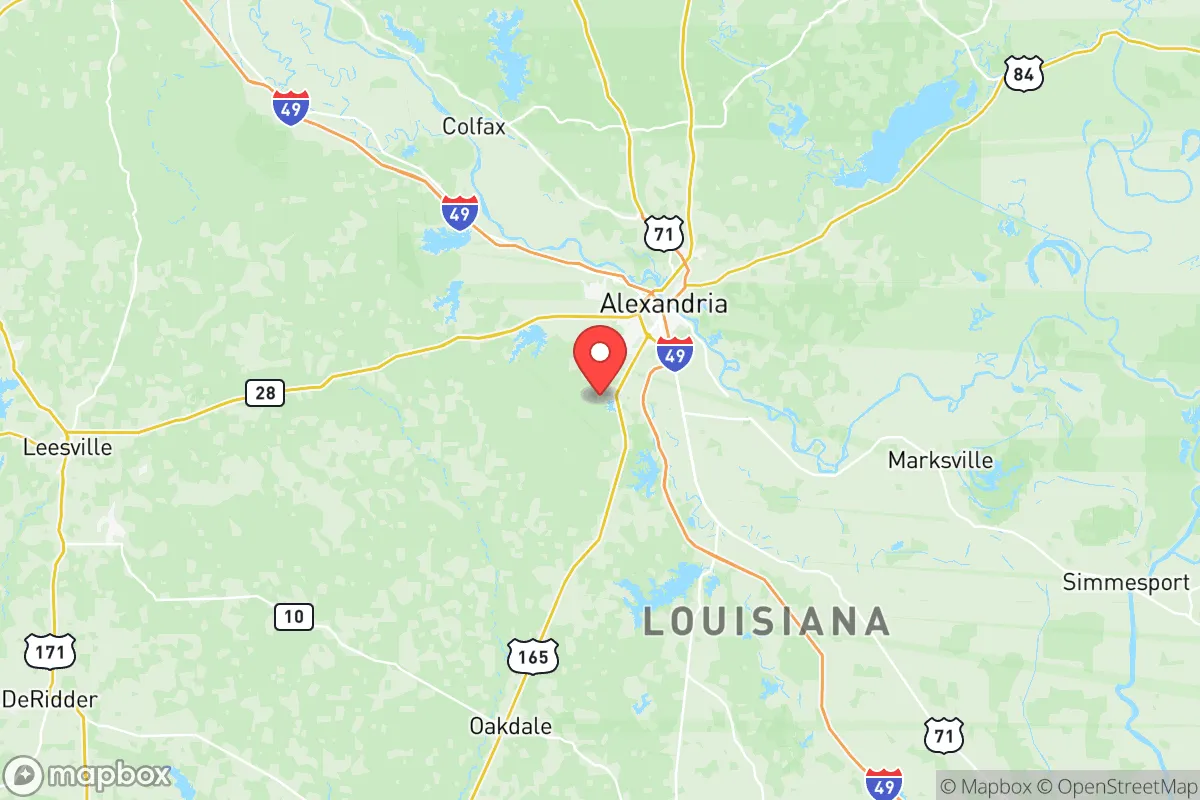
The people of Rapides County, Louisiana, today number 128,470, forming a population that is 59.7% White, 31.0% Black, 4.0% Hispanic, and less than 2% Asian or Indian, with a foreign-born share of just 1.8% — one of the lowest in the nation. This is a deeply rooted, predominantly native-born population concentrated in the urban core of Alexandria and its surrounding towns like Pineville, Ball, and Boyce. The county’s identity is shaped by its history as a crossroads of the Red River, a Civil War logistics hub, and a 20th-century military and healthcare center, producing a conservative-leaning, family-oriented culture with a strong sense of local place.
Settlement & growth (pre-1960)
Long before European arrival, the area now called Rapides County was home to the Adai and Caddo peoples, who lived along the Red River and its tributaries. French explorers and traders, including the legendary Louis Juchereau de St. Denis, passed through in the early 1700s, and by the 1740s the French had established a small military post and trading settlement at what is now Pineville, on the Red River’s east bank. The name “Rapides” comes from the rapids in the river near present-day Alexandria, a natural obstacle that made the site a natural landing and transshipment point.
After the Louisiana Purchase in 1803, American settlers — overwhelmingly Scots-Irish and English from the Upper South — poured into the Red River Valley. They were drawn by cheap, fertile land for cotton cultivation, and by the 1820s, Alexandria had been formally laid out as the parish seat. The cotton economy relied heavily on enslaved African labor; by 1860, enslaved people made up roughly 60% of the parish’s population. The Civil War devastated the region: Alexandria was burned by Union forces in 1864 during the Red River Campaign, and the post-war economy collapsed.
Reconstruction and the late 19th century saw a slow recovery. Freedmen remained in the area, many becoming sharecroppers or small farmers, and Black communities formed in Alexandria’s Fifth Ward and in rural settlements like Cheneyville and Lecompte. A small wave of Italian immigrants arrived in the 1890s, working as railroad laborers and later as truck farmers around Boyce and Forest Hill, though their numbers remained modest. The early 20th century brought the Kansas City Southern Railway and the Louisiana Railway, making Alexandria a regional rail hub and attracting a modest influx of German and Irish railroad workers.
The single most transformative event for Rapides County’s modern population was the establishment of Camp Beauregard (later England Air Force Base) during World War I and its massive expansion during World War II. The base brought thousands of military personnel and civilian workers to the area, many of whom stayed after the war. This influx was overwhelmingly White and native-born, drawn from across the South and Midwest. The post-war boom also saw the growth of Pineville as a residential suburb and the expansion of healthcare and education sectors, including the founding of Louisiana College (now Louisiana Christian University) in Pineville in 1906.
Modern era (post-1965)
The 1965 Hart-Cellar Act had minimal impact on Rapides County. Unlike coastal cities or major Sun Belt metros, the county attracted almost no post-1965 immigration. The foreign-born population today is just 1.8%, and the small immigrant communities that do exist are primarily Vietnamese and Filipino families connected to the military and medical sectors, concentrated in Alexandria near the former England Air Force Base (now England Airpark) and the Rapides Regional Medical Center. The Indian subcontinent population is tiny at 0.4%, mostly professionals in healthcare and engineering, with no visible enclave.
The major demographic shift since 1965 has been domestic. The closure of England Air Force Base in 1992 under BRAC was a severe blow, causing a population decline from a peak of roughly 135,000 in 1990 to around 126,000 by 2000. The county has since stabilized, with modest growth driven by retirees from the Rust Belt and returning military veterans who appreciate the low cost of living and slower pace. Suburbanization has been limited but real: Ball and Deville have grown as bedroom communities for Alexandria workers, while Tioga has seen new subdivisions catering to families seeking larger lots and newer schools.
Racially, the county has become slightly more diverse since 2000. The White share has declined from about 64% to 59.7%, while the Hispanic share has risen from 1.5% to 4.0%, driven by Mexican and Central American workers in construction, poultry processing, and agriculture. These families are concentrated in Alexandria’s southern and western neighborhoods and in rural areas around Bunkie and Marksville (the latter technically in Avoyelles Parish but part of the same labor market). The Black population has remained stable at around 31%, with a slight trend toward suburbanization into Pineville and Ball.
The future
Rapides County’s population is projected to remain flat or decline slightly over the next decade, as out-migration of young adults to Baton Rouge and Houston offsets in-migration of retirees and military-affiliated families. The county is homogenizing rather than tribalizing: the small Hispanic community is assimilating rapidly, with second-generation children largely English-dominant and integrated into local schools and churches. The East/Southeast Asian and Indian communities are too small to form distinct enclaves and are highly assimilated into professional circles.
The most significant cultural shift is the aging of the population. The median age has risen from 36 in 2000 to nearly 41 today, and the county’s school-age population has declined. This trend is likely to continue, as younger families move to larger metros for jobs, while retirees are drawn by the low cost of living and the presence of the VA Medical Center in Pineville and the Rapides Regional Medical Center in Alexandria. The county’s political and cultural identity — conservative, religious, and family-oriented — is likely to persist, as in-migrants are self-selecting for those values.
Bottom-line: Rapides County is becoming an older, slightly more diverse, but still overwhelmingly native-born and culturally Southern place. For someone moving in now, the county offers a stable, low-cost, and community-oriented environment, but with limited economic dynamism and a population that is slowly shrinking and aging. The people here are rooted, neighborly, and resistant to rapid change — a place where newcomers are welcomed, but expected to fit in rather than transform it.

* Values derived from national, state, county, city and local statistics and may differ in a specific area. Last updated: 2026-05-29T09:18:06.000Z
Narrative content on this page is AI-generated and may contain mistakes. Verify any details that matter before acting on them.
ReloMaps may earn a commission from affiliate links at no extra cost to you.

