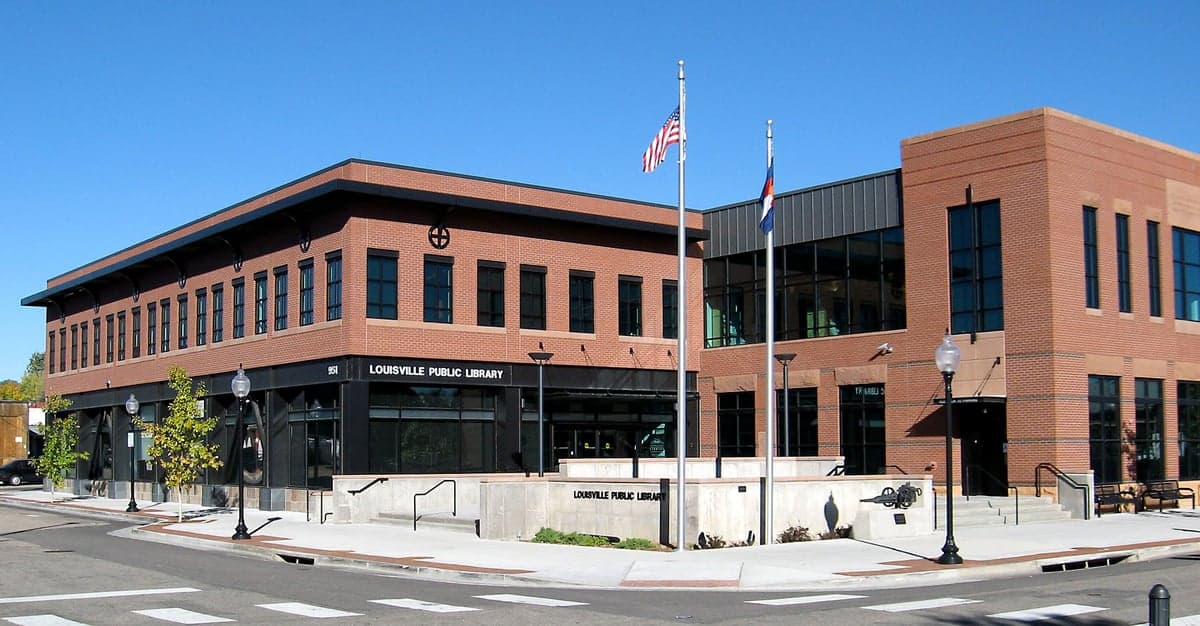
Photo: Wikipedia
Demographics of Louisville, CO
Affluence Level in Louisville, CO
A wealthy area with high-earning, well-educated households. Incomes, home values, and educational attainment meaningfully outpace national averages.
People of Louisville, CO
The people of Louisville, Colorado, today form a highly educated, predominantly white-collar community of 20,788 residents, with a distinctive character shaped by its evolution from a coal-mining town to a Boulder County tech suburb. The population is notably homogeneous: 79.1% white, with a small Hispanic community at 10.4%, and East/Southeast Asian residents comprising 3.6%. With 68.1% of adults holding a bachelor’s degree or higher, Louisville ranks among the most educated small cities in Colorado, and its low foreign-born share of just 3.2% reflects a population built primarily by domestic in-migration rather than international immigration.
How the city was settled and grew
Louisville’s original population was drawn not by agriculture or mining claims, but by coal. Incorporated in 1882, the city was founded as a company town for the Rocky Mountain Fuel Company, which operated mines along the Coal Creek corridor. The earliest residents were immigrant miners — primarily Italian, Irish, and Slavic families — who settled in what is now Old Town Louisville, the historic core centered on Pine and Main Streets. These working-class neighborhoods, with their modest frame houses and narrow lots, remain the city’s most walkable and historically intact area. A second wave arrived during the 1910s coal boom, when Greek and Italian laborers built homes in the South Side district near the former Industrial Mine site. By the 1930s, the mines began to close, and Louisville’s population stagnated at roughly 2,000 for decades, remaining a small, blue-collar enclave isolated from Boulder and Denver’s growth.
Modern era (post-1965)
The post-1965 transformation of Louisville’s population was driven not by immigration reform but by suburbanization and the rise of Boulder’s tech economy. The 1970s and 1980s saw an influx of professionals — engineers, scientists, and academics — drawn by jobs at IBM, StorageTek, and the University of Colorado. These newcomers bypassed Old Town and instead built homes in master-planned subdivisions such as Centennial Village (developed in the 1970s) and McCaslin Meadows (1980s), both located on the city’s western edge near the Boulder County line. The Hispanic population, which had been present since the mining era, remained concentrated in the East Louisville corridor along 96th Street, where older, more affordable housing stock attracted working-class families. The Asian population — primarily East and Southeast Asian — grew modestly during the 1990s and 2000s, settling in newer subdivisions like Coal Creek Ranch (built 1995–2005), drawn by the city’s top-ranked Boulder Valley School District. Notably, the Indian-subcontinent population (1.2%) is a separate, smaller group that arrived later, largely in the 2010s, and is dispersed rather than clustered in a single neighborhood.
The future
Louisville’s population is heading toward greater homogeneity by income and education, even as its racial composition remains stable. The city is effectively built out — little undeveloped land remains — so future growth will come from infill and redevelopment, not new subdivisions. The foreign-born share (3.2%) is well below the Colorado average of 7.5%, and there is no evidence of a growing immigrant enclave; the small Hispanic community is aging and assimilating, with second-generation families moving into the same neighborhoods as white professionals. The East/Southeast Asian population has plateaued, while the Indian-subcontinent community, though growing slowly, remains too small to form a distinct ethnic neighborhood. The most significant demographic trend is generational turnover: as older, less-educated residents sell their homes, they are replaced by younger, wealthier, college-educated families, particularly in Old Town and South Side, where historic homes are being renovated. This is pushing Louisville toward a more uniformly affluent, white-collar character, with the city’s few remaining working-class pockets — along Empire Road and 96th Street — shrinking as property values rise.
For someone moving in now, Louisville is becoming a place where demographic diversity is modest and stable, but economic diversity is declining. The city offers a safe, highly educated, and politically liberal environment (Boulder County voted +54 Democratic in 2024), with excellent schools and a strong sense of local identity rooted in its mining past. New residents should expect a community that values preservation and slow growth, where the population is unlikely to change dramatically in the next decade, but where the cost of entry — both financial and cultural — will continue to rise.

* Values derived from national, state, county, city and local statistics and may differ in a specific area. Last updated: 2026-05-01T12:44:52.000Z
Narrative content on this page is AI-generated and may contain mistakes. Verify any details that matter before acting on them.
ReloMaps may earn a commission from affiliate links at no extra cost to you.

