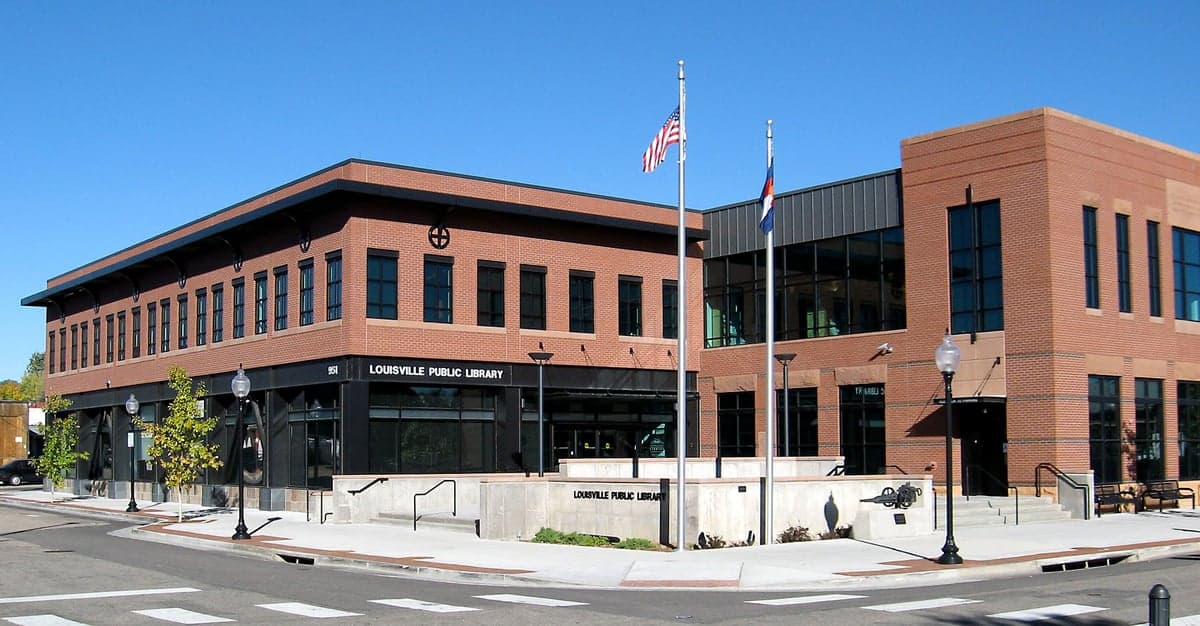
Photo: Wikipedia
Political ClimatePolitical Climate in Louisville, CO
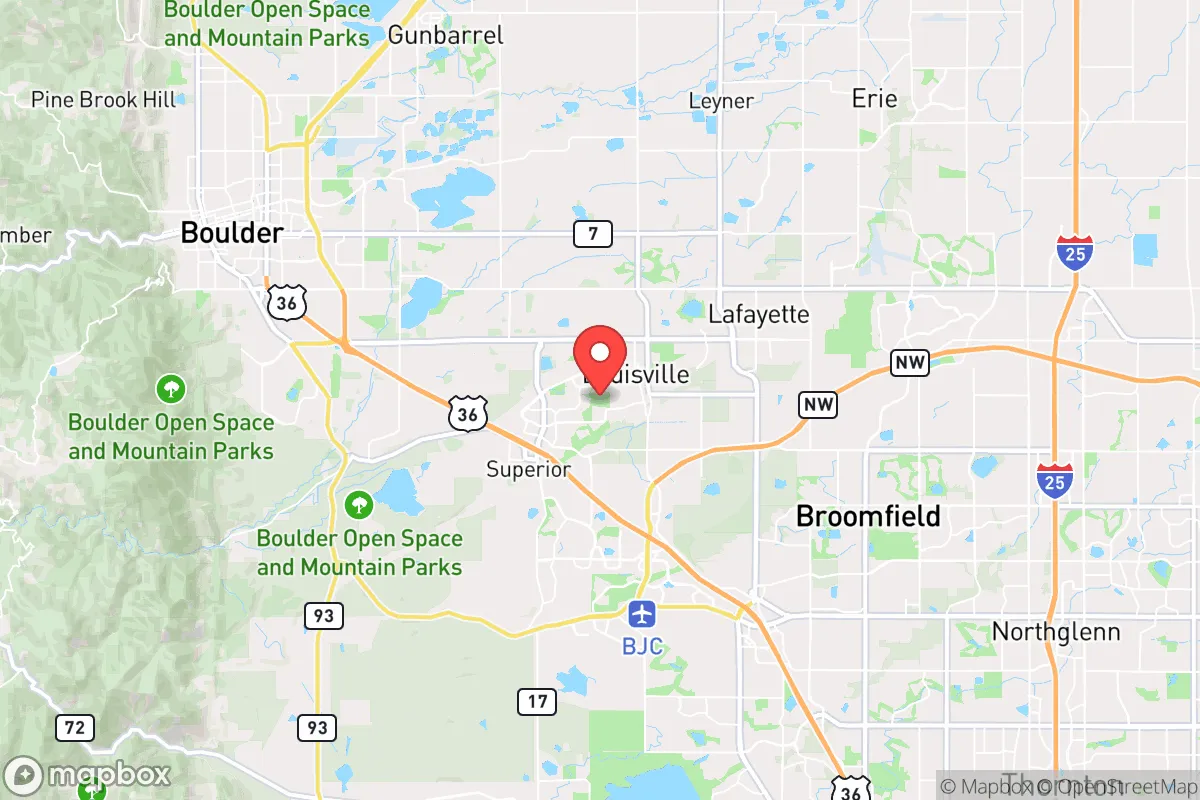
District shown is the primary district for this city’s centroid. Cities may span multiple districts.
Local Political AnalysisPolitical Analysis of Louisville, CO
Louisville, Colorado, has shifted hard to the left over the past decade, and if you’ve lived here as long as I have, you’ve felt it in everything from local ordinances to school board meetings. The Cook PVI now sits at D+20, meaning the city votes about 20 points more Democratic than the national average—a number that would have seemed unthinkable back when this was a quiet, blue-collar mining town. Today, that political lean isn’t just a voting pattern; it’s a cultural force that shapes what you can and can’t do with your property, your business, and your kids’ education.
How it compares
Drive ten minutes east to Erie or fifteen minutes north to Longmont, and you’ll find a noticeably different political vibe—more purple, more willing to push back on the kind of progressive policies that have become standard in Louisville. Erie, for instance, still has a strong contingent of folks who remember when the town was farmland, and they’ve fought harder to keep property rights intact and taxes lower. Meanwhile, Louisville has become a mirror of Boulder, just with slightly less traffic and a bit more open space. The city council here has embraced the same playbook: stricter building codes, higher impact fees, and a general attitude that government knows best when it comes to land use and energy mandates. If you’re coming from a place where local officials still respect the idea that you should be able to run your own life without a permit for everything, the contrast is jarring.
What this means for residents
For the average family, the biggest practical effect is a steady creep of regulations that touch daily life. Want to add a deck or a shed? Expect a longer review process and higher fees than in neighboring towns. Thinking about starting a home-based business? The zoning code here is tighter, and the city has been aggressive about enforcing noise and parking rules that can shut down a side hustle before it gets off the ground. On the school front, the Boulder Valley School District—which covers Louisville—has leaned heavily into social-emotional learning and equity initiatives, sometimes at the expense of core academics. Parents I know have pulled their kids out for private or charter options, but those are getting harder to find as the district tightens its grip. The tax burden is also creeping up: property taxes here are among the highest in Boulder County, and the city has floated new sales tax measures for everything from open space to bike paths. It adds up, and the people who can afford it stay; the ones who can’t quietly move to Erie or Firestone.
The cultural shift is the hardest part for those of us who remember when Louisville was a place where neighbors helped each other without a city program. There’s a growing sense that if you don’t align with the progressive consensus—on climate policy, on growth management, on social issues—you’re better off keeping your head down. The city’s official communications and public meetings have taken on a tone that feels less like community dialogue and more like a lecture. I’ve seen long-time residents stop attending council meetings because they’re tired of being talked down to. The near-term outlook? I don’t see it reversing. The demographics are shifting younger and wealthier, and those newcomers tend to vote for more of the same. If you value personal freedom and a government that stays out of your way, Louisville is probably not your long-term home. But if you’re okay with a well-managed, progressive enclave where the trade-off is convenience for control, you’ll fit right in.

State Political ClimatePolitical Climate in Colorado
State Political AnalysisPolitical Environment in the State
Colorado has shifted from a reliably purple swing state to a solidly blue-leaning state over the past two decades, with Democrats now controlling the governorship, both U.S. Senate seats, and both chambers of the state legislature. The state voted for Hillary Clinton by 5 points in 2016, Joe Biden by 13 points in 2020, and Kamala Harris by roughly 11 points in 2024, reflecting a durable leftward trend driven primarily by explosive growth in the Denver metro area and along the Front Range. For a conservative considering relocation, the state’s political trajectory is a story of accelerating progressive dominance, with the rural and exurban counties that once kept things balanced now increasingly outnumbered by urban and suburban voters.
Urban vs. rural divide
The political map of Colorado is a tale of two worlds. The Denver-Boulder corridor—including Denver, Boulder, Aurora, and Lakewood—is the engine of Democratic power, routinely delivering 65-75% of the vote for Democratic candidates. The I-25 corridor from Fort Collins down to Colorado Springs is more mixed: Fort Collins (Larimer County) has trended blue since 2016, while Colorado Springs (El Paso County) remains a conservative stronghold, though its margins have shrunk from +20 points for Republicans to closer to +10 in recent cycles. Rural and mountain counties—places like Mesa County (Grand Junction), Weld County (Greeley), and Douglas County (south of Denver)—vote heavily Republican, but their populations are too small to offset the Front Range urban centers. The Western Slope (e.g., Montrose, Delta) and the San Luis Valley (Alamosa) are reliably red, but they’re losing political relevance as the state’s population concentrates along the Front Range. A notable flip: Jefferson County (suburban Denver), once a bellwether, has voted Democratic in every presidential election since 2008, and Arapahoe County has followed suit. The only major county that still leans Republican is El Paso County, and even there, Democratic gains in Colorado Springs proper are narrowing the gap.
Policy environment
Colorado’s policy environment is increasingly progressive, with a tax and regulatory posture that reflects Democratic control. The state income tax rate is a flat 4.4% (down from 4.63% after a 2024 ballot measure), but property taxes have risen sharply—especially in fast-growing counties like Douglas and Weld—due to a 2023 law that capped assessment rate increases but still allowed local governments to raise mill levies. The state has no sales tax on groceries, but local sales taxes can push combined rates above 8% in Denver and Boulder. On education, Colorado passed a universal preschool program in 2023, but school choice is robust: charter schools are widespread, and open enrollment is the norm, though progressive school boards in Denver and Boulder have pushed critical race theory and gender ideology curricula. Healthcare is dominated by the state-run Connect for Health Colorado exchange, and the state expanded Medicaid under the ACA. Election laws are among the most liberal in the nation: Colorado automatically mails ballots to every registered voter, allows same-day registration, and has no voter ID requirement at the polls (though a signature match is used for mail ballots). This system, while convenient, has raised concerns among conservatives about ballot security and chain of custody, especially after the 2020 election saw high turnout with minimal fraud but persistent distrust in rural counties.
Trajectory & freedom
Colorado is becoming less free by any conservative measure of personal liberty. The most glaring example is gun rights: in 2023, the legislature passed a ban on so-called "assault weapons" (semi-automatic rifles with detachable magazines) and a law raising the purchase age to 21, both signed by Governor Jared Polis. A 2024 law also imposed a 10-day waiting period on all firearm purchases and required liability insurance for gun owners. These laws have sparked a wave of lawsuits and a push for county-level Second Amendment sanctuary resolutions—over 30 counties have passed them—but they carry no legal weight against state preemption. On parental rights, Colorado passed a 2023 law that prohibits schools from notifying parents if a child changes their gender identity or pronouns, effectively overriding parental authority. Medical autonomy has also eroded: the state legalized assisted suicide in 2016 and has no parental consent requirement for minors seeking abortions. Property rights are under pressure from a 2024 "land use" bill that allows higher-density development in single-family neighborhoods, overriding local zoning. On the tax front, the Taxpayer Bill of Rights (TABOR) still limits state revenue growth, but Democrats have repeatedly found ways to bypass it through "fees" and enterprise funds. The overall trajectory is one of expanding government control over daily life, with the legislature increasingly willing to override local control.
Civil unrest & political movements
Colorado has seen its share of political flashpoints. The 2020 George Floyd protests in Denver turned violent, with property damage and clashes between protesters and police, and the city later cut its police budget by $8 million. The state’s sanctuary policies are a major point of contention: Colorado bars local law enforcement from cooperating with federal immigration authorities except in limited cases, and Denver has been a "sanctuary city" since 2019. This has led to visible tensions, especially as the state has seen an influx of migrants from the southern border—Denver spent over $40 million on migrant services in 2023-2024. On the right, the "Colorado Project" and local GOP groups have organized against these policies, but they’ve had limited legislative success. Election integrity remains a hot-button issue: the 2020 election saw widespread use of mail ballots, and while no evidence of widespread fraud emerged, rural counties like Elbert and Lincoln have passed resolutions calling for hand-count audits. The "Three Percenter" militia movement has a presence in the state, particularly in the mountains and on the Western Slope, but it’s largely fringe. A more visible movement is the push for county secession—several rural counties have floated the idea of joining Wyoming or forming a new state, but it’s mostly symbolic. The most practical flashpoint for a new resident is the growing cultural divide between urban and rural areas, visible in everything from school board meetings to county commission decisions on land use.
Projection
Over the next 5-10 years, Colorado will likely become more progressive, not less. Demographic trends are clear: the Front Range is growing faster than the rest of the state, and the new arrivals are disproportionately young, college-educated, and left-leaning. The 2024 election results showed Democrats gaining ground even in traditionally red suburbs like Douglas County, where Trump’s margin shrank to single digits. The state’s in-migration from California and Texas is a mixed bag—some conservatives move here for the outdoor lifestyle, but the net effect is a slight blue shift. The legislature will likely continue to pass gun control, expand government healthcare, and erode parental rights. The only brake is TABOR, which limits tax increases, but Democrats have become adept at working around it. A conservative moving here now should expect to live in a state where their vote for president or Senate is effectively meaningless, but where local elections—county commission, school board, city council—still matter. The best bet for a conservative is to settle in a red county like El Paso, Weld, or Mesa, where local governance can still reflect their values, but even there, state-level policies will increasingly override local preferences.
For a conservative considering relocation, Colorado offers stunning natural beauty and a strong economy, but the political climate is a growing liability. You’ll pay higher taxes, face more regulations on everything from guns to land use, and live under a government that actively undermines parental rights and election integrity. The state is not a lost cause—rural and exurban counties still hold the line—but the trend lines are clear. If you move here, plan to be politically active at the local level, because state-level change is unlikely in the near term. The best you can hope for is to preserve some islands of freedom in a sea of progressive governance.
* Values derived from national, state, county, city and local statistics and may differ in a specific area. Last updated: 2026-05-01T12:44:52.000Z
Narrative content on this page is AI-generated and may contain mistakes. Verify any details that matter before acting on them.
ReloMaps may earn a commission from affiliate links at no extra cost to you.

