
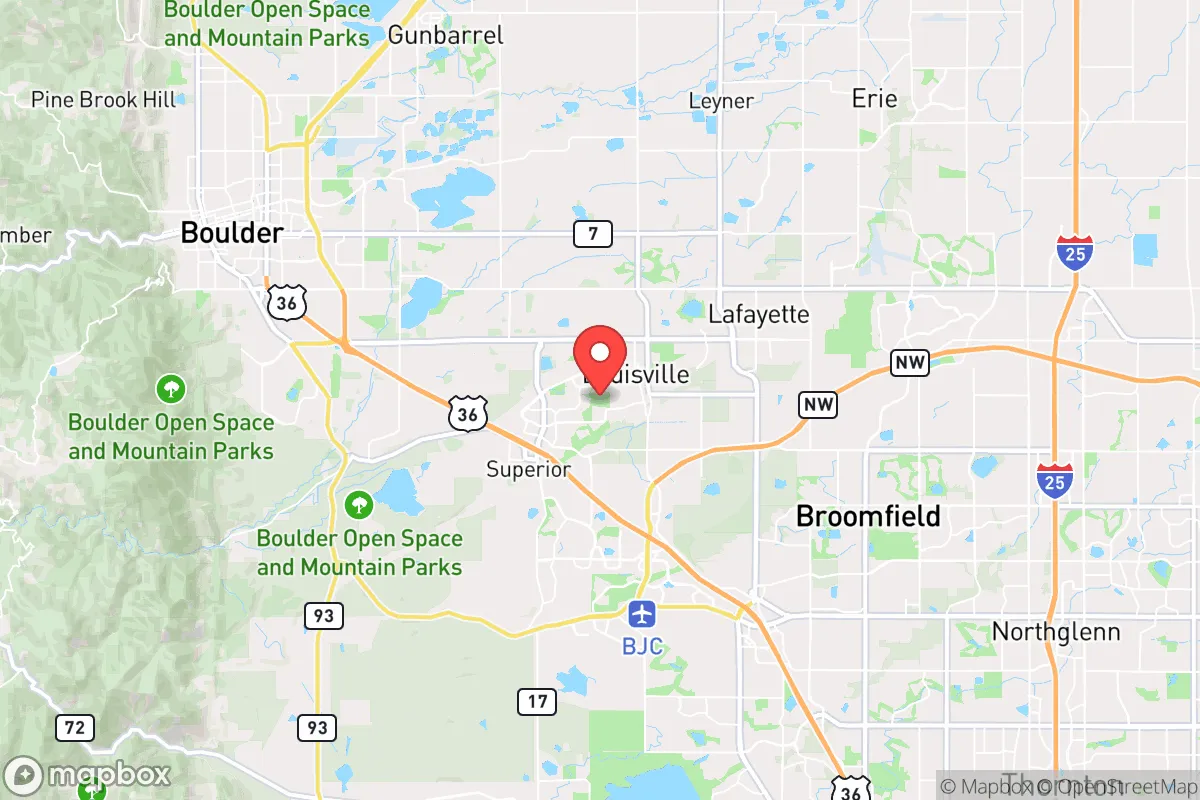
Photo: Wikipedia
Personal Sovereignty in Louisville, CO
Viable for self-reliance. Generally workable, though some barriers may limit total independence.
What does Personal Sovereignty tell us?
Personal Sovereignty measures your capacity for self-reliance and independence with minimal government friction. Higher scores mean fewer barriers between you and the way you want to live... but it assumes you have the space you need and good neighbors.
What does this tell us?
Personal Sovereignty measures your capacity for self-reliance and independence with minimal government friction. Higher scores mean fewer barriers between you and the way you want to live... but it assumes you have the space you need and good neighbors.
State Policy
Energy independence: Net exporter (110% of energy produced in-state)
Personal Liberty
Homesteading

Personal Liberty Analysis
Louisville, Colorado, presents a complex environment for personal sovereignty, where a strong local community ethos and access to open space coexist with a state-level regulatory framework that many liberty-minded individuals find increasingly intrusive. While the city itself maintains a relatively high degree of local control and a culture of self-reliance, it sits within Boulder County and the state of Colorado, both of which have enacted policies that can significantly constrain individual autonomy, particularly in areas of taxation, self-defense, and property rights. For a strategic relocation analysis, Louisville offers a mixed picture: a solid foundation for community-based resilience, but with significant headwinds from state and county governance that require careful navigation.
Tax burden and regulatory posture in Louisville and Colorado
Colorado’s overall tax burden is moderate compared to many states, but the regulatory posture in Boulder County leans heavily toward progressive intervention. Louisville itself has a local sales tax of 3.5% on top of the state’s 2.9% and Boulder County’s 0.85%, bringing the combined rate to roughly 7.25% in most areas. Property taxes are relatively low by national standards—around 0.5% of assessed value—thanks to the Gallagher Amendment’s legacy, though this is being eroded by rising home values. However, the real sovereignty concern lies in regulatory overreach. The state’s 2021 “Family Leave Act” mandates paid leave for nearly all workers, funded by a payroll tax, which many conservatives view as an infringement on employer and employee freedom. Additionally, Boulder County has some of the most stringent land-use and building codes in the state, including strict energy efficiency mandates and electric vehicle readiness requirements for new construction. For a prepper or survivalist, this means that even basic home modifications—like adding a backup generator or installing a rainwater catchment system—can trigger costly permitting and inspection processes. The state’s increasingly aggressive climate agenda, including a goal of 100% renewable energy by 2040, creates uncertainty for those who value energy independence and the right to choose their own power sources.
Self-defense and gun law specifics in Louisville and Colorado
This is the most significant sovereignty red flag for the area. While Louisville itself is a relatively safe community, the state of Colorado has moved decisively to restrict Second Amendment rights. In 2023, the state passed a law raising the minimum age to purchase any firearm to 21, and in 2024, it enacted a ban on “ghost guns” and required universal background checks for private sales. Boulder County has gone further, with local ordinances that effectively ban the open carry of firearms in many public spaces, including parks and government buildings. For a survivalist, the ability to defend oneself and one’s family is non-negotiable, and these restrictions create a legal minefield. The state also has a “red flag” law (Extreme Risk Protection Order) that allows courts to temporarily confiscate firearms from individuals deemed a risk, based on a petition from law enforcement or family members. While proponents argue it saves lives, critics see it as a due-process-free seizure of property that can be abused. Concealed carry is permitted with a license, but the process requires a training course and a background check. For those prioritizing self-reliance, the legal climate here is hostile compared to states like Wyoming or Texas, and the constant threat of new restrictions makes long-term planning difficult.
Self-reliance and homesteading viability in Louisville
Louisville’s zoning and lot sizes present a mixed picture for homesteading. The city is largely suburban, with typical lot sizes ranging from 0.15 to 0.5 acres in established neighborhoods. While this is enough for a substantial vegetable garden and a few fruit trees, it is insufficient for any meaningful livestock or large-scale food production. Chickens are allowed in most residential zones, but roosters are prohibited, and coop size and placement are regulated. The city’s water rights are tied to municipal supply, making off-grid water collection legally complex—rainwater harvesting is allowed for non-potable uses, but permits are required for larger systems. Solar panels are permitted, but homeowners associations (HOAs) in many Louisville neighborhoods can restrict their placement. For a serious prepper, the lack of acreage and restrictive zoning make true self-sufficiency nearly impossible within city limits. The nearby unincorporated areas of Boulder County offer larger parcels, but come with even stricter environmental regulations, including wildfire mitigation requirements that can force landowners to clear vegetation. The state’s “Right to Farm” laws are weak, and local governments can easily override them. For those seeking a true homestead, Louisville is a compromise at best—a place to build community resilience, but not to achieve full independence from the grid or the supply chain.
Personal liberties in Louisville: parental rights, medical autonomy, speech, and property
Parental rights are a growing flashpoint in Colorado. The state has some of the most progressive education policies in the country, including a 2023 law that requires schools to allow students to use names and pronouns without parental consent, and a 2024 law that prohibits schools from notifying parents about a child’s gender identity without the child’s permission. For conservative parents, this represents a direct assault on their authority and privacy. Medical autonomy is similarly constrained: Colorado has legalized assisted suicide (2016) and recreational marijuana (2012), but has also mandated vaccines for school attendance (with limited exemptions) and passed laws that restrict the use of ivermectin and hydroxychloroquine for COVID-19. Free speech is protected under the state constitution, but Boulder County has a history of “hate speech” resolutions and local ordinances that can chill political expression. Property rights are under constant pressure from the state’s “just transition” policies, which can restrict how landowners use their property in the name of environmental goals. The state’s “adverse possession” laws are also relatively favorable to squatters, a concern for those with vacant land. Overall, Louisville offers a community that values neighborly interaction and local events, but the state-level erosion of parental and medical autonomy is a serious consideration for families who prioritize these liberties.
In the broader context of personal sovereignty, Louisville, CO, is a place of trade-offs. It offers a strong sense of community, low crime, and access to the outdoors, but sits within a state that is actively moving toward greater government control over firearms, education, healthcare, and property. Compared to a place like rural Texas or Idaho, where local control and individual rights are more robust, Louisville requires constant vigilance and a willingness to engage in local politics to protect remaining freedoms. For the strategic relocator who values community resilience but can accept a higher regulatory burden in exchange for a vibrant, walkable town, Louisville is a viable option—but only if you are prepared to fight for your rights at the ballot box and in the courtroom. It is not a sanctuary for those seeking to escape government overreach, but rather a battleground where personal sovereignty must be actively defended.

* Values derived from national, state, county, city and local statistics and may differ in a specific area. Last updated: 2026-05-01T12:44:52.000Z
Narrative content on this page is AI-generated and may contain mistakes. Verify any details that matter before acting on them.
ReloMaps may earn a commission from affiliate links at no extra cost to you.

