Photo: Wikipedia
Demographics of Lowell, MA
Affluence Level in Lowell, MA
A middle-class area roughly in line with national averages across income, home values, education, and employment.
People of Lowell, MA
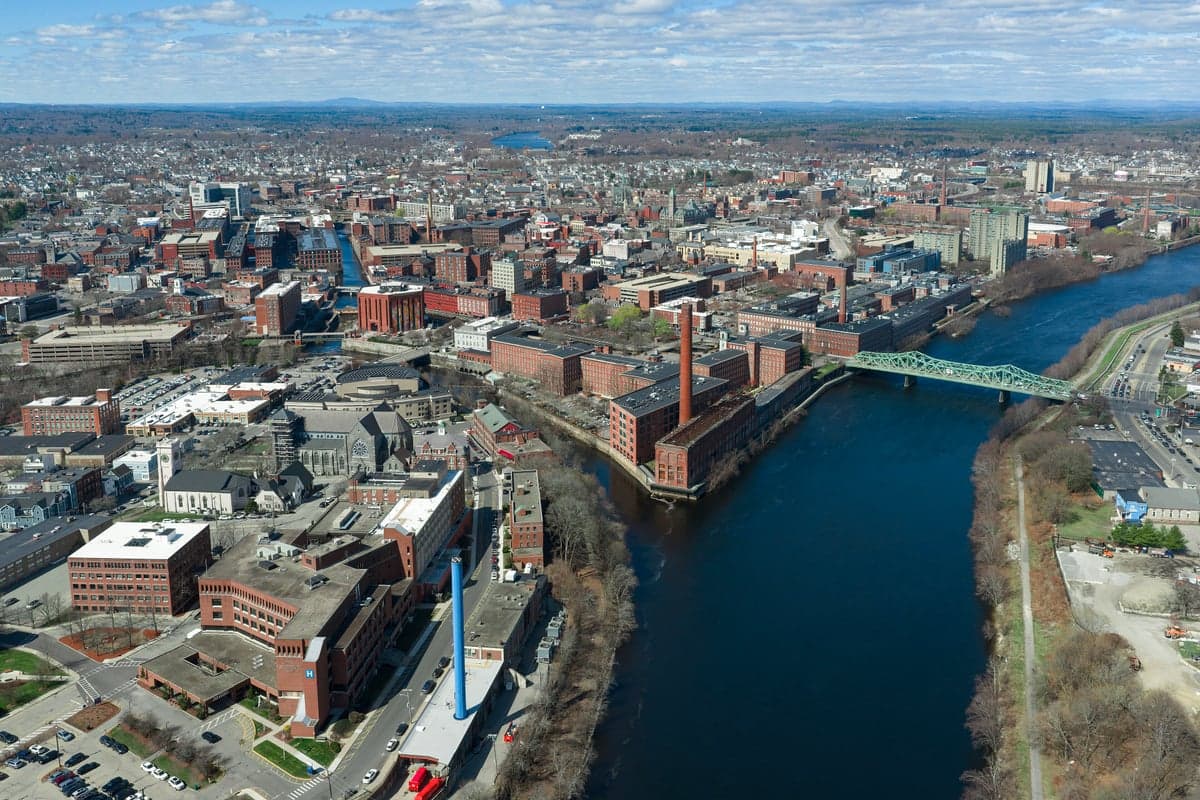
The people of Lowell, Massachusetts today form a dense, ethnically layered city of 114,799 residents, one of the most diverse in New England. Its character is defined by a working-class resilience rooted in industrial history, now overlaid with a significant East/Southeast Asian plurality (18.3%) and a growing Hispanic population (19.3%), while the non-Hispanic white share has fallen to 44.2%. Distinctive identity markers include a strong Cambodian-American cultural presence, a revitalized downtown anchored by the University of Massachusetts Lowell, and a palpable tension between longtime Irish and French Canadian families and newer immigrant communities.
How the city was settled and grew
Lowell was founded in the 1820s as America’s first planned industrial city, a bold experiment in textile manufacturing that drew its initial workforce from young Yankee farm women—the famous "Lowell Mill Girls." By the 1840s, the city’s rapid expansion required more labor, and Irish immigrants fleeing the Great Famine arrived in large numbers, settling in the Lower Highlands and The Acre neighborhoods, where they built St. Patrick’s Church and established a lasting political and labor-union presence. The next major wave came from French Canada between 1860 and 1900, as Quebecois families crossed the border to work in the mills, concentrating in Little Canada (the area around Moody and Merrimack Streets) and the Back Central district, where French was the dominant language in homes and parish schools well into the 20th century. Smaller but significant groups of Greeks, Poles, and Portuguese arrived in the early 1900s, each forming their own enclaves—Greeks around Market Street and Poles in the Sacred Heart neighborhood. By 1920, Lowell’s population peaked at over 112,000, a polyglot industrial city of mill workers, union halls, and ethnic parishes.
Modern era (post-1965)
The post-1965 era reshaped Lowell’s population more dramatically than any period since the 1840s. The 1975 fall of Saigon and subsequent refugee resettlement programs brought the first wave of Cambodians, who were drawn by cheap housing in the aging mill districts and the availability of entry-level manufacturing and service jobs. They established a dense, visible community in The Acre and Highlands, transforming blocks of formerly Irish and French Canadian tenements into a Cambodian commercial corridor along Chelmsford Street. By 2020, East and Southeast Asian residents—overwhelmingly Cambodian, with smaller numbers of Vietnamese and Laotian families—made up 18.3% of the population, the highest concentration of any Massachusetts city outside Boston. The same period saw a steady inflow of Hispanic immigrants, primarily Puerto Ricans and Dominicans, who settled in Centralville and the Lower Highlands, bringing the Hispanic share to 19.3%. The Black population (10.1%) includes both African American families with deep New England roots and more recent African immigrants, while the Indian-subcontinent community (2.6%) is a smaller, more recent addition concentrated near the university and tech-sector employment. The city’s foreign-born share stands at 13.7%, lower than gateway cities like Boston or Lawrence, reflecting a population that is now largely second- and third-generation immigrant.
The future
Lowell’s population is trending toward a stable, multi-ethnic plurality rather than homogenization. The non-Hispanic white share continues a slow decline, while the Hispanic and Asian shares are growing modestly but not explosively—the city lacks the cheap housing stock to absorb the rapid inflows seen in smaller Gateway Cities. The Cambodian community is showing signs of generational assimilation: younger adults are more likely to attend UMass Lowell and move to suburbs like Chelmsford or Tewksbury, while the Acre retains its role as a cultural anchor and first-stop neighborhood for new arrivals. The Indian-subcontinent population, though small, is growing faster than any other group, drawn by tech and healthcare jobs, and is beginning to form a visible presence near the UMass Lowell East Campus. The city is not tribalizing into hostile enclaves—intermarriage rates are rising, and the public schools are among the most diverse in the state—but distinct neighborhood identities persist. The next 10-20 years will likely see Lowell become a majority-minority city where no single group holds a majority, with a character closer to a smaller, grittier version of Somerville than to a homogenizing suburb.
For someone moving in now, Lowell offers a genuinely multicultural urban environment with a strong sense of place, but one where the old ethnic hierarchies have given way to a more fluid, competitive mix of communities. The city is becoming a place where Cambodian, Hispanic, and white working-class families coexist in the same school districts and neighborhoods, with the university acting as a stabilizing, upward-mobility force. It is not a gentrifying boomtown, but a steady, layered city where the next chapter will be written by the children of its most recent immigrants.

* Values derived from national, state, county, city and local statistics and may differ in a specific area. Last updated: 2026-05-02T01:37:53.000Z
Narrative content on this page is AI-generated and may contain mistakes. Verify any details that matter before acting on them.
ReloMaps may earn a commission from affiliate links at no extra cost to you.

