Photo: Wikipedia
Demographics of Manchester, NH
Affluence Level in Manchester, NH
A middle-class area roughly in line with national averages across income, home values, education, and employment.
People of Manchester, NH
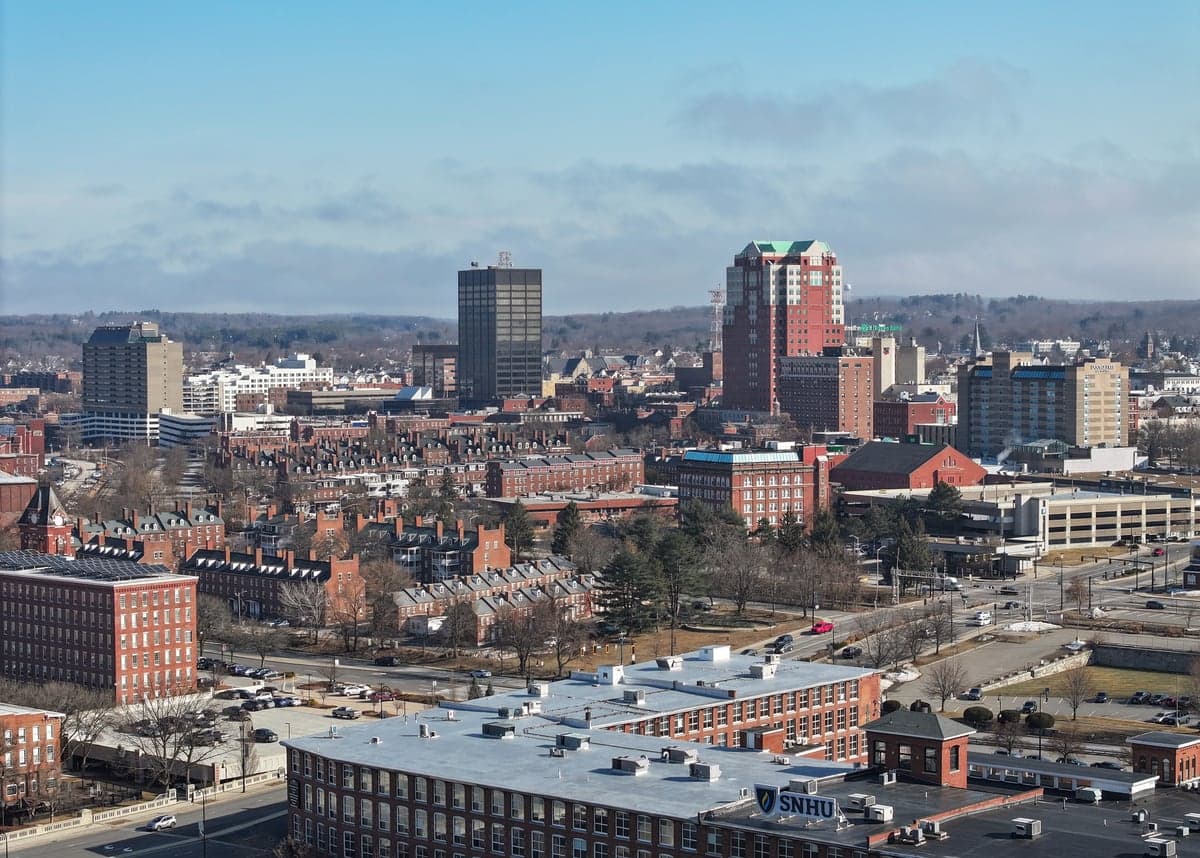
The people of Manchester, New Hampshire today form a dense, working-to-middle-class city of 115,415 residents, marked by a distinctive blend of historic French-Canadian roots, a growing Hispanic population, and a modest but visible East/Southeast Asian and Indian-subcontinent presence. With a foreign-born share of just 6.7%—well below the national average—Manchester remains a predominantly native-born city, though its racial and ethnic composition is shifting noticeably. The city’s identity is still shaped by its mill-town past and the Catholic, union-oriented culture that built it, but newer arrivals are gradually diversifying neighborhoods that were once overwhelmingly white.
How the city was settled and grew
Manchester’s population history begins with the Amoskeag Manufacturing Company, which harnessed the Merrimack River’s water power in the early 1800s to create the world’s largest cotton textile mill. The company recruited heavily from Quebec, and by 1900, French-Canadian immigrants and their children made up roughly 40% of the city’s population. These families settled in dense tenement blocks near the mills, particularly in the Rimmon Heights and West Side neighborhoods, where French was spoken on the streets and Catholic parishes like Ste. Marie anchored community life. A smaller wave of Irish immigrants arrived during the Great Famine and concentrated in the Hollows district along the river, while German and Polish immigrants formed pockets on the East Side. The mill’s decline after World War I ended large-scale immigration, and Manchester’s population plateaued through the mid-20th century as the city became a stable, blue-collar, overwhelmingly white community.
Modern era (post-1965)
The 1965 Hart-Cellar Act had a muted effect on Manchester compared to gateway cities; the foreign-born share remained low through the 1990s. Instead, the city’s modern demographic shifts have been driven by domestic in-migration and natural increase. The Hispanic population—now 13.4% of the city—grew rapidly after 2000, fueled by Puerto Rican and Dominican families moving from the Northeast corridor. These arrivals have concentrated in the West Side and North End, where older triple-decker housing stock is affordable and where Spanish-language churches and bodegas have opened. The East/Southeast Asian community (3.0%) is smaller and more dispersed, with a visible cluster of Vietnamese and Cambodian families in the South End near the river. The Indian-subcontinent population (1.5%) is newer and more professional, drawn by jobs in healthcare and tech, and tends to settle in the East Side near the Elliot Hospital corridor. The Black population (4.7%) includes both African American families who moved from Boston and a smaller number of African refugees, with no single dominant neighborhood. Suburbanization has pulled many white, college-educated families to towns like Bedford and Goffstown, leaving Manchester’s core slightly more diverse and less affluent than its suburbs.
The future
Manchester’s population is slowly becoming more diverse, but the pace is moderate. The Hispanic share is the fastest-growing segment, projected to approach 18-20% by 2040 if current trends hold, driven by higher birth rates and continued migration from Puerto Rico and Central America. The East/Southeast Asian and Indian-subcontinent populations are growing from a small base, largely through professional migration tied to the city’s expanding healthcare and logistics sectors. The white non-Hispanic share—72.8% today—is declining gradually as older residents age and younger families move to suburbs. The city is not tribalizing into starkly separate enclaves; instead, neighborhoods like the West Side are becoming more mixed, with Hispanic families moving into formerly French-Canadian blocks. The foreign-born share is likely to rise modestly but remain below 10%, as Manchester lacks the large refugee resettlement programs or high-skilled visa pipelines of Boston or Nashua. For a newcomer, this means moving into a city that is still majority-white and culturally rooted in its Franco-American past, but where everyday life increasingly includes Spanish-language signage, Asian grocery stores, and Indian restaurants—a slow, organic diversification rather than a rapid transformation.
Manchester is becoming a more typical mid-sized American city—less insular than it was in 1990, but still far from the hyper-diverse melting pot of larger metros. For conservative-leaning singles and parents, this means a place where change is gradual enough to feel manageable, where English remains the dominant public language, and where the city’s historic character is still visible in its neighborhoods. The population trajectory points toward a slightly browner, slightly more foreign-born Manchester, but one that will remain recognizably the same city for at least another generation.

* Values derived from national, state, county, city and local statistics and may differ in a specific area. Last updated: 2026-05-01T23:54:22.000Z
Narrative content on this page is AI-generated and may contain mistakes. Verify any details that matter before acting on them.
ReloMaps may earn a commission from affiliate links at no extra cost to you.

