
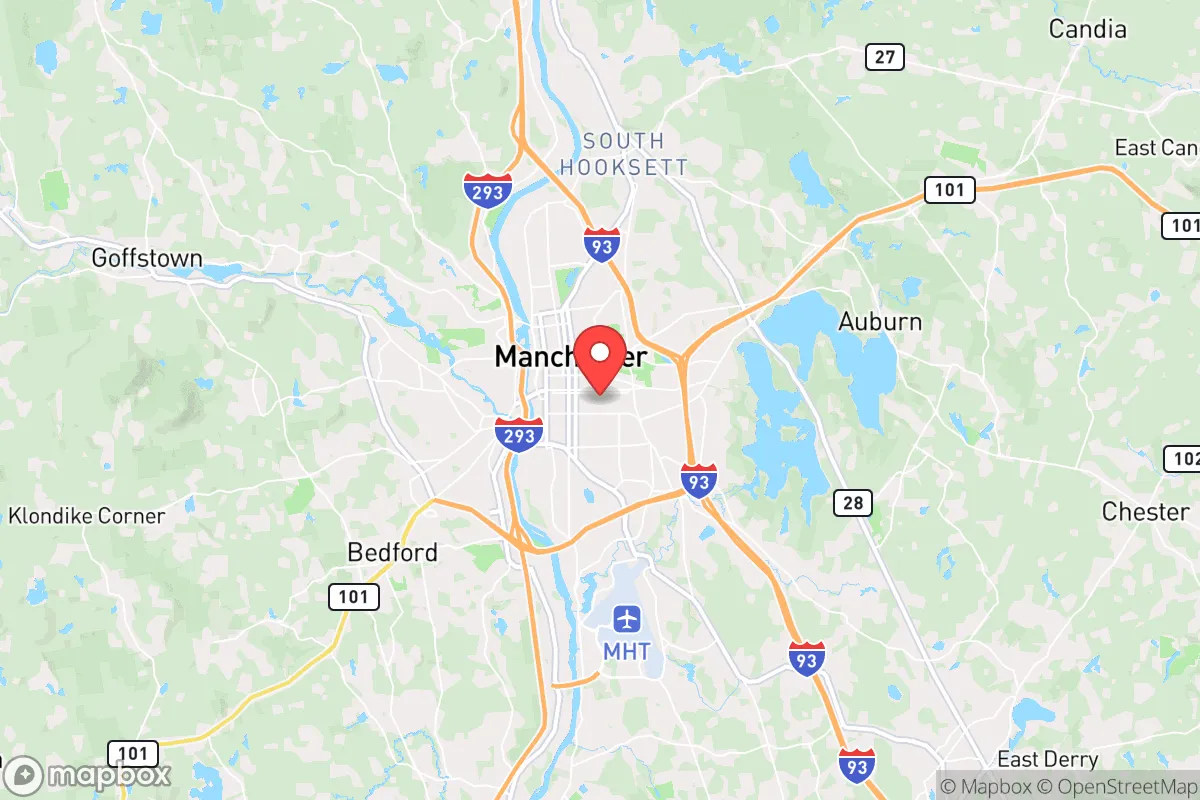
Photo: Wikipedia
Personal Sovereignty in Manchester, NH
Viable for self-reliance. Generally workable, though some barriers may limit total independence.
What does Personal Sovereignty tell us?
Personal Sovereignty measures your capacity for self-reliance and independence with minimal government friction. Higher scores mean fewer barriers between you and the way you want to live... but it assumes you have the space you need and good neighbors.
What does this tell us?
Personal Sovereignty measures your capacity for self-reliance and independence with minimal government friction. Higher scores mean fewer barriers between you and the way you want to live... but it assumes you have the space you need and good neighbors.
State Policy
Energy independence: Importer (10% of energy produced in-state)
Personal Liberty
Homesteading

Personal Liberty Analysis
Manchester, New Hampshire, offers a rare environment for personal sovereignty in the modern Northeast, where state-level policies deliberately carve out wide latitude for individual decision-making. The city sits within a state that has no broad-based income tax, no sales tax, and a Live Free or Die ethos that translates into concrete legal protections for self-defense, property rights, and parental authority. For the survivalist or prepper evaluating relocation, Manchester represents a strategic compromise—urban infrastructure within a jurisdiction that respects personal autonomy far more than neighboring Massachusetts or Vermont. The key question is whether the city’s local governance undermines the state’s libertarian framework, and the answer, for now, is that Manchester largely stays out of the way.
Tax burden and regulatory posture: How New Hampshire’s fiscal structure protects personal wealth
New Hampshire’s tax structure is the single strongest pillar of personal sovereignty in Manchester. The state imposes no general income tax on wages or salaries and no statewide sales tax, meaning residents keep nearly every dollar they earn. This is not a minor detail—it directly reduces government’s claim on your labor and savings, a core concern for those wary of fiscal overreach. The state does levy a 5% tax on interest and dividend income above $2,400 (single) or $4,800 (joint), but this is narrow in scope. Property taxes in Manchester are the primary local revenue source, with a rate around $24.50 per $1,000 of assessed value as of 2025, which is moderate for the region but higher than rural New Hampshire towns. However, the absence of income and sales taxes means your total effective tax rate remains low compared to most of New England. Regulatory posture is similarly restrained: New Hampshire has no state-level minimum wage above the federal $7.25, no mandatory paid family leave program, and no rent control. Zoning in Manchester is municipal, but the city’s approach is generally permissive for residential uses, with no county-level overlay adding bureaucracy. For the prepper, this means fewer layers of government to navigate when securing property or starting a home-based enterprise.
Self-defense and gun law specifics: What the Second Sanctuary status means for residents
New Hampshire is one of the most firearm-friendly states in the country, and Manchester residents benefit directly. The state has constitutional carry without a permit for both open and concealed carry, effective since 2017. No license, background check, or waiting period is required to purchase a rifle, shotgun, or handgun from a private seller, though federal checks apply at licensed dealers. The city of Manchester does not impose its own firearms ordinances beyond state law, so there are no local bans on magazine capacity, specific weapon types, or carry in most public spaces. New Hampshire is also a Second Amendment Sanctuary state by statute, meaning state and local law enforcement are prohibited from enforcing any federal gun control measures that violate the state constitution—a direct check on federal overreach. Stand-your-ground laws are in effect, with no duty to retreat in any place you are lawfully present. For the survivalist, this legal environment means you can maintain a full armory without bureaucratic hurdles, train on your own property, and carry for personal protection without fear of arbitrary prosecution. The only notable restriction: carrying in federal buildings, courthouses, and schools is prohibited, but these are standard limitations. Manchester’s proximity to the Massachusetts border (about 20 miles) means you must be vigilant about crossing into a state with vastly more restrictive laws, but within New Hampshire, your self-defense rights are robust.
Self-reliance and homesteading viability: Lot sizes, zoning, and off-grid feasibility in Manchester
Manchester is an urban center, so large-scale homesteading within city limits is limited, but the surrounding area offers viable options for self-reliance. Within the city, typical residential lots range from 0.1 to 0.25 acres in older neighborhoods, with newer subdivisions offering up to 0.5 acres. Zoning permits backyard chickens in most residential zones (up to six hens, no roosters), and beekeeping is allowed with registration. Vegetable gardens face no restrictions, and rain barrel collection is legal. However, off-grid living is not feasible within Manchester proper—the city requires connection to municipal water and sewer, and building codes mandate grid-tied electrical systems. For true self-sufficiency, you need to look to the surrounding towns like Goffstown, Hooksett, or Auburn, where 1- to 5-acre lots are common and well water, septic systems, and solar panels are standard. New Hampshire state law actually protects the right to install solar panels against restrictive HOAs, and there are no state-level bans on rainwater harvesting. The growing season is short (Zone 5b, roughly 140 frost-free days), but cold frames and hoop houses extend it. For the prepper, the strategy is clear: live in Manchester for employment and infrastructure access, but secure a rural property within 30 minutes for serious homesteading. The city itself is not a bug-out location, but it is a functional base of operations.
Personal liberties: Parental rights, medical autonomy, speech, and property protections
New Hampshire’s legal framework strongly favors individual liberty across several domains critical to the conservative worldview. Parental rights are explicitly protected under state law (RSA 186-C:7), which affirms parents’ authority to direct their children’s education, healthcare, and religious upbringing. The state has no mandatory vaccine requirements for school attendance—parents can claim religious or philosophical exemptions easily. Homeschooling is deregulated: no prior approval needed, no curriculum mandates, and no home visits. For medical autonomy, New Hampshire does not have a state-level vaccine passport mandate, and while COVID-era restrictions existed, they were among the lightest in the Northeast and have been fully repealed. Medical freedom is further supported by the state’s lack of a prescription drug monitoring program that restricts patient access, and there is no state income tax penalty for choosing alternative treatments. Free speech protections are robust; New Hampshire has no hate speech laws that criminalize expression, and the state constitution’s Article 22 guarantees the right to speak, write, and publish freely. Property rights are strong: eminent domain is limited to public use (not economic development), and there is no statewide rent control or forced inclusionary zoning. For the survivalist, these protections mean you can raise your children according to your values, make medical decisions without state interference, speak your mind on controversial topics, and develop your property without fear of government seizure for private gain.
Overall, Manchester offers a level of personal sovereignty that is exceptional for the Northeast and competitive with many Western states. The combination of no income tax, constitutional carry, strong parental rights, and minimal regulatory burden creates an environment where individuals can live largely free from government intrusion. The trade-off is that Manchester is a city of 115,000 with typical urban challenges—property crime rates above the national average, some homelessness, and occasional progressive local politics—but the state-level framework acts as a ceiling on overreach. Compared to Boston (45 minutes south), where income taxes, strict gun laws, and vaccine mandates constrain autonomy, Manchester is a sanctuary. For the prepper or conservative strategist, it is not a perfect redoubt, but it is a defensible position in a region where such options are vanishingly rare.

* Values derived from national, state, county, city and local statistics and may differ in a specific area. Last updated: 2026-05-01T23:54:22.000Z
Narrative content on this page is AI-generated and may contain mistakes. Verify any details that matter before acting on them.
ReloMaps may earn a commission from affiliate links at no extra cost to you.

