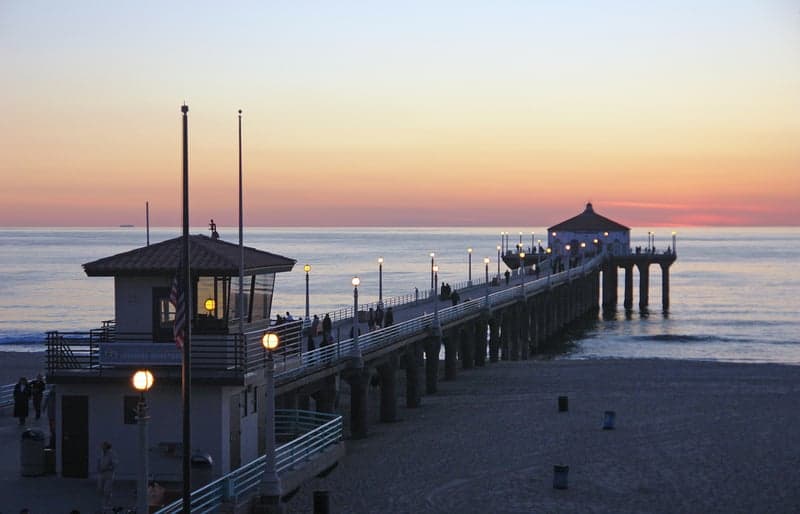
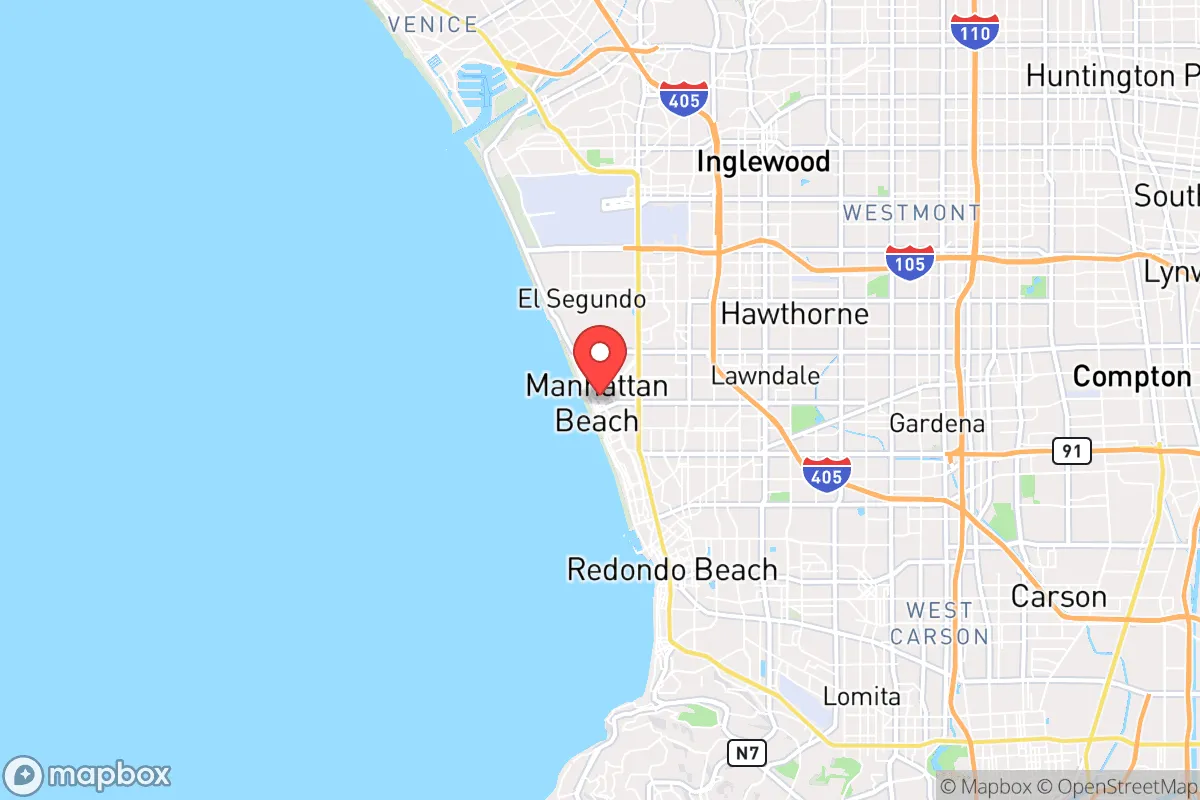
Photo: Wikipedia
Demographics of Manhattan Beach, CA
Affluence Level in Manhattan Beach, CA
An elite concentration of wealth — high incomes, strong home values, advanced degrees, and minimal poverty signal a top-tier socioeconomic profile.
People of Manhattan Beach, CA
Manhattan Beach today is a densely settled, highly educated coastal city of 34,584 residents where 79% of adults hold a college degree — one of the highest rates in Los Angeles County. The population is predominantly White (72.0%), with a notable East/Southeast Asian community (12.0%) and a smaller Hispanic share (7.6%). Foreign-born residents make up just 5.0% of the city, well below the national average, giving Manhattan Beach a native-born, family-oriented character that sets it apart from the more ethnically diverse South Bay cities to its east and south.
How the city was settled and grew
Manhattan Beach was a latecomer even by California standards. The area was originally part of the Rancho Sausal Redondo Mexican land grant, and the first permanent non-Native settlers arrived only in the 1880s after the Santa Fe Railroad extended a line to the coast. The city was formally incorporated in 1912, built around beachfront tourism and small-scale agriculture. The original population was overwhelmingly White and native-born, drawn from the Midwest and the East Coast by the promise of oceanfront lots sold through speculative land companies. The earliest residential clusters formed in the Hill Section (the original townsite north of Manhattan Beach Boulevard) and the Beach Lots directly along the strand, where modest bungalows and summer cottages housed seasonal visitors and a small year-round workforce. A second wave arrived during the 1920s oil boom, when the El Porto neighborhood (the city's northernmost pocket, now part of the North End) was developed to house oil-field workers and their families. By 1940, the population had reached roughly 8,000, still almost entirely White and native-born, with a tiny Japanese American fishing community concentrated near the pier — a community that was forcibly removed during World War II and never reestablished in significant numbers.
Modern era (post-1965)
The post-1965 period transformed Manhattan Beach from a modest beach town into an affluent bedroom community. The 1965 Immigration and Nationality Act had little direct effect here — the city's foreign-born share has never risen above 8% — but the broader suburbanization of Los Angeles County drove rapid domestic in-migration. The Sand Section (the flat blocks between the beach and Sepulveda Boulevard) was largely rebuilt during the 1970s and 1980s as older cottages were replaced with larger single-family homes, attracting professionals working in aerospace, finance, and entertainment. The Tree Section (the easternmost residential area, named for its mature street trees) filled with young families seeking good schools and larger lots. The East/Southeast Asian population, now 12.0% of the city, began arriving in the 1980s and 1990s, primarily as well-educated professionals from Taiwan, South Korea, and Japan who bought into the Tree Section and the newer townhouse developments near the Manhattan Beach Village shopping district. The Hispanic share (7.6%) is concentrated among service workers and tradespeople, many living in the older apartment stock near Sepulveda Boulevard and the eastern border with Lawndale. The Black population (0.7%) and Indian-subcontinent population (1.7%) remain very small, reflecting the city's high housing costs and limited rental stock.
The future
The demographic trajectory of Manhattan Beach points toward continued homogenization at the top of the income scale. The city is not tribalizing into distinct ethnic enclaves — the East/Southeast Asian community is highly assimilated and residentially dispersed, and the Hispanic population is plateauing rather than growing. The primary demographic shift is generational: older White homeowners who bought in the 1970s and 1980s are gradually selling to younger, equally affluent White and Asian professionals who can afford the current median home price of roughly $2.8 million. The foreign-born share (5.0%) is likely to remain low, as immigration from abroad is constrained by the city's lack of affordable housing and its reputation as a high-cost, family-oriented suburb. Over the next 10 to 20 years, Manhattan Beach will likely become slightly more East/Southeast Asian (perhaps reaching 15-18%) and slightly less White, but the overall character — wealthy, highly educated, native-born, and politically moderate to conservative — will remain stable.
For someone moving in now, Manhattan Beach is a place where demographic change happens slowly and incrementally, driven by housing costs rather than immigration waves. The city is becoming more expensive and slightly more Asian, but it remains fundamentally a White-majority, native-born, family-centered community with a strong civic identity rooted in its beach culture and school system. New residents should expect a high degree of social and economic homogeneity, with little of the ethnic diversity or immigrant vibrancy found in neighboring Torrance or Gardena.

* Values derived from national, state, county, city and local statistics and may differ in a specific area. Last updated: 2026-04-15T23:34:19.000Z
Narrative content on this page is AI-generated and may contain mistakes. Verify any details that matter before acting on them.
ReloMaps may earn a commission from affiliate links at no extra cost to you.

