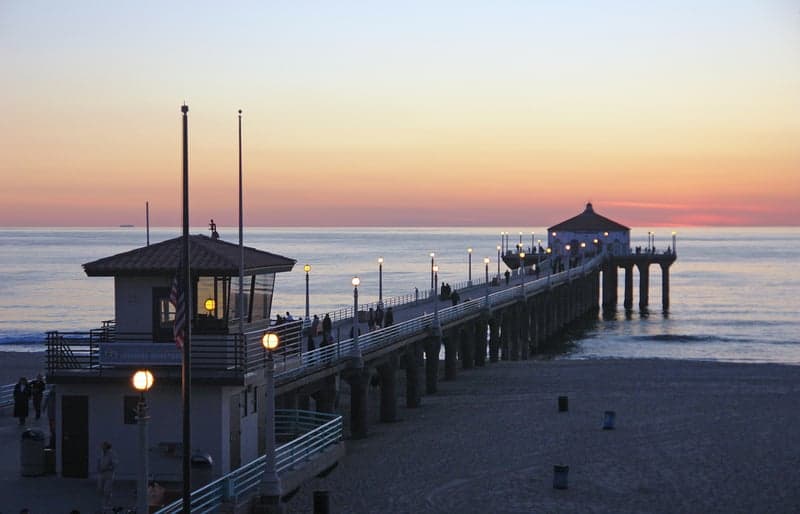
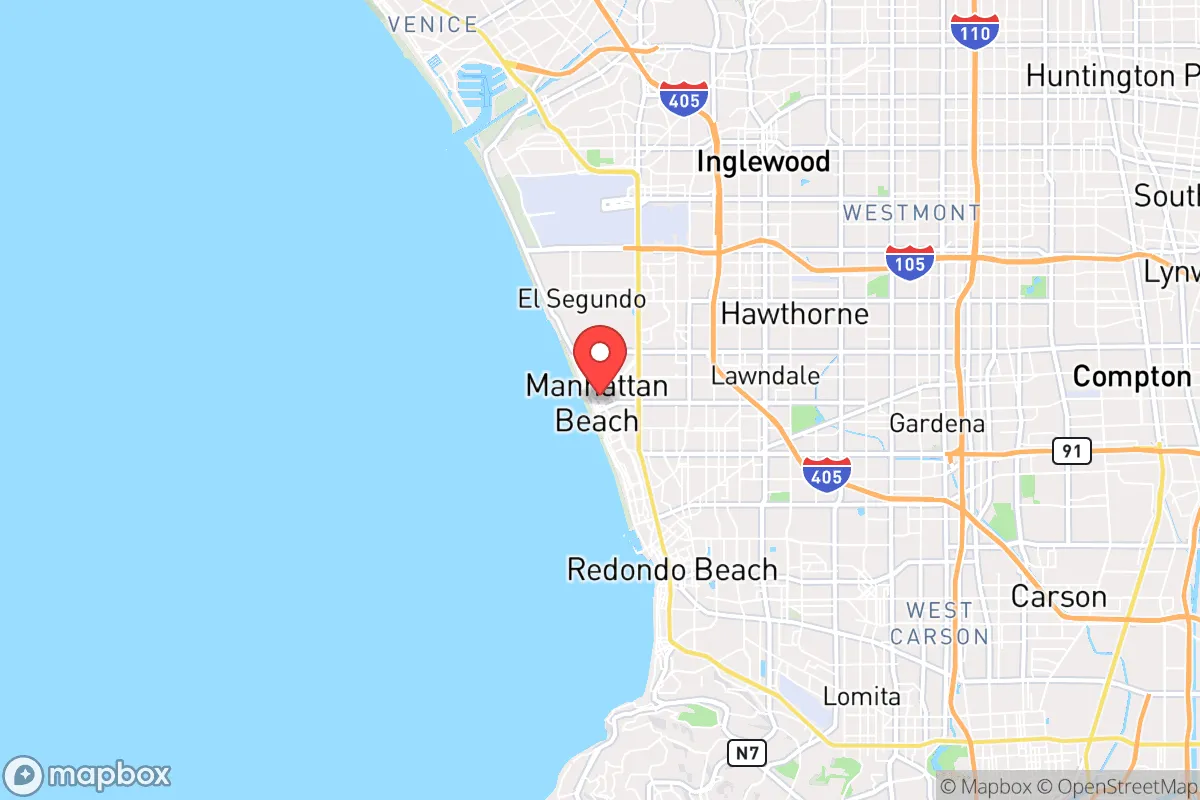
Photo: Wikipedia
Political ClimatePolitical Climate in Manhattan Beach, CA
District shown is the primary district for this city’s centroid. Cities may span multiple districts.
Local Political AnalysisPolitical Analysis of Manhattan Beach, CA
Manhattan Beach has a Cook PVI of D+21, meaning it votes about 21 points more Democratic than the national average, but that number doesn't tell the whole story for those of us who've lived here a while. This town used to be a solidly moderate, business-friendly beach community where people cared more about property values and surf conditions than political posturing. Over the last decade, the shift has been real and noticeable—what was once a place where you could disagree on taxes but agree on keeping the streets safe has become increasingly progressive, with local elections and policy debates reflecting a much more left-leaning agenda than the old-timers remember.
How it compares
If you drive a few miles inland to places like Hermosa Beach or Redondo Beach, you'll find a similar but slightly more tempered political vibe—still blue, but with more room for fiscal conservatism and skepticism of overregulation. Head further south to Palos Verdes Estates or Rolling Hills, and you're in a completely different world: those communities lean Republican, with lower taxes, less zoning drama, and a general attitude of "leave us alone." Even El Segundo, just north of the airport, has a more pragmatic, pro-business council than Manhattan Beach's current crop. The contrast is stark: while neighboring towns still debate the trade-offs of growth and freedom, Manhattan Beach has embraced a progressive agenda that touches everything from housing mandates to plastic straw bans, often without much pushback from a council that seems to think more rules equal better living.
What this means for residents
For those who value personal freedom and limited government, the trend here is concerning. Local ordinances have expanded into areas that used to be left to individual choice—think strict short-term rental bans, aggressive environmental regulations that hit small businesses harder than big corporations, and a school board that's increasingly focused on social ideology over academic rigor. Property taxes are already high by national standards, and the city's appetite for new fees and compliance costs doesn't seem to be slowing down. If you're a homeowner or a small business owner, you're feeling the squeeze: more paperwork, more restrictions, and a council that seems more interested in signaling virtue than in protecting your right to use your property as you see fit. The long-term trajectory, if unchecked, points toward a place where the cost of living—both financial and in terms of personal liberty—continues to climb, pushing out the very families and entrepreneurs who built this community.
Culturally, Manhattan Beach still has its charms—the beach, the weather, the schools are top-notch—but the political climate has shifted in a way that feels less like community consensus and more like top-down management. The city's recent push for "equity" initiatives in local government and schools raises red flags for anyone who believes in merit and individual responsibility. If you're considering a move here, understand that the political culture is increasingly activist, and the days of a live-and-let-live beach town are fading. For those who share a more traditional, freedom-oriented outlook, the nearby conservative enclaves offer a better fit without sacrificing coastal access. Keep an eye on the next few election cycles—if the current trend holds, Manhattan Beach may become a place where your personal rights take a back seat to the latest progressive cause.

State Political ClimatePolitical Climate in California
State Political AnalysisPolitical Environment in the State
California is a deep blue state where Democrats hold every statewide office and supermajorities in both legislative chambers, but that monolithic label hides a fractured reality. The state’s overall partisan lean is roughly D+20 in presidential elections, yet this number is propped up almost entirely by the coastal metros of Los Angeles, San Francisco, and San Diego. Over the last 20 years, the state has lurched leftward on social and economic policy, but a quiet exodus of moderate and conservative families to places like Bakersfield, Temecula, and Redding has created a growing inland resistance. The 2024 election saw Trump improve his vote share in 40 of 58 counties compared to 2020, even as the statewide margin widened for Democrats—a sign of deepening geographic polarization.
Urban vs. rural divide
The political map of California is a tale of two states. The coastal crescent—from San Francisco down through Los Angeles and San Diego—is the engine of Democratic dominance, with San Francisco County delivering 85% of its vote to Biden in 2020 and Los Angeles County adding over 4 million Democratic votes. Inland, the Central Valley and far north are reliably red: Bakersfield (Kern County) voted +15 for Trump in 2024, while Redding (Shasta County) went +30. The Inland Empire, including Riverside and San Bernardino counties, has become a key battleground—Riverside County flipped from blue in 2020 to red in 2024, driven by suburban families fleeing coastal costs and progressive policies. The Bay Area suburbs like Walnut Creek and Pleasanton remain blue but have seen a noticeable rightward shift among Asian-American and white-collar voters frustrated with crime and school policies.
Policy environment
California’s policy environment is the most progressive in the nation, and it shows in the tax code and regulatory landscape. The state has the highest top marginal income tax rate (13.3%) and the highest state sales tax (up to 10.25% in some cities). Property taxes are capped at 1% of assessed value under Prop 13, but annual increases and transfer taxes in cities like Los Angeles and San Francisco add layers of cost. Education policy is dominated by the California Teachers Association, with school choice virtually nonexistent—no vouchers, no charter expansion, and a 2023 law (AB 1078) that bans school boards from rejecting instructional materials on “inclusive” grounds, effectively mandating progressive curricula. Healthcare is heavily regulated, with the state running its own insurance exchange (Covered California) and moving toward a single-payer system. Election laws are among the most liberal: universal mail-in voting, same-day registration, and no voter ID requirement, which has fueled ongoing integrity concerns among conservatives. Gun laws are the strictest in the nation, including an “assault weapons” ban, a 10-day waiting period, and a 2024 law (SB 2) that bans concealed carry in most public places, effectively nullifying the Bruen decision.
Trajectory & freedom
On the freedom index, California is trending sharply downward. The state has expanded government control over personal decisions in nearly every domain. On gun rights, SB 2 (2024) makes it a crime to carry a firearm in “sensitive places” like parks, hospitals, and any business that hasn’t posted a sign allowing it—a de facto ban for most law-abiding citizens. On parental rights, AB 1955 (2024) prohibits school districts from requiring parental notification when a child changes gender identity, overriding local school boards like the one in Temecula that tried to maintain transparency. On medical autonomy, the state has mandated COVID-19 vaccines for schoolchildren (though not yet enforced) and in 2023 passed SB 525, which phases in a $25/hour minimum wage for healthcare workers, driving up costs and reducing access. On property rights, the 2023 “builder’s remedy” law (SB 423) allows developers to bypass local zoning in cities that fail to meet housing targets, eroding community control. The only area of expansion is marijuana legalization, which is fully commercialized. For a conservative, the trajectory is unmistakable: less freedom to raise your kids, defend your home, or keep your earnings.
Civil unrest & political movements
California has been a flashpoint for civil unrest and organized activism on both sides. The 2020 George Floyd protests in Los Angeles and San Francisco saw widespread looting and property destruction, with the city of LA paying out over $100 million in settlements for police misconduct during the unrest. The “defund the police” movement had real teeth here—Los Angeles cut $150 million from the LAPD budget in 2020, though most was restored by 2022 after crime spikes. On the right, the “Recall Newsom” movement in 2021 gathered over 1.6 million signatures and came within 4 points of ousting the governor, driven by frustration with COVID lockdowns, school closures, and homelessness. The state’s sanctuary law (SB 54) prohibits local law enforcement from cooperating with federal immigration authorities, making California a magnet for illegal immigration and a flashpoint for border politics. In San Francisco, the “secession” movement (Calexit) has fizzled, but rural counties like Shasta and Modoc have floated secession from the state itself, citing irreconcilable cultural and policy differences. Election integrity remains a live issue: the 2020 and 2022 elections saw widespread use of ballot drop boxes and mail-in voting, with no voter ID, leading to ongoing distrust among conservatives, especially in Orange County, which flipped from red to blue in 2018 and has seen razor-thin margins since.
Projection
Over the next 5-10 years, California will likely become even more polarized. Demographic trends favor Democrats: the state’s Latino population, while not monolithic, leans blue, and the white working-class base that once supported Republicans is shrinking or leaving. In-migration from other states is net negative—over 300,000 people left in 2023 alone, many to Texas, Arizona, and Idaho—and those who stay are increasingly coastal, college-educated, and progressive. The inland counties will continue to harden red, but their population growth is slower than the coast. The state’s fiscal trajectory is concerning: a projected $68 billion deficit in 2024, driven by over-reliance on capital gains taxes from a volatile tech sector, will likely force tax increases or service cuts. On policy, expect more of the same: stricter gun laws, expanded government healthcare, and further erosion of parental rights. The one wildcard is housing—if the state’s pro-development laws actually produce enough units to lower costs, it could slow the exodus and attract new residents, but that’s a long shot. For a conservative moving in now, the political environment will be more hostile in a decade, with fewer checks on state power.
For a new resident, the bottom line is this: California offers unmatched natural beauty and economic opportunity, but you will pay a heavy price in taxes, regulation, and cultural friction. If you value low taxes, school choice, gun rights, and local control, you will find yourself fighting an uphill battle against a state government that sees those things as obstacles. The best strategy is to pick your county carefully—Temecula or Bakersfield offer a more conservative lifestyle than San Francisco or Los Angeles—but even there, state preemption will limit what local communities can do. Come for the weather and the job market, but be prepared to advocate for your values every step of the way.
* Values derived from national, state, county, city and local statistics and may differ in a specific area. Last updated: 2026-04-15T23:34:19.000Z
Narrative content on this page is AI-generated and may contain mistakes. Verify any details that matter before acting on them.
ReloMaps may earn a commission from affiliate links at no extra cost to you.

