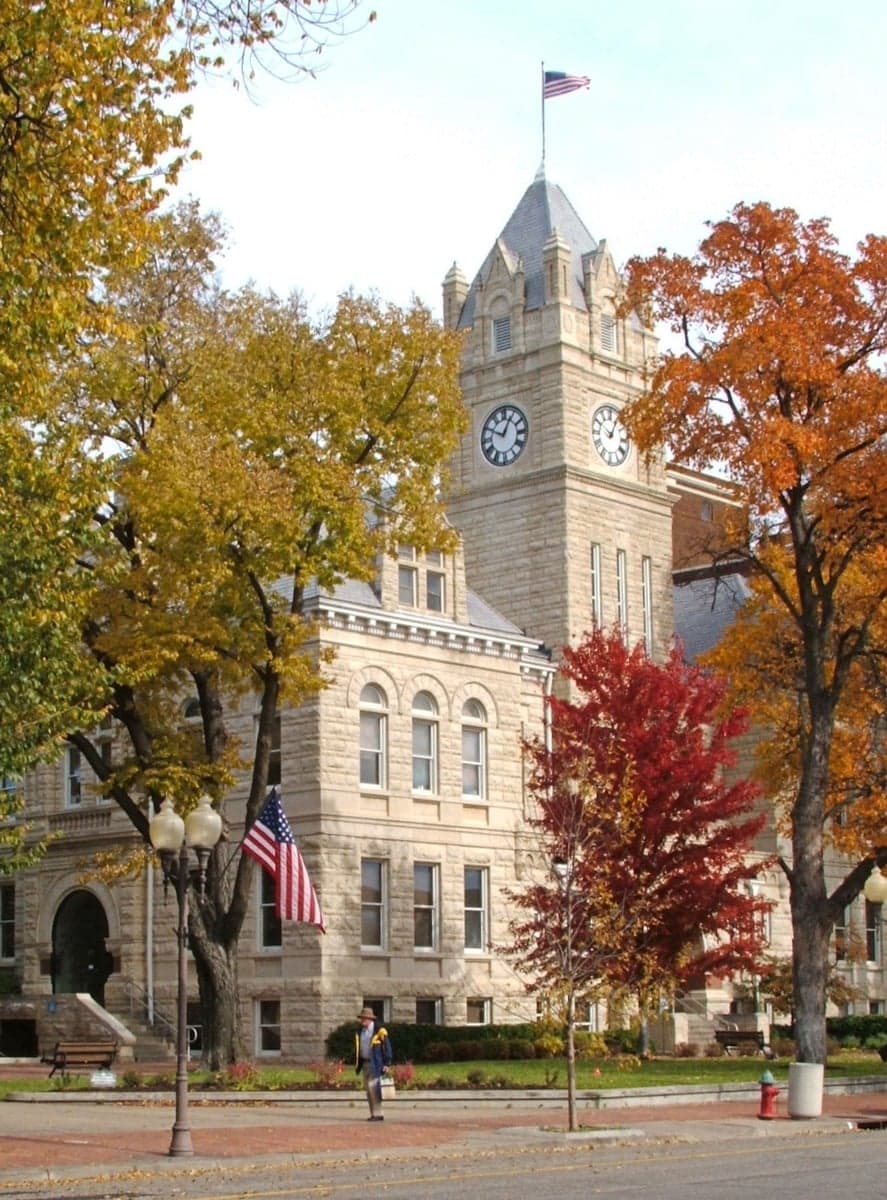
Photo: Wikipedia
Personal Sovereignty in Manhattan, KS
Viable for self-reliance. Generally workable, though some barriers may limit total independence.
What does Personal Sovereignty tell us?
Personal Sovereignty measures your capacity for self-reliance and independence with minimal government friction. Higher scores mean fewer barriers between you and the way you want to live... but it assumes you have the space you need and good neighbors.
What does this tell us?
Personal Sovereignty measures your capacity for self-reliance and independence with minimal government friction. Higher scores mean fewer barriers between you and the way you want to live... but it assumes you have the space you need and good neighbors.
State Policy
Energy independence: Self-sufficient (80% of energy produced in-state)
Personal Liberty
Homesteading

Personal Liberty Analysis
Manhattan, Kansas, offers a notably higher degree of personal sovereignty than many comparably sized college towns, largely because it sits within a state that has consistently pushed back against federal overreach on issues ranging from gun rights to medical freedom. While the presence of Kansas State University introduces a more transient, left-leaning population, the surrounding Riley County and the broader state political structure provide a legal and cultural buffer that preserves individual autonomy. For a conservative-leaning individual or family evaluating relocation from a survivalist or prepper perspective, Manhattan represents a pragmatic middle ground—not a libertarian utopia, but a place where state-level protections and a strong rural ethos meaningfully limit government intrusion into daily life.
Tax burden and regulatory posture: How Kansas state law limits local overreach
Kansas maintains a relatively light tax burden compared to coastal states, with a flat state income tax rate of 5.7% as of 2026 and no local income taxes in Manhattan. Property taxes in Riley County average around 1.2% of assessed value, which is moderate by national standards but noticeably lower than in neighboring Missouri or Colorado. The state’s regulatory environment is explicitly designed to limit municipal overreach: Kansas law preempts local governments from enacting their own minimum wage ordinances, paid leave mandates, or rent control measures. This means Manhattan’s city council cannot unilaterally impose the kind of progressive labor or housing regulations seen in Lawrence or Johnson County. For a prepper concerned about creeping government control, this state-level preemption is a critical safeguard—it ensures that even if local politics shift leftward, the city cannot easily impose burdensome rules on firearm ownership, energy choices, or property use. The Kansas Taxpayer Transparency Act also requires all local tax increases to be put to a public vote, giving residents direct veto power over fiscal overreach.
Self-defense and gun law specifics: Constitutional carry and castle doctrine in practice
Kansas is a constitutional carry state, meaning no permit is required to carry a concealed firearm for any law-abiding adult 21 or older. Manhattan’s local ordinances do not restrict this right—there is no city-level ban on open carry, no magazine capacity limit, and no waiting period beyond the federal background check. The state’s castle doctrine is among the strongest in the region: it imposes no duty to retreat in any place where a person is lawfully present, and it provides civil immunity for justified use of force. This is particularly relevant for preppers who view home defense as a non-negotiable right. Kansas also explicitly prohibits the enforcement of any federal firearm law that does not have a state equivalent, a 2013 statute that remains on the books and has been cited by sheriffs in Riley County as grounds for non-cooperation with federal agents. The practical effect is that Manhattan residents can own NFA items like suppressors and short-barreled rifles without local interference, though federal registration still applies. For those concerned about federal overreach, the state’s Second Amendment Preservation Act provides a legal shield that local law enforcement is expected to honor.
Self-reliance and homesteading viability: Lot sizes, zoning, and off-grid feasibility
Manhattan’s zoning code is more accommodating to self-reliance than most college towns, but it is not a free-for-all. Within city limits, standard residential lots range from 6,000 to 12,000 square feet, which is sufficient for a substantial vegetable garden, small livestock like chickens or rabbits, and rainwater collection systems. The city explicitly permits backyard chickens (hens only, no roosters) on lots under one acre, and beekeeping is allowed with a simple registration. However, larger livestock like goats or pigs are restricted to properties zoned agricultural, which are found primarily in the unincorporated areas of Riley County just outside Manhattan. Off-grid living is legally feasible in the county but not within city limits—Manhattan requires connection to municipal water and sewer for any habitable structure. Solar panels are permitted without special permits, and the state’s net metering law requires utilities to credit homeowners for excess generation, though the credit rate has been reduced in recent years. For a prepper seeking true independence, the most viable strategy is to purchase land in the surrounding county—lots of 5 to 20 acres are available within 15 minutes of downtown for $10,000 to $30,000 per acre—while maintaining a smaller city property for access to jobs and schools. The county has no building codes for agricultural structures, meaning a pole barn or shipping container home can be erected without government approval, provided it is not used as a primary residence.
Personal liberties: Parental rights, medical autonomy, speech, and property
Kansas has been a battleground for parental rights, and the current legal landscape strongly favors family autonomy. The state’s Parental Bill of Rights, enacted in 2023, guarantees parents the right to direct their children’s education, medical care, and moral upbringing, and it requires schools to obtain parental consent before administering any health survey or mental health screening. Homeschooling is lightly regulated—no notification to the state is required, and parents are free to design their own curriculum without standardized testing mandates. Medical autonomy is similarly robust: Kansas has no vaccine mandate for adults or children, and the state explicitly prohibits discrimination based on vaccination status. The Kansas Medical Freedom Act allows any licensed physician to prescribe off-label treatments without fear of disciplinary action, and the state does not participate in federal vaccine databases. On speech and property rights, Kansas is a right-to-work state with no statewide mask or gathering mandates currently in effect. The Kansas Property Rights Protection Act requires the government to compensate landowners for any regulatory taking that reduces property value by more than 20%, a powerful check against zoning overreach. For those concerned about federal overreach, Kansas also has a Tenth Amendment Sovereignty Resolution on the books, though its practical enforcement depends on local sheriffs and prosecutors.
In the broader context of American personal sovereignty, Manhattan, Kansas, ranks favorably for a conservative prepper mindset. It lacks the extreme low-regulation environment of a place like rural Idaho or Montana, but it also avoids the high-tax, high-control dynamics of the West Coast or Northeast. The state-level protections on guns, medical choice, and parental rights are genuine and enforceable, while the local culture—though influenced by the university—still respects individual property and privacy. For a single individual or family willing to navigate the trade-offs of living near a college town, Manhattan offers a rare combination: access to employment and education without sacrificing the legal framework for self-reliance. The key is to stay outside city limits for maximum autonomy, but even within town, the legal protections are stronger than in 80% of U.S. municipalities. If the country continues its trajectory toward federal consolidation, Kansas’s sovereignty laws provide a meaningful legal bulwark—one that Manhattan residents can rely on more than most.

* Values derived from national, state, county, city and local statistics and may differ in a specific area. Last updated: 2026-04-30T21:39:08.000Z
Narrative content on this page is AI-generated and may contain mistakes. Verify any details that matter before acting on them.
ReloMaps may earn a commission from affiliate links at no extra cost to you.

