Photo: Wikipedia
Demographics of Martinsburg, WV
Affluence Level in Martinsburg, WV
A low-income area with significant economic hardship. Household wealth and educational attainment are well below national averages.
People of Martinsburg, WV
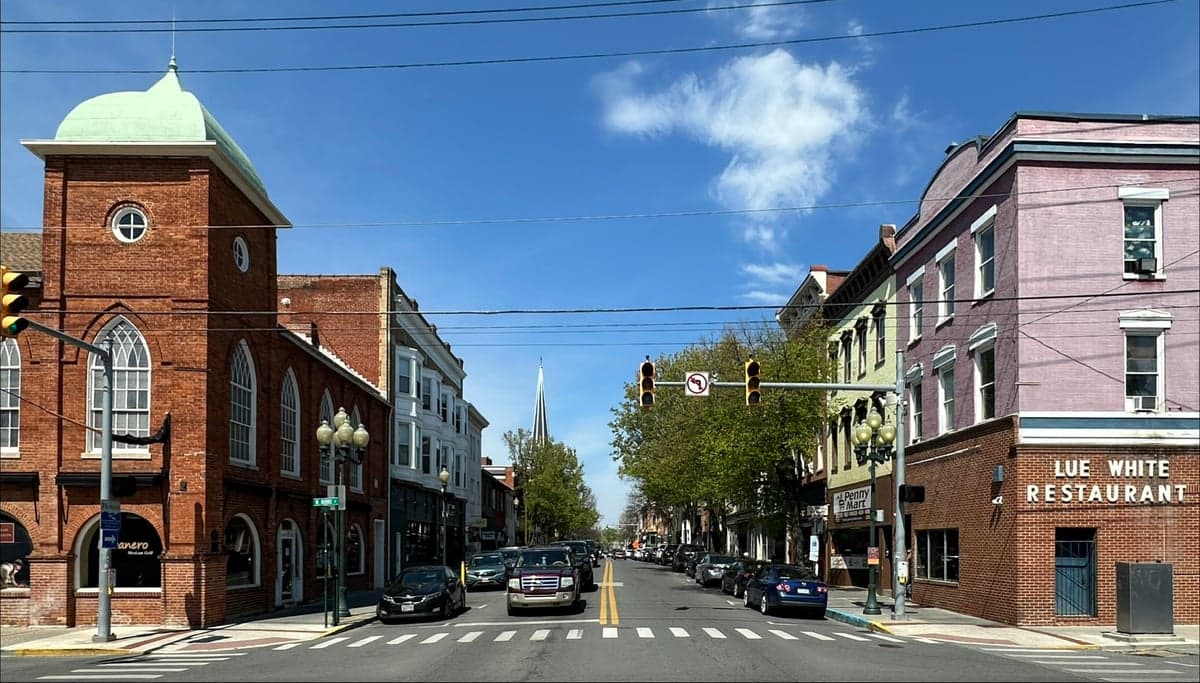
Martinsburg, West Virginia, is a small city of 18,805 residents with a distinctly working-class, historically rooted character. The population is predominantly White (69.2%) with a significant Black minority (13.5%) and a growing Hispanic community (8.0%), while the foreign-born share remains low at 2.1%. The city’s identity is shaped by its railroad and manufacturing past, its role as a regional commercial hub for Berkeley County, and a population that is less college-educated (23.1%) than the national average, reflecting a blue-collar and family-oriented demographic.
How the city was settled and grew
Martinsburg was founded in 1778 on land granted to General Adam Stephen, a Scottish-born physician and Revolutionary War officer. The city’s early growth was driven by its location along the Baltimore and Ohio Railroad, which arrived in 1842 and made Martinsburg a critical rail hub. The original population was overwhelmingly of English, Scottish, and German descent, with families like the Van Metres and the Hedges establishing the early grid of streets. The historic Adam Stephen House neighborhood and the area around Queen Street (the original commercial corridor) were built by these early settlers, who were farmers, merchants, and tradesmen. The railroad brought a second wave: Irish immigrants who dug the tunnels and laid the tracks, settling in the North Martinsburg area near the rail yards. By the late 19th century, the B&O Railroad shops employed thousands, drawing German and Italian immigrants into neighborhoods like Spring Mills (then a separate village) and the South End near the roundhouse. The city’s population peaked at around 20,000 in the 1950s, sustained by the railroad and a growing apple-orchard economy in the surrounding county.
Modern era (post-1965)
The post-1965 era brought significant demographic shifts. The 1965 Hart-Cellar Act had a muted direct effect on Martinsburg—foreign-born residents today are only 2.1%—but the city experienced substantial domestic in-migration. The decline of the B&O Railroad in the 1970s and 1980s led to population stagnation and an outflow of younger workers. However, the 1990s and 2000s saw a reverse: Martinsburg became a bedroom community for Washington, D.C., and Northern Virginia, located about 90 minutes east on I-81. This brought a wave of White and Black middle-class families seeking cheaper housing, settling in newer subdivisions like Foxcroft and Wynnefield on the city’s eastern edge. The Black population, historically concentrated in the East End (around Martin Street and the area near the old segregated school), has remained stable at 13.5%, with many families tracing roots to the Great Migration of the 1940s and 1950s when Black workers came for railroad and factory jobs. The Hispanic population grew from negligible to 8.0% since 2000, driven by Mexican and Central American immigrants working in agriculture (apple orchards and nurseries) and construction. They have clustered in the West Side near the industrial parks and along Winchester Avenue. The East/Southeast Asian population (0.7%) is tiny, consisting mostly of Vietnamese and Filipino families who arrived in the 1980s and 1990s, many connected to the military or medical professions at the nearby VA Medical Center. The Indian-subcontinent population is effectively zero (0.0%).
The future
Martinsburg’s population is slowly homogenizing in terms of race, but tribalizing by geography. The White share (69.2%) is declining gradually as the Hispanic share rises, but the Black share (13.5%) has been flat for decades, suggesting little new Black in-migration. The Hispanic community is growing and likely to continue doing so, driven by family reunification and agricultural labor demand, but it remains small enough that assimilation into the broader White working-class culture is the norm. The city is not seeing the ethnic enclave formation common in larger metros; instead, new Hispanic arrivals tend to settle in the West Side and Spring Mills areas, mixing with long-time White residents. The East/Southeast Asian population is too small to form a distinct neighborhood and is dispersed. The biggest demographic trend is the continued in-migration of White and Black families from the D.C. suburbs, who are buying older homes in Downtown and North Martinsburg, driving modest gentrification. Over the next 10–20 years, Martinsburg will likely remain a predominantly White, working-class city with a stable Black minority and a slowly growing Hispanic population. The foreign-born share may rise to 4–5% but will stay far below national averages.
For someone moving in now, Martinsburg is a city where the population is stable and rooted, not rapidly diversifying or polarizing. The dominant culture remains that of the old railroad and apple-growing families, with a growing overlay of D.C. exurbanites seeking affordability. The city is becoming slightly more Hispanic and slightly more suburban, but its core identity—small-town, blue-collar, and historically White with a significant Black presence—is likely to persist. New arrivals will find a place where neighborhood identity matters, with the East End, West Side, and Foxcroft each offering a distinct social character.

* Values derived from national, state, county, city and local statistics and may differ in a specific area. Last updated: 2026-04-23T05:45:27.000Z
Narrative content on this page is AI-generated and may contain mistakes. Verify any details that matter before acting on them.
ReloMaps may earn a commission from affiliate links at no extra cost to you.

