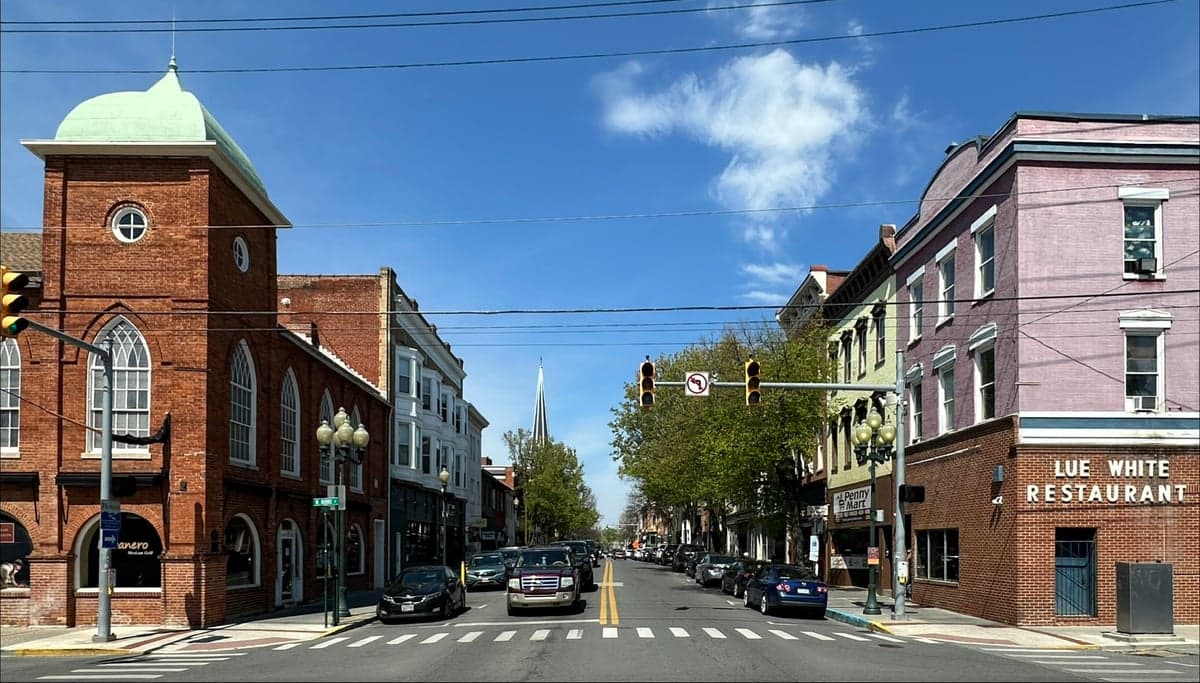
Photo: Wikipedia
Political ClimatePolitical Climate in Martinsburg, WV
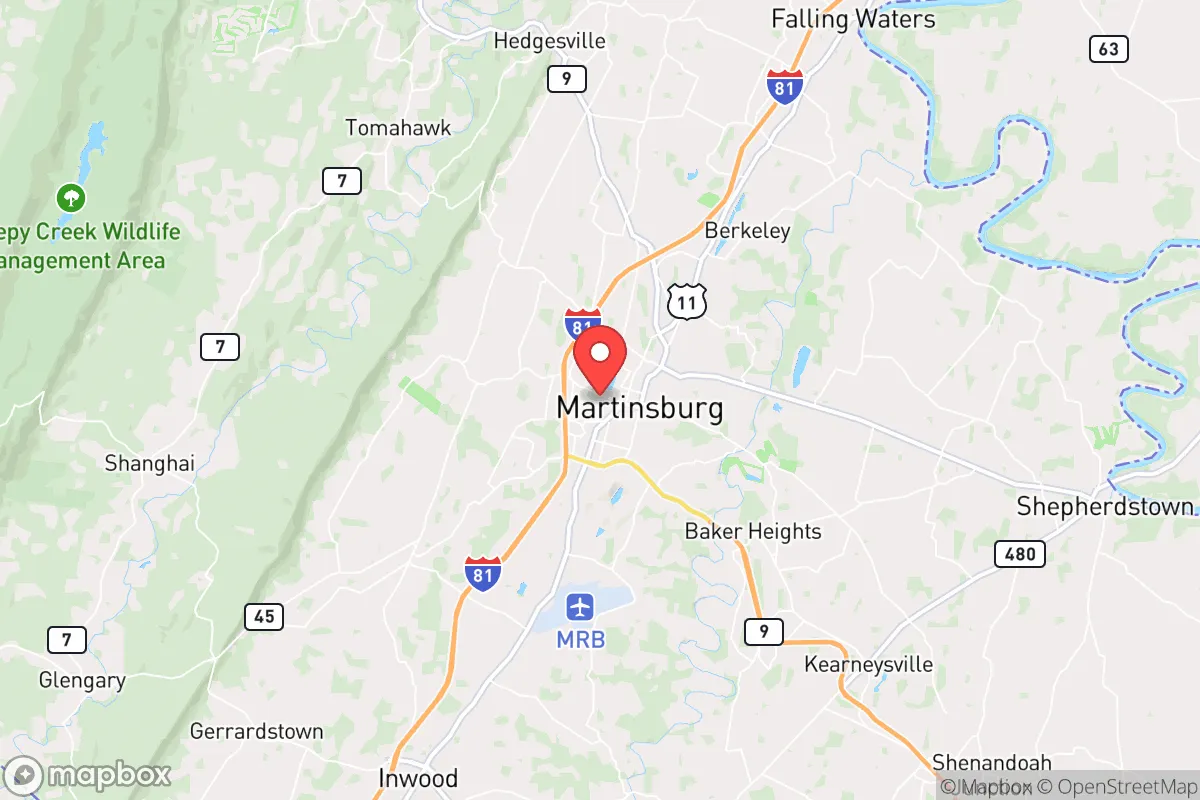
District shown is the primary district for this city’s centroid. Cities may span multiple districts.
Local Political AnalysisPolitical Analysis of Martinsburg, WV
Martinsburg, West Virginia, sits deep in reliably red territory, with a Cook PVI of R+20 that reflects generations of conservative values. This isn't a place that flips on a dime; the area has voted solidly Republican in every presidential election since 2000, and local offices are overwhelmingly held by folks who believe in limited government and personal responsibility. That said, you can feel a subtle shift creeping in from the east—folks moving out of the D.C. metro area, especially from places like Frederick, MD, and Leesburg, VA, are bringing different ideas with them. It’s not a blue wave by any stretch, but the political conversation is getting a little more complicated than it was even ten years ago.
How it compares
Drive 20 miles east into Maryland, and you hit Hagerstown—a town that’s noticeably more purple, with a Democratic mayor and a city council that’s pushed progressive policies like paid sick leave and sanctuary city resolutions. That contrast is stark for Martinsburg residents, who see Hagerstown as a cautionary tale of what happens when government overreach creeps into daily life. Head south to Winchester, VA, and you’ll find a similar conservative tilt to Martinsburg, but with a stronger suburban influence that’s slowly nudging local politics toward more moderate stances on development and taxes. The real eye-opener is Berkeley County itself: while the county commission remains conservative, the city of Martinsburg has seen a few closer races in recent years, with progressive candidates gaining traction on issues like police reform and affordable housing mandates. It’s not a takeover, but it’s a warning sign for anyone who values keeping government out of their personal business.
What this means for residents
For the average Martinsburg resident, the political climate means you can still count on low property taxes, a sheriff’s office that focuses on real crime rather than social experiments, and a school board that hasn’t bought into the latest national curriculum fads. Gun rights are respected—you won’t find the kind of permitting delays or magazine bans you see across the border in Maryland. But the concern is real: as more people move in from high-tax, high-regulation states, they bring voting habits with them. Local zoning battles are heating up, with some newcomers pushing for more government control over housing density and short-term rentals. The long-term worry is that Martinsburg could slowly lose its character—a place where you could build a shed without a permit or run a small business from your garage without a stack of forms. If the progressive drift continues, residents fear they’ll end up with the same red tape they moved here to escape.
Culturally, Martinsburg still feels like old West Virginia—church potlucks, hunting season as a local holiday, and a general distrust of politicians who promise to fix everything with new laws. The biggest policy distinction is the county’s resistance to state-level pushes for renewable energy mandates and electric vehicle infrastructure, which many locals see as federal overreach disguised as green policy. There’s a strong sense here that the best government is the one that leaves you alone, and that’s the political line that’s worth defending. If you’re looking for a place where your vote actually means something and your freedoms aren’t treated as negotiable, Martinsburg is still that place—but you’ve got to keep an eye on the ballot box every election cycle.

State Political ClimatePolitical Climate in West Virginia
State Political AnalysisPolitical Environment in the State
West Virginia has been a reliably red state for over two decades, with Donald Trump winning it by nearly 39 points in 2024, making it the most Republican-leaning state in the nation. The state’s political transformation from a Democratic stronghold to a conservative bastion is one of the most dramatic in modern American history, driven largely by the collapse of organized labor and the coal industry’s decline. Today, the dominant coalition is a mix of rural populists, evangelical Christians, and former union Democrats who have shifted right on cultural and economic issues, creating a political environment that is deeply skeptical of federal overreach and progressive social policies.
Urban vs. rural divide
The political map of West Virginia is starkly divided between a few small urban centers and the vast, deeply conservative countryside. Charleston, the state capital and largest city, is the only real blue dot, with Kanawha County voting Democratic in recent presidential cycles by narrow margins, driven by state government workers, university faculty, and a small but vocal progressive activist class. Morgantown, home to West Virginia University, leans left as well, though its student population creates a transient liberal influence that doesn’t reflect the permanent electorate. Huntington, the second-largest city, is more purple but still votes Republican in statewide races. Everywhere else—from the coal fields of Logan and Mingo counties to the eastern panhandle towns of Martinsburg and Charles Town—votes overwhelmingly red. The rural-urban divide is less about policy disagreement and more about culture: rural West Virginians see Charleston and Morgantown as out-of-touch enclaves that don’t understand the realities of life in the hollows and hills.
Policy environment
West Virginia’s policy environment is aggressively conservative, with a focus on reducing taxes, limiting regulation, and protecting traditional values. The state has no personal income tax on Social Security benefits, and in 2023, Governor Jim Justice signed a bill to phase out the state’s personal income tax entirely over several years, with a 4% cut already in effect. Property taxes are among the lowest in the nation, and there is no estate or inheritance tax. The regulatory posture is business-friendly, particularly for energy extraction, with the state actively courting natural gas and coal companies. Education policy has shifted toward school choice: the 2021 Hope Scholarship program provides state funding for private school tuition, and charter schools were legalized in 2019. Healthcare is a mixed bag—Medicaid expansion was accepted under the ACA, but the state has not created its own insurance exchange, and abortion is banned after 15 weeks with no exceptions for rape or incest. Election laws are strict: voter ID is required, early voting is limited to 10 days, and absentee ballots require an excuse. The state also passed a constitutional amendment in 2018 declaring that there is no right to abortion in West Virginia.
Trajectory & freedom
West Virginia is becoming more free in several key areas, particularly regarding gun rights, parental rights, and taxation. In 2023, the state enacted constitutional carry, allowing residents to carry a concealed firearm without a permit. The same year, the legislature passed the Parental Bill of Rights, which requires schools to notify parents of any curriculum involving human sexuality and prohibits instruction on gender identity in grades K-12. Medical freedom has seen some wins: the state banned COVID-19 vaccine mandates for government employees and students in 2022, and it has not implemented any mask or lockdown mandates since 2021. However, property rights remain a concern, particularly with the state’s aggressive use of eminent domain for pipeline projects, such as the Mountain Valley Pipeline, which has sparked legal battles from landowners. On the downside, the state’s heavy reliance on federal funding—over 40% of its budget comes from Washington—creates a vulnerability that limits true independence. The trajectory is toward more personal liberty on cultural and Second Amendment issues, but economic freedom is constrained by the state’s dependence on federal dollars and a shrinking tax base.
Civil unrest & political movements
West Virginia has a long history of labor unrest, but modern political movements are more focused on cultural and environmental issues. The 2021 teachers’ strike over pay and benefits was the most significant recent protest, shutting down schools across the state for nine days and forcing a deal that included a 5% pay raise. That strike was notable for its bipartisan support—many rural conservatives backed the teachers, even as the Republican-controlled legislature resisted. On the right, the West Virginia Citizens Defense League is active in gun rights advocacy, and the state has seen a rise in county-level Second Amendment sanctuary resolutions, with over 30 counties passing symbolic measures against federal gun control. Immigration politics are minimal—the state has one of the smallest foreign-born populations in the country, and there are no sanctuary cities. Election integrity has been a flashpoint: in 2020, the state’s Republican secretary of state, Mac Warner, conducted a post-election audit that found no evidence of widespread fraud, but some grassroots groups continue to push for hand-counting ballots and stricter voter roll maintenance. The most visible flashpoint for a new resident would be the Mountain Valley Pipeline protests, which have drawn both environmental activists and property rights advocates into a messy, ongoing conflict that has resulted in arrests and court battles.
Projection
Over the next 5-10 years, West Virginia is likely to become even more conservative, driven by two demographic trends: the continued out-migration of younger, more liberal residents to cities like Charlotte and Columbus, and the in-migration of retirees and remote workers from blue states seeking lower taxes and a slower pace of life. The eastern panhandle, particularly Berkeley County and Jefferson County, is seeing the fastest growth, with new arrivals from the D.C. metro area who tend to be more moderate but still vote Republican in state races. The state’s population is aging and shrinking—it lost over 3% of its population between 2020 and 2024—which means the political power of rural, older voters will only increase. The income tax phase-out will make the state more attractive to high-earners, but the lack of economic diversification and the ongoing decline of coal will keep the tax base fragile. Expect continued battles over school choice expansion, further restrictions on abortion, and a push to eliminate the state’s remaining corporate taxes. The biggest wildcard is the federal funding cliff—if Washington cuts Medicaid or infrastructure dollars, the state will face a fiscal crisis that could force tax increases or service cuts, testing the limits of its conservative governance model.
For a new resident, the bottom line is that West Virginia offers a deeply conservative, low-tax, culturally traditional environment where your Second Amendment rights are protected and your kids won’t be exposed to progressive gender ideology in public schools. The trade-offs are real: the economy is weak, the population is aging, and the state’s dependence on federal money creates long-term uncertainty. If you’re looking for a place where the government stays out of your life and your wallet, West Virginia delivers—but you’ll need to be comfortable with a slower pace, limited job opportunities, and a political culture that is unapologetically red, from the hollows of Boone County to the hills of Preston County.
* Values derived from national, state, county, city and local statistics and may differ in a specific area. Last updated: 2026-04-23T05:45:27.000Z
Narrative content on this page is AI-generated and may contain mistakes. Verify any details that matter before acting on them.
ReloMaps may earn a commission from affiliate links at no extra cost to you.

