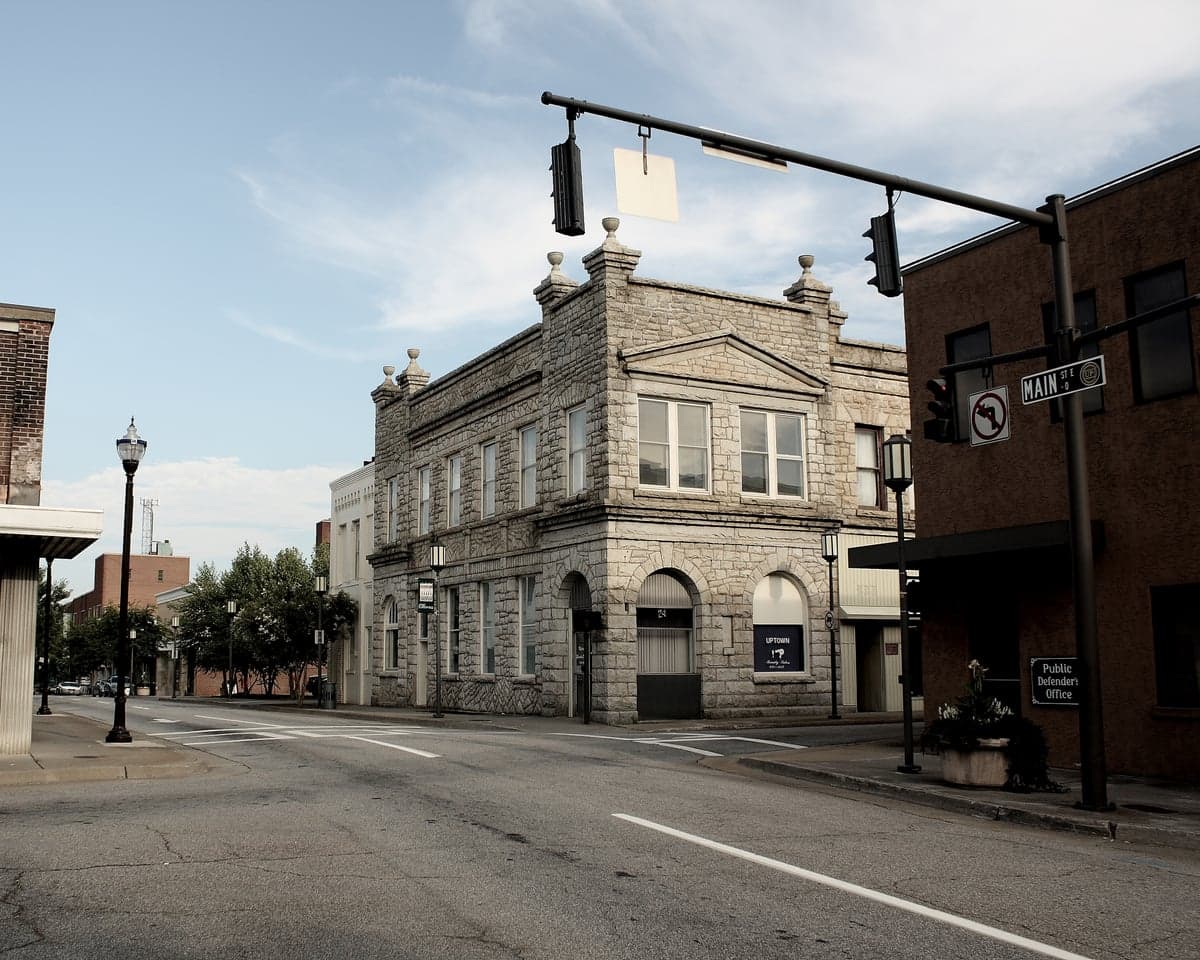
Photo: Wikipedia
Demographics of Martinsville, VA
Affluence Level in Martinsville, VA
A below-average socioeconomic profile. Incomes, home values, and educational attainment trail the U.S., with higher poverty and unemployment.
People of Martinsville, VA
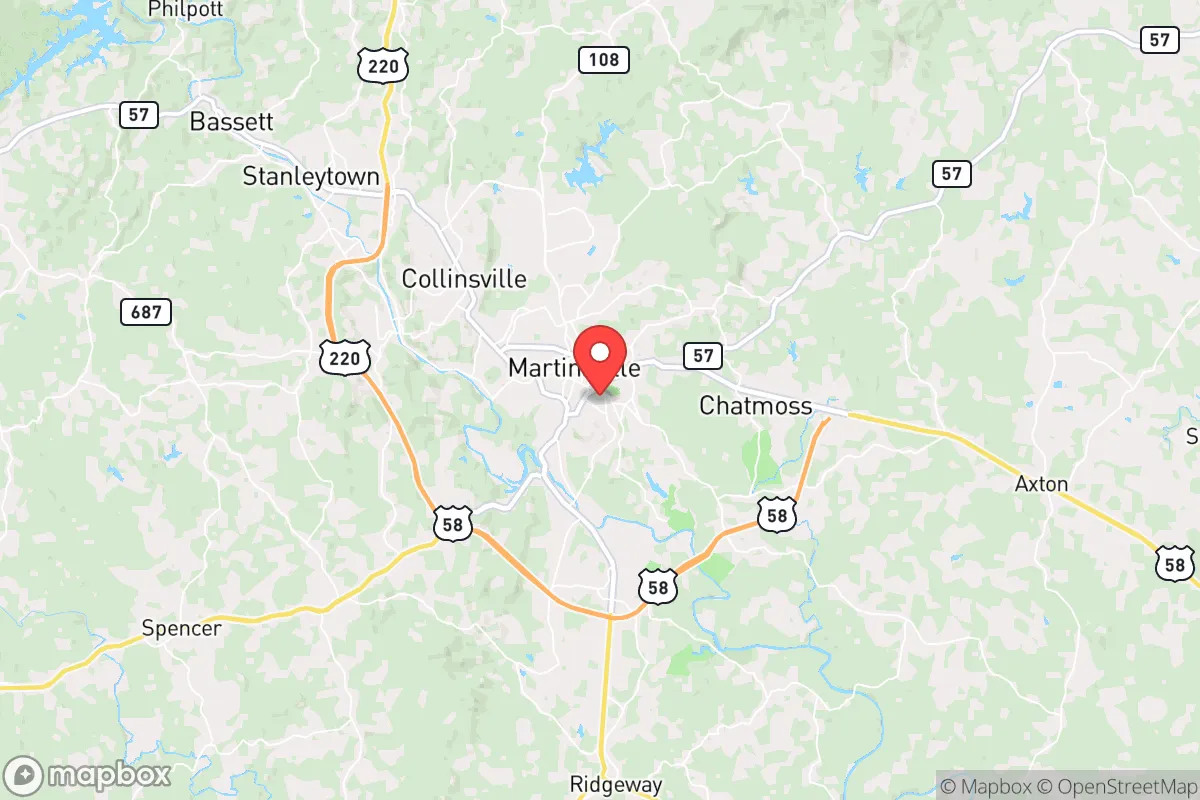
Martinsville, Virginia, is a small, historically industrial city of 13,584 residents where Black and white populations are nearly balanced, with Black residents forming a slight plurality at 44.2% and white residents at 41.7%. The city is notably less diverse than the national average, with a foreign-born population of just 4.2% and a Hispanic share of 8.0%, reflecting a community shaped by deep-rooted local families rather than recent immigration. Its population density is moderate for a small city, but the defining characteristic is a strong sense of place tied to the furniture and textile mills that once defined the region. Today, Martinsville is a community grappling with economic transition, where the legacy of industrial work and racial division still shapes daily life and neighborhood patterns.
How the city was settled and grew
Martinsville’s population history begins with the arrival of English and Scots-Irish settlers in the mid-18th century, drawn by land grants in the Piedmont foothills. The town was officially established in 1793 as the county seat of Henry County, but its real growth came after the Civil War, when the region’s abundant timber and water power fueled a furniture and textile boom. By the early 1900s, the city’s economy was anchored by the Stanley Furniture Company and DuPont’s nylon plant, which attracted waves of white workers from the surrounding rural areas and Black workers from the Deep South seeking industrial jobs. These groups settled in distinct neighborhoods: white mill workers concentrated in Fairystone and Horsepasture (now part of the city’s northern fringe), while Black families built communities in Fayette Street and Uptown, near the mills and rail lines. The city’s population peaked at around 20,000 in the 1970s, driven by the post-war industrial expansion that made Martinsville a regional manufacturing hub.
Modern era (post-1965)
The post-1965 period brought significant demographic change, though not through the immigration waves seen in larger Virginia cities. Instead, Martinsville’s modern shift was driven by domestic migration: the decline of the furniture and textile industries after the 1980s triggered a steady out-migration of white families to surrounding suburbs like Collinsville and Bassett, while Black families remained more concentrated in the city core. The white population share dropped from over 60% in 1980 to 41.7% today, while the Black share rose from roughly 35% to 44.2%, reflecting both white flight and a higher birth rate among Black residents. The Hispanic population, now 8.0%, began growing in the 1990s as a small number of Mexican and Central American workers arrived to fill labor gaps in poultry processing and construction, settling primarily in the West End and Spruce Street areas. The East/Southeast Asian population remains tiny at 0.8%, mostly Vietnamese and Filipino families who came in the 1980s and 1990s, concentrated near the Memorial Hospital corridor. The Indian-subcontinent population is negligible at 0.3%, largely professionals at the local hospital or nearby colleges.
The future
Martinsville’s population is projected to continue its slow decline, with the city losing roughly 1-2% of residents per decade since 2000. The trend is toward homogenization rather than tribalization: the white population is aging and shrinking, the Black population is stable but also aging, and the Hispanic share is growing slowly but remains too small to reshape the city’s character. The foreign-born population (4.2%) is unlikely to rise significantly, as the city lacks the job base or immigrant networks that drive growth in larger metros. The college-educated share (21.2%) is below the national average, and the city’s economy—now reliant on healthcare, retail, and a struggling manufacturing sector—does not attract young professionals in large numbers. Over the next 10-20 years, Martinsville will likely become slightly more Hispanic and slightly less white, but the dominant story will be population loss and aging, not diversification. The city’s neighborhoods will remain largely defined by race and class: Fayette Street and Uptown as historically Black areas, Fairystone and Horsepasture as predominantly white, and the West End as a small Hispanic enclave.
For someone moving to Martinsville today, the city offers a tight-knit, affordable community with a strong sense of local history, but it is not a place of rapid demographic change or new growth. The population is stable in its composition, with clear racial and geographic lines that have persisted for decades. New residents—especially those from outside the region—should expect a community where family ties run deep, where the economy is still recovering from deindustrialization, and where the social fabric is shaped more by local tradition than by new arrivals.

* Values derived from national, state, county, city and local statistics and may differ in a specific area. Last updated: 2026-05-01T06:43:47.000Z
Narrative content on this page is AI-generated and may contain mistakes. Verify any details that matter before acting on them.
ReloMaps may earn a commission from affiliate links at no extra cost to you.

