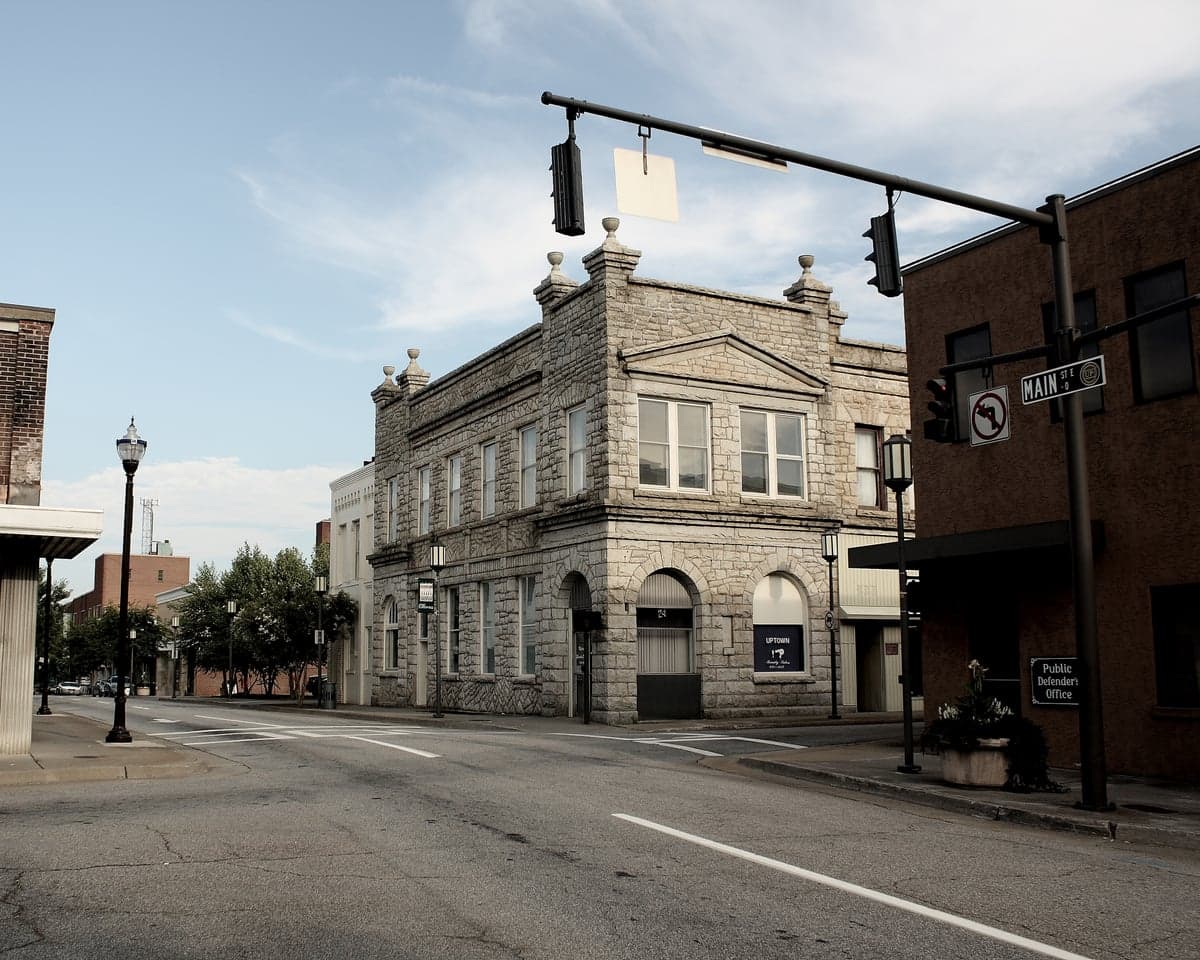
Photo: Wikipedia
Personal Sovereignty in Martinsville, VA
Viable for self-reliance. Generally workable, though some barriers may limit total independence.
What does Personal Sovereignty tell us?
Personal Sovereignty measures your capacity for self-reliance and independence with minimal government friction. Higher scores mean fewer barriers between you and the way you want to live... but it assumes you have the space you need and good neighbors.
What does this tell us?
Personal Sovereignty measures your capacity for self-reliance and independence with minimal government friction. Higher scores mean fewer barriers between you and the way you want to live... but it assumes you have the space you need and good neighbors.
State Policy
Energy independence: Importer (20% of energy produced in-state)
Personal Liberty
Homesteading

Personal Liberty Analysis
Martinsville, Virginia, offers a notably high degree of personal sovereignty compared to many urban and coastal jurisdictions, largely due to its location in a state that has historically resisted the most aggressive forms of government overreach. While no location is a perfect libertarian paradise, the combination of a low cost of living, a relatively hands-off regulatory environment, and a culture of self-reliance makes this area a serious consideration for those prioritizing autonomy. For the survivalist or prepper mindset, the key question is whether the local and state frameworks allow you to live your life, defend your family, and prepare for uncertainty without constant interference from the state. The answer here is a cautious but genuine yes, with specific caveats around state-level tax and gun policies that require careful navigation.
Tax burden and regulatory posture: How much the state takes and how much it interferes
Virginia is not a no-tax state, but its overall burden is moderate, and Martinsville’s specific local posture leans toward minimal interference. The state income tax is a flat rate of 5.75% on all taxable income, which is straightforward but not negligible. Property taxes in Martinsville are relatively low, with a real estate tax rate of approximately $1.12 per $100 of assessed value, and the city has not aggressively reassessed properties to capture inflation-driven gains. There is no state-level tax on Social Security benefits, and military pensions are partially exempt, which matters for long-term planning. The regulatory environment for small businesses and home-based enterprises is permissive; there is no county-level business license requirement for most sole proprietorships, and zoning in the outlying areas of Henry County (which surrounds the city) is generally lenient. However, Virginia does have a state-level sales tax of 5.3% (with local add-ons pushing it to about 6.3% in Martinsville), and the state’s Department of Environmental Quality can impose hurdles on certain land uses, such as large-scale timbering or excavation. For the prepper, the key takeaway is that the state does not actively hunt for regulatory violations, but you must stay compliant with the basics—building permits for major structures, septic system approvals, and well water testing—to avoid becoming a target. The overall posture is one of benign neglect rather than active hostility, which is a significant advantage over states like California or New York.
Self-defense and gun law specifics: What you can own and where you can carry
Virginia is a shall-issue state for concealed carry permits, and Martinsville’s local sheriff’s office processes applications without undue delay or subjective discretion. The state law allows open carry without a permit for anyone legally allowed to possess a firearm, and constitutional carry (permitless concealed carry) became legal on July 1, 2021. This means that as of 2026, any law-abiding adult can carry a concealed handgun without a permit, though a permit is still available for reciprocity with other states. There are no magazine capacity restrictions in Virginia, and the state does not ban any specific type of firearm by name, including AR-15s and other modern sporting rifles. The state does have a one-handgun-per-month law, which is an irritant for collectors and those building a serious armory, but it can be bypassed by purchasing from private sellers or out of state (with proper transport). The NFA (National Firearms Act) items—suppressors, short-barreled rifles, and machine guns—are legal with federal paperwork, and the state does not impose additional restrictions. The local culture in Martinsville is strongly pro-Second Amendment; gun stores and ranges are common, and there is no social stigma attached to carrying openly or discussing firearms. For the survivalist, the legal framework is solid, but the one-gun-per-month rule is a reminder that Virginia is not a free state in the same sense as Alaska or New Hampshire. Still, compared to the Northeast or West Coast, this is a haven.
Self-reliance and homesteading viability: Lot sizes, zoning, and off-grid feasibility
Martinsville itself is a small city with typical suburban lot sizes (0.25 to 0.5 acres), but the surrounding Henry County and adjacent areas like Patrick County offer genuine homesteading opportunities. Agricultural zoning in Henry County allows lots as small as 1 acre for a single-family home with livestock, and parcels of 5 to 20 acres are readily available for under $5,000 per acre. The county does not have a blanket ban on rainwater collection, and many rural properties rely on private wells and septic systems, which gives you direct control over your water and waste. Solar panels are permitted without special permits, and net metering is available through the local electric cooperative (Mecklenburg Electric Cooperative) for grid-tied systems. Off-grid living is legally feasible: you can build a dwelling without connection to municipal water or sewer, provided you meet the Virginia Department of Health’s well and septic standards. The county does not require a certificate of occupancy for structures that are not intended for permanent habitation, so a workshop, barn, or storage shed can be built without triggering a full inspection. The main regulatory hurdle is the building code for habitable structures, which requires permits and inspections for electrical and plumbing. For the serious prepper, the ideal move is to buy 5+ acres in Henry or Patrick County, drill a well, install solar, and build a pole barn or small cabin as a base. The local government will largely leave you alone if you pay your property taxes and do not create a public nuisance.
Personal liberties: Parental rights, medical autonomy, speech, and property
Virginia’s state-level policies on parental rights are mixed. The state does not have a comprehensive parental rights in education law like Florida’s, but local school boards in Henry County and Martinsville have generally been conservative and deferential to parents. The state does not mandate any specific medical treatments for children without parental consent, and the recent trend has been toward protecting parental authority in medical decisions. On medical autonomy, Virginia does not have a state-level vaccine mandate for adults, and the emergency powers used during the COVID-19 pandemic have been significantly curtailed by the legislature. The state does have a prescription drug monitoring program, but there is no state-level mandate for any specific treatment or procedure for the general population. Free speech is protected under the First Amendment, and local law enforcement in Martinsville does not engage in the kind of viewpoint-based censorship seen in larger cities. Property rights are strong: Virginia is a “Dillon’s Rule” state, meaning local governments only have powers explicitly granted by the state, which limits the ability of city councils to impose onerous land-use restrictions. Eminent domain is rarely used for private development, and the state’s right-to-farm law protects agricultural operations from nuisance lawsuits. For the prepper, the most critical liberty is the ability to stockpile supplies, store fuel, and maintain a low profile without government surveillance. There is no state-level red flag law in Virginia (as of 2026), and the state does not have a firearm registry. The combination of strong property rights, weak local government, and a conservative judiciary makes Martinsville a solid choice for those who value personal autonomy over collective conformity.
In the broader landscape of American personal sovereignty, Martinsville and its surrounding county offer a rare combination of low cost, permissive gun laws, and genuine homesteading potential. The state-level irritants—the one-gun-per-month rule, the flat income tax, and the lingering possibility of future emergency powers—are real but manageable. Compared to the heavily regulated states of the Northeast and West Coast, this area is a sanctuary. Compared to the truly free states of the Mountain West, it is a compromise. For the strategic relocator who values self-reliance, family autonomy, and the ability to prepare for an uncertain future without government interference, Martinsville represents a rational, defensible choice—not perfect, but far better than most.

* Values derived from national, state, county, city and local statistics and may differ in a specific area. Last updated: 2026-05-01T06:43:47.000Z
Narrative content on this page is AI-generated and may contain mistakes. Verify any details that matter before acting on them.
ReloMaps may earn a commission from affiliate links at no extra cost to you.

