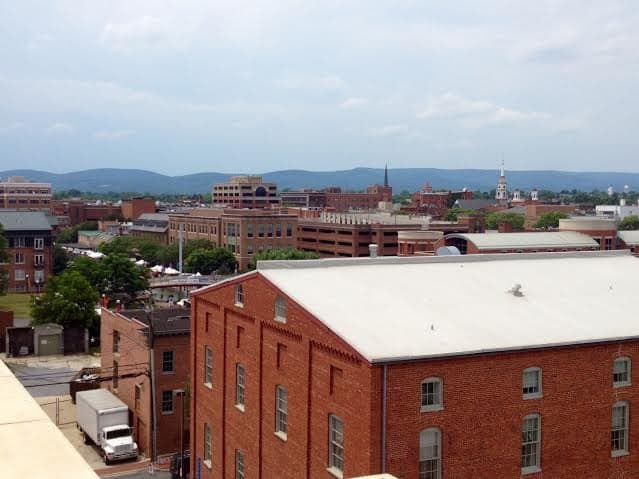
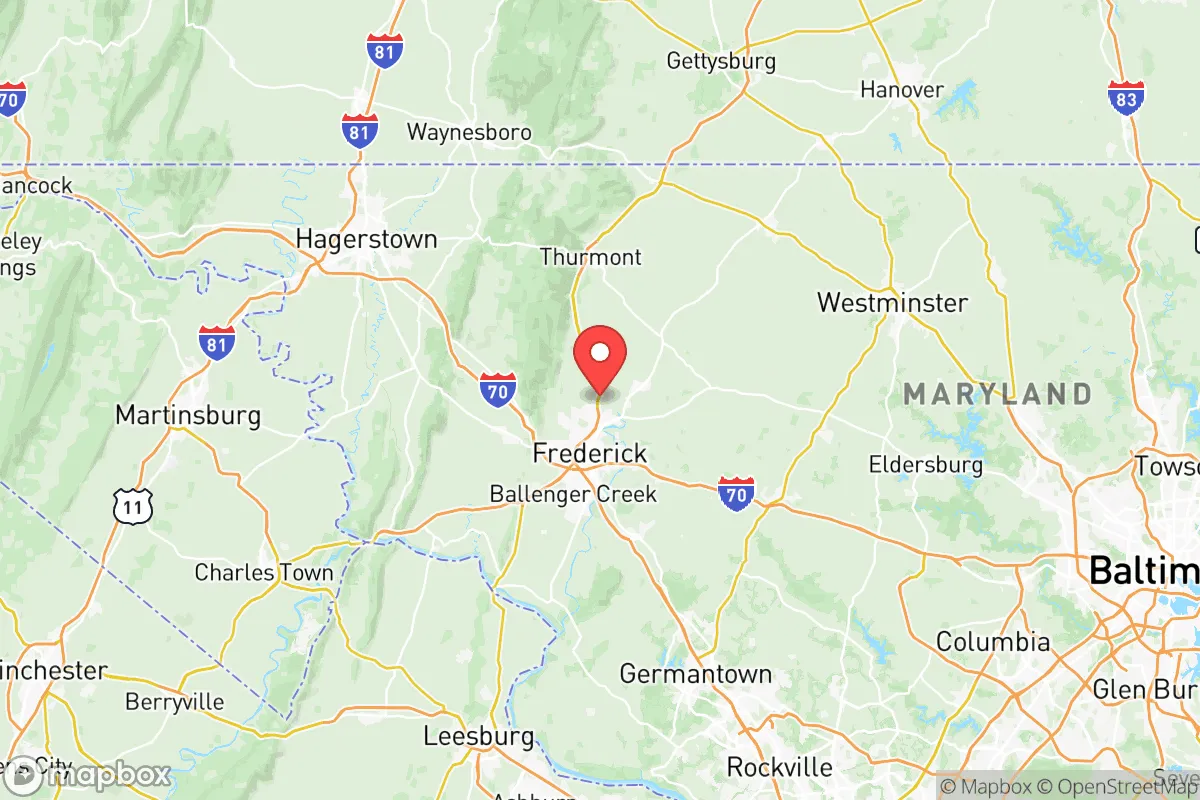
Photo: Wikipedia
Demographics of Frederick County
Affluence Level in Frederick County
An upper-middle-class area. Household wealth, education levels, and homeownership run ahead of national benchmarks.
People of Frederick County
Frederick County, Maryland, is home to 280,341 residents who form a community defined by its deep German and Scots-Irish roots, a growing Hispanic and Asian presence, and a strong sense of local identity that balances rural tradition with suburban expansion. The county’s population is 67.3% white, with a notable 12.3% Hispanic share and a combined 5.4% Asian and Indian population, reflecting a steady diversification that began in earnest after 1965. With 44.9% of adults holding a college degree, Frederick County is more educated than the national average, a trait that attracts families and professionals seeking a blend of historic charm and modern opportunity. The people here are characterized by a pragmatic, community-oriented outlook, where agricultural heritage and tech-sector growth coexist within a politically moderate-to-conservative framework.
Settlement & growth (pre-1960)
Long before European settlement, the region now known as Frederick County was home to the Piscataway and Susquehannock peoples, who used the Potomac River and Monocacy River valleys for hunting and trade. The first European incursion came from English and German settlers in the early 1700s, drawn by the fertile limestone soils of the Monocacy Valley and the promise of land grants under Lord Baltimore’s proprietorship. By the 1730s, German-speaking immigrants from the Palatinate region—often called Pennsylvania Dutch—had established the first permanent European settlements in what is now Frederick City, Middletown, and Walkersville, building stone farmhouses and Lutheran churches that still dot the landscape.
The Scots-Irish arrived in force after the French and Indian War, pushing into the western reaches of the county around Boonsboro and Hagerstown (the latter now in Washington County). These Presbyterian farmers and craftsmen were drawn by cheap land and a desire to escape English-dominated coastal cities. The county’s official founding in 1748 as Frederick County, Maryland, formalized a population that was overwhelmingly German and Scots-Irish, with a small English elite controlling the courts and commerce. The National Road, completed through the county in the 1810s, funneled additional settlers westward and made Frederick City a critical waypoint for goods and people moving to the Ohio Valley.
The 19th century brought a trickle of Irish immigrants, who built the C&O Canal and the B&O Railroad through the county, settling in canal towns like Brunswick and Point of Rocks. After the Civil War, freed African Americans established small farming communities and neighborhoods in Frederick City’s All Saints Street area and in Linganore, working as sharecroppers and laborers. The county’s population remained overwhelmingly rural and white through the early 1900s, with German and Scots-Irish surnames dominating the phone book. The Great Depression and World War II saw little new immigration, but the post-war boom brought a wave of white-collar workers from Washington, D.C., who began buying farmland in Urbana and New Market for commuter housing.
Modern era (post-1965)
The 1965 Hart-Cellar Act fundamentally reshaped Frederick County’s demographics, though the changes came more slowly than in the D.C. suburbs closer to the capital. The first post-1965 arrivals were East and Southeast Asian professionals—primarily Chinese and Korean engineers and medical researchers—who settled in Frederick City and Urbana during the 1980s and 1990s, drawn by jobs at Fort Detrick and the National Cancer Institute. Today, East and Southeast Asian communities make up 2.9% of the county’s population, with a visible presence in the city’s downtown and in newer subdivisions near the I-270 corridor.
Hispanic growth accelerated after 2000, driven by both domestic migration from other U.S. states and direct immigration from Central America, particularly El Salvador and Guatemala. The Hispanic population now stands at 12.3%, with concentrations in Frederick City’s south side and in Brunswick, where many work in construction, landscaping, and the poultry processing plants of the Shenandoah Valley. Indian subcontinent immigrants—2.5% of the population—arrived later, largely after 2010, as IT and biotech firms expanded along the I-270 tech corridor. They cluster in Urbana and Frederick City’s newer developments, often in professional households with high educational attainment.
Domestic migration has been the larger driver of change. Since the 1990s, families and retirees from Montgomery County and the D.C. metro area have moved north to Frederick County seeking lower taxes, larger lots, and a more conservative political climate. This influx has transformed Urbana from a crossroads hamlet into a sprawling bedroom community, and has pushed development into Jefferson and Middletown. The county’s white population, while still the majority at 67.3%, has seen its share decline from over 90% in 1980, as the Hispanic, Asian, and Indian populations have grown and as some white families have moved farther west to Washington County or Pennsylvania.
The future
Frederick County is heading toward a more diverse but still majority-white future, with the Hispanic and Asian populations likely to continue growing as the county absorbs spillover from the D.C. metro area. The Indian subcontinent community, while small, is growing faster than the East/Southeast Asian group, driven by the biotech and cybersecurity sectors around Fort Detrick. The county is not tribalizing into distinct ethnic enclaves; rather, newer immigrant groups are dispersing across the suburban developments of Urbana, Frederick City, and Walkersville, assimilating into the broader middle-class culture while maintaining cultural institutions like Hindu temples and Hispanic grocery stores.
The biggest demographic pressure is domestic: continued in-migration from the D.C. suburbs will push the county’s population past 300,000 by 2030, likely accelerating the conversion of farmland into subdivisions. This will test the county’s conservative identity, as new arrivals bring more moderate-to-liberal voting patterns, though the county’s rural western towns—Boonsboro, Middletown, and Myersville—are likely to remain bastions of traditional values. The foreign-born share, currently 5.3%, is low compared to the national average, suggesting that Frederick County will remain a place where assimilation into an English-speaking, church-going, family-oriented culture is the norm.
For someone moving in now, Frederick County offers a community that is still recognizably rooted in its German and Scots-Irish past, but is gradually becoming more diverse and suburban. The population is educated, family-focused, and politically moderate-to-conservative, with a strong sense of local history that newcomers are expected to respect. The county is not a melting pot in the urban sense, but a place where distinct groups—longtime farming families, D.C. transplants, Hispanic workers, and Asian professionals—coexist in a landscape of rolling hills and historic towns, with the understanding that change is coming but tradition still holds sway.

* Values derived from national, state, county, city and local statistics and may differ in a specific area. Last updated: 2026-05-12T21:48:14.000Z
Narrative content on this page is AI-generated and may contain mistakes. Verify any details that matter before acting on them.
ReloMaps may earn a commission from affiliate links at no extra cost to you.

