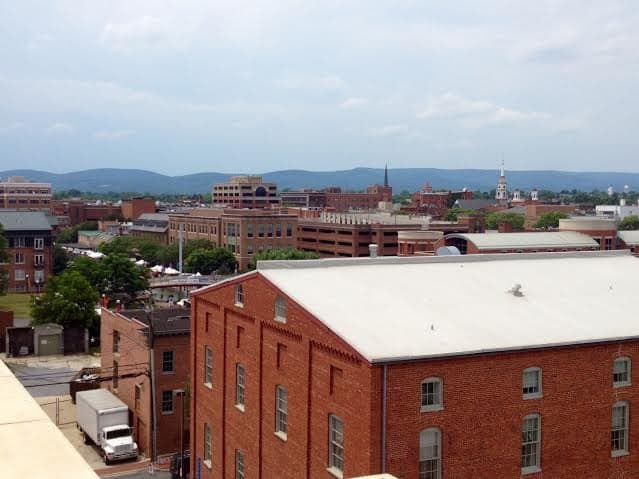
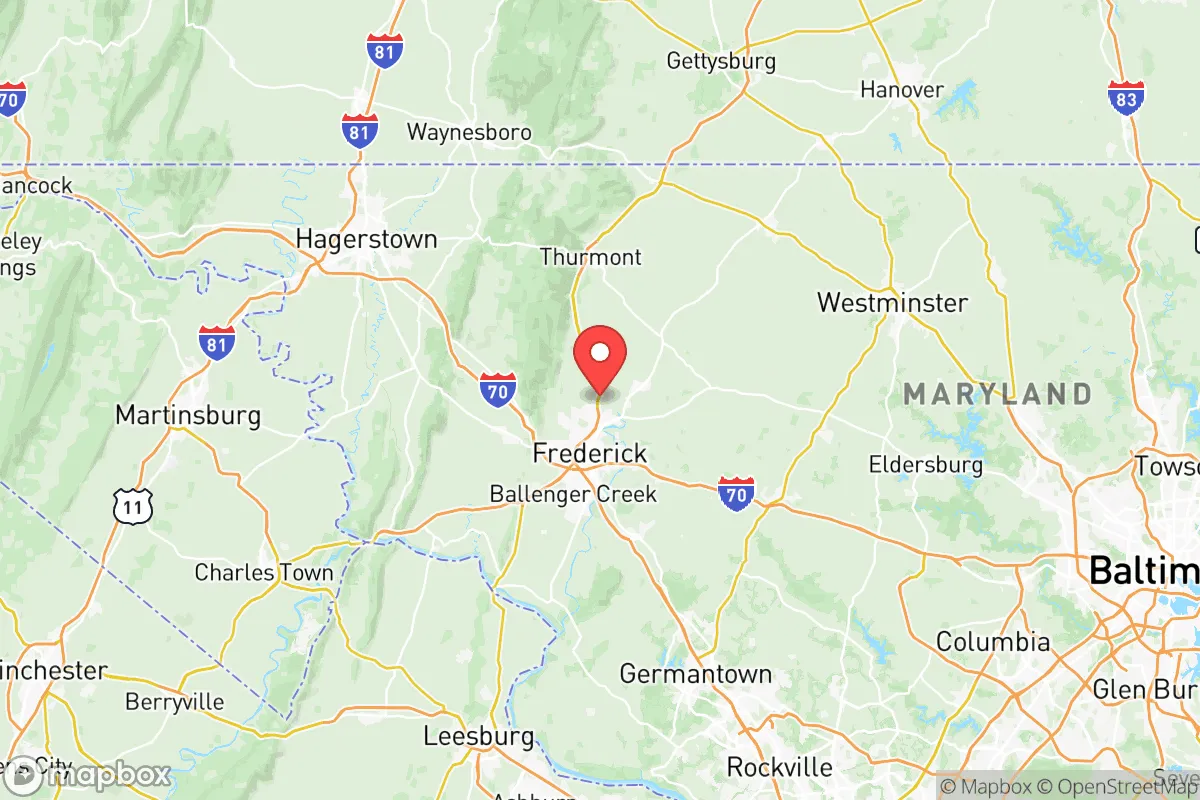
Photo: Wikipedia
Political ClimatePolitical Climate in Frederick County
Showing district-level results — no local-only data available.
Local Political AnalysisPolitical Analysis of Frederick County
Frederick County used to be a place where you could count on common-sense, live-and-let-live values, but it’s been shifting under our feet. The Cook PVI is now D+3, which means the county leans slightly Democratic, but that’s a far cry from the deep-blue D+17 of the rest of Maryland. For those of us who’ve been here a while, it feels like the old Frederick—where folks minded their own business and didn’t want the government in their backyards—is fighting to hold on against a wave of progressive policies coming out of Annapolis and creeping into local elections.
How it compares
The contrast with Maryland as a whole is stark. While the state is solidly blue at D+17, Frederick County’s D+3 tells you we’re still a battleground. You can see it on the ground: Middletown and Brunswick still lean reliably red, with voters who remember when the county was a Republican stronghold. Emmitsburg and Thurmont in the north are similar—more conservative, more skeptical of the big-government stuff coming out of Baltimore and D.C. But then you’ve got Frederick City itself, which has gone hard blue in recent cycles, especially downtown and around the new developments near the MARC station. The swing precincts are in the suburban sprawl around Urbana and New Market—places where transplants from Montgomery County have moved in, bringing their voting habits with them. That’s where the real fight is: those areas used to be solidly conservative, but now they’re tipping the scales toward the left.
What this means for residents
For those of us who value personal freedoms, the trend is worrying. The county government has started mirroring state-level overreach—think mask mandates that lasted longer than necessary, zoning rules that make it harder to build a shed on your own property, and school board decisions that prioritize ideological agendas over parental input. Property taxes have crept up to fund programs that feel more like social engineering than actual community needs. If you’re a small business owner or a farmer, you’ve probably noticed more red tape from the county health department and planning commission. The silver lining is that the D+3 rating means we’re still close enough that local elections matter—a few thousand votes can flip a council seat or a school board race, and that keeps the progressive machine from running unchecked.
On the cultural side, you’ll still find plenty of gun shows, church potlucks, and Fourth of July parades in the smaller towns. But the county’s identity is splitting: the rural north and west hold onto their independence, while the urban corridor along I-270 is becoming a bedroom community for D.C. bureaucrats. The biggest policy distinction is land use—Frederick County still has some of the most restrictive agricultural preservation rules in the state, which sounds good until you realize it’s used to block development that would let families build homes without jumping through hoops. If the current trajectory holds, expect more mandates on energy, more school curriculum battles, and a continued erosion of the live-free ethos that made this county special. Keep your eyes on the 2026 county council races—that’s where the real fight for Frederick’s soul will happen.

State Political ClimatePolitical Climate in Maryland
State Political AnalysisPolitical Environment in the State
Maryland is a deep blue state with a Cook PVI of D+17, meaning it votes about 17 points more Democratic than the national average in presidential elections. The Democratic coalition is driven overwhelmingly by the Baltimore-Washington corridor, while the rest of the state — particularly the Eastern Shore, Western Maryland, and southern counties — votes reliably Republican. Over the last 10-20 years, the state has shifted leftward as the D.C. suburbs have exploded in population and influence, while rural areas have seen stagnant or declining numbers. If you're a conservative looking at Maryland, you need to understand that the political center of gravity is in Montgomery County and Prince George's County, not in the small towns that still fly the "Maryland, My Maryland" flag.
Urban vs. rural divide
The political map of Maryland is a tale of two worlds. The Baltimore-Washington corridor — including Montgomery County, Prince George's County, Howard County, and Baltimore City — accounts for roughly 60% of the state's vote and is overwhelmingly Democratic. Montgomery County alone has more people than the entire Eastern Shore and Western Maryland combined. These areas are dominated by federal government employees, contractors, and professionals who lean heavily progressive. In contrast, Garrett County in the far west, Carroll County north of Baltimore, and Harford County are reliably Republican. The Eastern Shore counties like Queen Anne's and Talbot also vote red, though they're increasingly feeling pressure from D.C. exurbanites moving in. A notable exception is Anne Arundel County (home to Annapolis), which has been trending purple-to-blue as the state capital's workforce grows. The divide isn't just cultural — it's economic. The urban corridor thrives on government and tech, while rural areas depend on farming, tourism, and small business.
Policy environment
Maryland's policy environment is a textbook example of progressive governance. The state has a graduated income tax with rates up to 5.75%, plus local county taxes that can push the combined rate over 8% in places like Baltimore City and Montgomery County. Property taxes are high, and the state's estate tax kicks in at $5 million, with no portability. On the regulatory front, Maryland has some of the strictest environmental laws in the country, including a ban on fracking and aggressive renewable energy mandates. Education policy is dominated by the Blueprint for Maryland's Future, a massive funding plan that pours billions into public schools but has also led to battles over curriculum transparency and parental rights. Healthcare is heavily regulated, with a state-based insurance exchange and Medicaid expansion. Election laws are among the most liberal: no-excuse mail-in voting, same-day registration, and automatic voter registration are all in place. For a conservative, the policy environment feels like a constant push toward higher taxes, more regulation, and less local control.
Trajectory & freedom
Maryland has been on a clear trajectory of expanding government control and contracting personal freedoms over the last decade. The most glaring example is gun rights: in 2023, the state passed the Gun Safety Act, which bans carrying firearms in "sensitive places" like hospitals, parks, and any private business that hasn't explicitly posted a sign allowing them. This law is currently being challenged in court, but it's a major infringement on Second Amendment rights. On parental rights, the state passed the Trans Health Equity Act in 2023, which prohibits insurance companies from excluding gender-affirming care for minors — effectively overriding parental consent requirements in some cases. Property rights have been eroded by the state's aggressive use of impact fees and zoning restrictions, particularly in the D.C. suburbs. Medical freedom took a hit during COVID with some of the longest-lasting mask mandates and vaccine requirements in the country. On the tax front, the state's estate tax and high income taxes make it one of the least attractive places for wealth preservation. The trend is unmistakable: Maryland is becoming less free, not more, especially for those who value individual liberty over collective mandates.
Civil unrest & political movements
Maryland has seen its share of civil unrest, most notably the 2015 Baltimore riots following the death of Freddie Gray, which led to a state of emergency and National Guard deployment. Since then, the Black Lives Matter movement has remained active, particularly in Baltimore and Prince George's County. On the right, there's a growing "Free State" movement — a nod to Maryland's historical nickname — that advocates for secession or at least greater autonomy for rural counties. In 2021, several Western Maryland counties passed resolutions calling for a "constitutional convention" to address state overreach. Immigration politics are a flashpoint: Maryland is a sanctuary state, with laws prohibiting local law enforcement from cooperating with federal immigration authorities except in limited circumstances. This has led to tensions in places like Frederick County, where the sheriff has publicly clashed with state officials. Election integrity remains a concern for conservatives, especially after the 2020 election saw widespread use of mail-in ballots with no signature verification requirement. The state's automatic voter registration system has also raised eyebrows, as it registers people through the MVA without proof of citizenship. These issues create a palpable sense of unease for anyone who values election security.
Projection
Over the next 5-10 years, Maryland is likely to become even more blue. The D.C. suburbs are growing faster than the rest of the state, and the influx of federal workers and tech professionals will continue to shift the electorate leftward. The rural counties will lose further political influence as their populations stagnate or decline. The state's tax burden and regulatory environment will likely worsen, as the Democratic supermajority in Annapolis shows no signs of moderation. However, there are some counter-trends: remote work is allowing some conservatives to move to cheaper rural areas like Washington County or the Eastern Shore while keeping D.C.-area salaries, which could slowly shift those areas purple. But for a conservative moving in now, the realistic expectation is that Maryland will be a one-party state for the foreseeable future, with policies that prioritize collective outcomes over individual freedoms.
For a new resident, the bottom line is this: Maryland offers proximity to D.C. and Baltimore, excellent schools in some counties, and beautiful natural landscapes, but you will pay for it in taxes, regulations, and a political climate that is increasingly hostile to conservative values. If you're moving here, choose your county carefully — Carroll County or Harford County will give you a more conservative community, while Montgomery County will feel like a different country. And be prepared to fight for your rights, because the state government isn't going to give them up willingly.
* Values derived from national, state, county, city and local statistics and may differ in a specific area. Last updated: 2026-05-12T21:48:14.000Z
Narrative content on this page is AI-generated and may contain mistakes. Verify any details that matter before acting on them.
ReloMaps may earn a commission from affiliate links at no extra cost to you.

