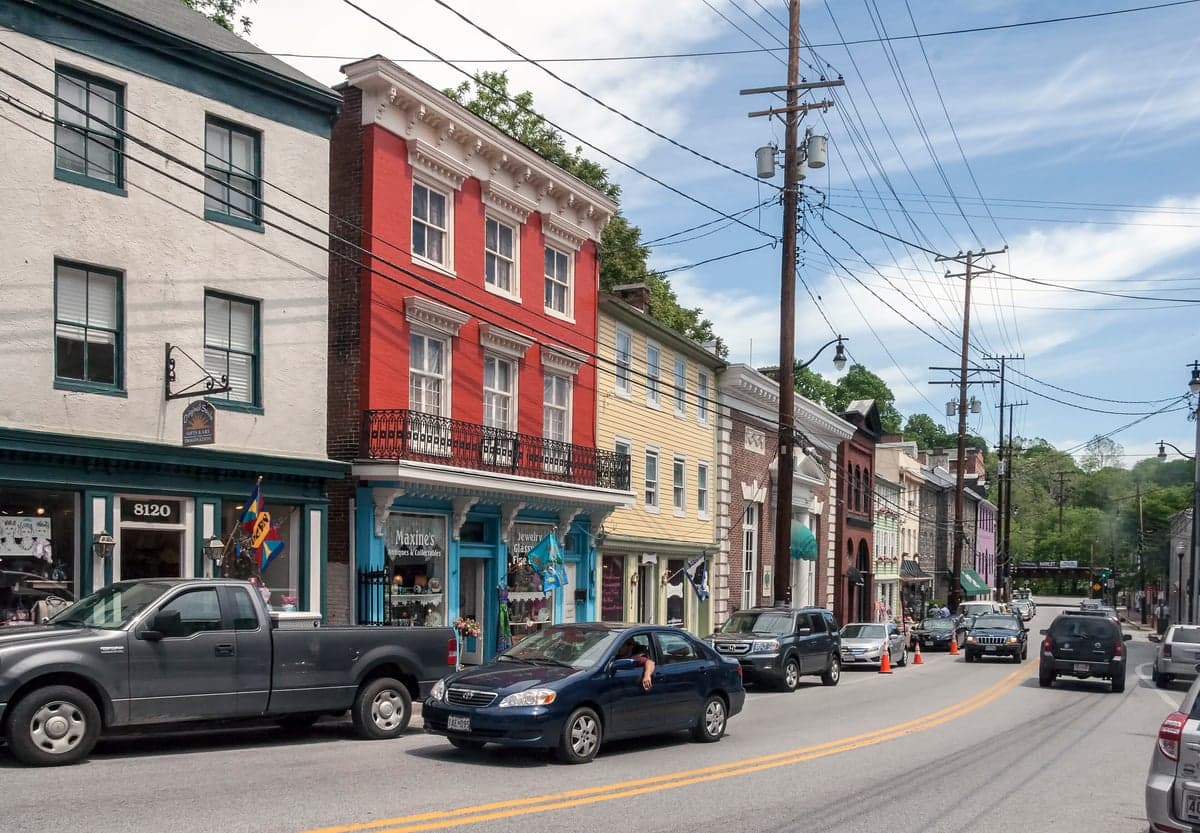
Photo: Wikipedia
Personal Sovereignty in Howard County
Viable for self-reliance. Generally workable, though some barriers may limit total independence.
What does Personal Sovereignty tell us?
Personal Sovereignty measures your capacity for self-reliance and independence with minimal government friction. Higher scores mean fewer barriers between you and the way you want to live... but it assumes you have the space you need and good neighbors.
What does this tell us?
Personal Sovereignty measures your capacity for self-reliance and independence with minimal government friction. Higher scores mean fewer barriers between you and the way you want to live... but it assumes you have the space you need and good neighbors.
State Policy
Energy independence: Importer (8% of energy produced in-state)
Personal Liberty
Homesteading

Personal Liberty Analysis
Howard County, Maryland, presents a complex personal sovereignty environment where a relatively high tax burden and dense regulatory structure coexist with strong property rights, robust parental control over education, and a self-defense legal framework that is more restrictive than many Southern or Midwestern states but less so than neighboring Montgomery County or Washington, D.C. For the freedom-minded individual or family, the county offers genuine autonomy in schooling and property use, but those seeking minimal government interference in taxation, firearms, or off-grid living will find the overall posture leans toward managed liberty rather than rugged independence. The key is understanding where the county's rules create friction and where they leave room for self-reliance.
Tax burden and regulatory posture: what to expect from local government
Howard County's tax and regulatory environment is among the heaviest in Maryland, which itself ranks in the top ten nationally for combined state and local tax burden. The county's income tax rate is 3.20% on top of Maryland's progressive state income tax (2%–5.75%), and the property tax rate hovers around $1.01 per $100 of assessed value for the county portion, plus additional fire, library, and school district levies. In practice, a $500,000 home in Columbia or Ellicott City carries an annual property tax bill of roughly $5,500–$6,000. The regulatory posture is similarly dense: the county enforces a stormwater management fee (the "rain tax"), strict stormwater management regulations for any new construction or major renovation, and a detailed zoning code that limits lot coverage, building height, and impervious surfaces. For a family looking to buy a small homestead in West Friendship or Glenelg, these rules mean that adding a shed, driveway, or even a large deck may require a permit and site plan review. The county's Agricultural Preservation Program does protect large tracts of farmland in the western part of the county, but it also restricts subdivision and non-agricultural development on preserved land. Compared to rural counties in Pennsylvania or Virginia, Howard's regulatory touch is heavy; compared to Montgomery County or Northern Virginia, it is moderate. The trade-off is high-quality public services—schools, libraries, parks, and emergency services—that many families find worth the cost.
Self-defense and gun law specifics: what is allowed and where
Maryland is a "may-issue" state for concealed carry permits, meaning the state police have discretion to deny applications even if the applicant meets statutory requirements. In practice, Howard County residents face a permitting process that requires a demonstrated "good and substantial reason" to carry, though the Bruen decision (2022) has loosened this standard somewhat. The county itself does not impose additional restrictions beyond state law, but the local sheriff's office in Ellicott City processes applications with a reputation for thoroughness rather than hostility. Assault weapons are banned under state law, including many popular semi-automatic rifles, and magazine capacity is limited to 10 rounds for long guns and 10 rounds for handguns. Handgun purchases require a seven-day waiting period and a state-issued Handgun Qualification License (HQL), which involves a background check, fingerprinting, and a four-hour training course. Private firearm sales must go through a licensed dealer with a background check. For the self-defense-minded individual, the practical reality is that owning a handgun for home defense is straightforward but time-consuming and costly; carrying concealed is possible but requires navigating a discretionary permitting system. In Dayton or Highland, where homes sit on larger lots and rural crime concerns are lower, many residents simply keep a shotgun or handgun for home defense without seeking a carry permit. The county's gun culture is not hostile—there are several gun shops and ranges in the area—but it is not permissive. For those who prioritize easy access to firearms for self-defense, neighboring Pennsylvania or Virginia offer a far lighter regulatory touch.
Self-reliance and homesteading viability: lot sizes, zoning, and off-grid feasibility
Homesteading and off-grid living in Howard County are possible but heavily constrained by zoning and environmental regulations. The county's zoning code divides land into residential, rural, and agricultural districts. In the Rural Conservation (RC) and Agricultural (A) zones, which cover much of western Howard County—areas like Woodbine, Lisbon, and Cookeysville—minimum lot sizes are 1 acre for RC and 3 acres for A zones. This allows for substantial gardens, small orchards, and livestock such as chickens, goats, and even a cow or two, provided the property meets setback and manure management requirements. However, off-grid energy systems face significant hurdles: solar panels are permitted, but net metering rules require connection to the grid for any system over 10 kW, and battery storage for full off-grid operation is not explicitly prohibited but must meet building code and fire safety standards. Rainwater harvesting is allowed for non-potable uses (irrigation, livestock) but not for drinking water without a permit from the county health department. Composting toilets and greywater systems are legal but require a state-approved design and county inspection. In practice, a family seeking true off-grid independence—no utility connections, no county permits for basic structures—will find Howard County's regulatory environment frustrating. The county's Department of Planning and Zoning actively enforces building codes, and neighbors in rural areas are often quick to report unpermitted structures. For a more permissive homesteading environment, the Eastern Shore or Western Maryland offer larger lots, fewer regulations, and lower taxes. Within Howard County, the best bet for self-reliance is a 3+ acre parcel in the Glenwood or Fulton area, where agricultural zoning allows for a diversified small farm with livestock, gardens, and a farm stand, but even there, the county's stormwater and nutrient management plans add paperwork and cost.
Personal liberties: parental rights, medical autonomy, speech, and property
Howard County is generally strong on parental rights in education. The county's public school system, widely regarded as one of the best in Maryland, allows parents to opt their children out of specific instructional materials or lessons they find objectionable, and the school board has a formal policy for parental review of curriculum. Homeschooling is straightforward: parents must submit a one-time notice of intent and provide an annual portfolio review or standardized test results, but there is no requirement for state-approved curriculum or teacher certification. The county also has a robust school choice environment, with several magnet programs, charter schools, and private schools in Columbia and Ellicott City. On medical autonomy, Maryland is a vaccine mandate state for school attendance, with only medical exemptions allowed (no religious or philosophical exemptions), which is a significant constraint for families who oppose mandatory vaccination. Medical marijuana is legal with a state-issued card, and the county has several dispensaries. COVID-19 mandates are no longer in effect, but the county health department retains authority to impose restrictions during public health emergencies. Free speech is protected under the First Amendment, and Howard County does not have any local ordinances restricting speech beyond state law. Property rights are generally respected, but the county's zoning and environmental regulations can limit what owners can do with their land. The county has a Right to Farm ordinance that protects agricultural operations from nuisance lawsuits, which is a plus for homesteaders. Overall, personal liberties in Howard County are strongest in education and property use (within regulatory bounds) and weakest in medical autonomy and firearms. For a family that values school choice and parental control over curriculum, the county is a strong option; for those who prioritize medical freedom or minimal vaccination requirements, it is not.
Compared to other areas in the Mid-Atlantic, Howard County offers a moderate-to-heavy regulatory environment that rewards those who can navigate permits and pay higher taxes in exchange for excellent public services and strong property protections. For the freedom-minded individual, the county's best features are its school choice options, agricultural zoning in the west, and robust property rights for existing homeowners. Its weakest points are the high tax burden, restrictive gun laws, and limited off-grid feasibility. For a family seeking a balance of personal autonomy and community infrastructure, Howard County is a viable choice—but those who prioritize maximum sovereignty should look to rural Pennsylvania, Virginia, or the Eastern Shore.

* Values derived from national, state, county, city and local statistics and may differ in a specific area. Last updated: 2026-08-24T22:38:45.000Z
Narrative content on this page is AI-generated and may contain mistakes. Verify any details that matter before acting on them.
ReloMaps may earn a commission from affiliate links at no extra cost to you.

