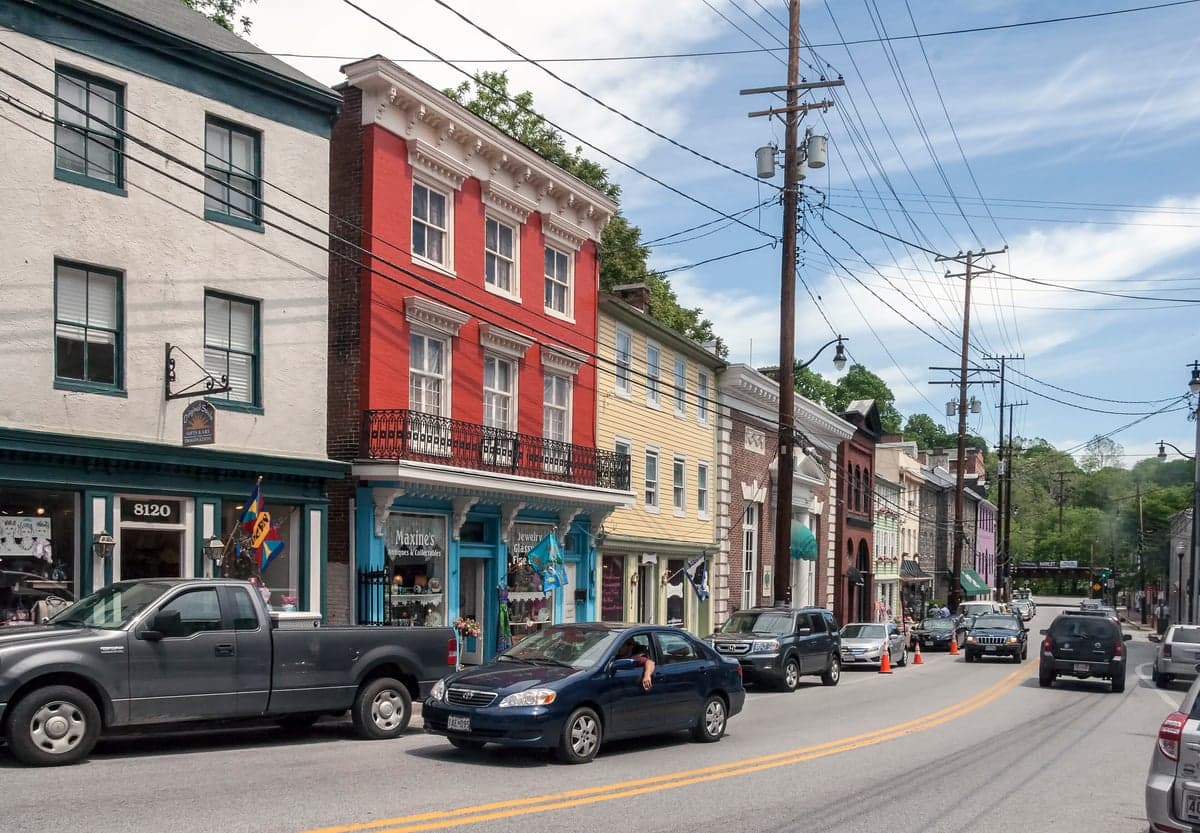
Photo: Wikipedia
Political ClimatePolitical Climate in Howard County
Showing district-level results — no local-only data available.
Local Political AnalysisPolitical Analysis of Howard County
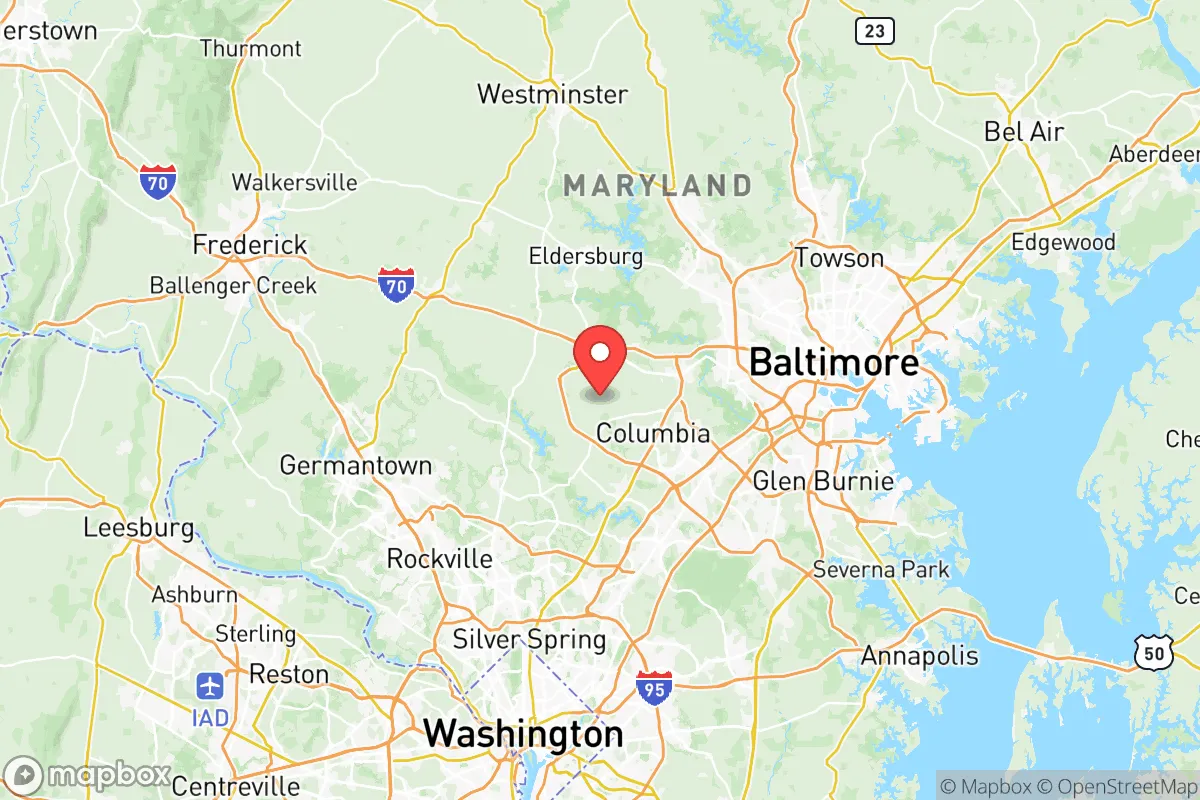
Howard County is one of the most reliably Democratic jurisdictions in Maryland, but it’s not quite as deep blue as the state as a whole. With a Cook Partisan Voting Index (PVI) of D+12, the county leans heavily Democratic, though it trails the statewide PVI of D+17 by a noticeable five points. That gap reflects a real political diversity within the county’s borders—especially when you compare the urbanized, transit-oriented communities near the Washington, D.C. line with the more rural, historically agricultural areas in the western and northern parts of the county. In the 2024 presidential election, Howard County gave Kamala Harris roughly 68% of the vote, while Donald Trump pulled about 29%, a margin that’s solidly blue but not as lopsided as in neighboring Prince George’s County or Montgomery County.
How it compares
Compared to Maryland as a whole, Howard County is a slightly more moderate Democratic stronghold. The state’s D+17 PVI is driven by the overwhelming Democratic margins in Baltimore City and the D.C. suburbs, but Howard County’s D+12 rating shows it has a larger Republican minority. That’s most visible in the county’s internal geography. The city of Columbia, the county’s largest population center, is the Democratic engine—precincts there routinely deliver 75-80% of the vote for Democratic candidates. Ellicott City, the historic county seat, is also reliably blue but with a bit more variation; its older neighborhoods near the Patapsco River can swing closer to 60-65% Democratic. In contrast, the towns of Elkridge and Jessup lean Democratic but have a stronger Republican presence, often hovering around 55-60% Democratic. The real red pockets are in the county’s rural fringe: West Friendship, Glenelg, and Dayton are areas where Republican candidates can win 55-60% of the vote, especially in local races. These are the precincts that make Howard County’s overall PVI less blue than the state’s.
What this means for residents
For liberal residents, Howard County is a comfortable environment where Democratic policies on education funding, environmental regulation, and social services are the norm. The county council has a 5-0 Democratic majority as of 2026, and the school board is similarly progressive. For conservative residents, the picture is more nuanced. You won’t feel politically isolated in the western towns, and the county’s Republican Party is active, but you’ll have limited influence on countywide policy. The practical effect is that property taxes are among the highest in the state (around $1.35 per $100 of assessed value in 2025), funding a top-tier public school system and extensive parks. Conservatives often grumble about the tax burden, but the quality of services is a trade-off most accept. The county’s political trajectory is slowly shifting leftward as new development—especially in the Maple Lawn and North Laurel areas—brings in younger, more diverse, and more Democratic-leaning residents.
Culturally, Howard County stands out for its deliberate emphasis on diversity and inclusion, which is baked into the county’s founding vision for Columbia. The county has a Office of Human Rights and Equity that actively enforces anti-discrimination ordinances, and the school system’s curriculum includes explicit discussions of race and LGBTQ+ history. This can feel like a point of pride for liberals and a source of friction for some conservatives who prefer a more traditional approach. The county also has a notable policy distinction: it was one of the first in Maryland to implement a county-level minimum wage above the state’s, currently at $16.50 per hour as of 2026. That kind of local initiative is a direct reflection of the county’s political character—progressive, but with enough internal variation to keep things interesting.

State Political ClimatePolitical Climate in Maryland
State Political AnalysisPolitical Environment in the State
Maryland is one of the most reliably Democratic states in the country, with a Cook Partisan Voting Index of D+17, meaning it votes about 17 points more Democratic than the national average in presidential elections. The state hasn't voted for a Republican presidential candidate since George H.W. Bush in 1988, and Democrats hold supermajorities in both chambers of the General Assembly. Over the last 10-20 years, the shift has been steady but not dramatic — the D+17 today is actually slightly less blue than the D+19 of a decade ago, driven by population growth in the more moderate Washington, D.C., suburbs and a slow but real conservative drift in some exurban and rural areas.
Urban vs. rural divide
The political map of Maryland is a textbook study in the urban-rural split. The entire Democratic margin comes from the Washington, D.C., suburbs — Montgomery County and Prince George's County alone deliver about 40% of the state's Democratic votes. Montgomery County, with its high-income, highly educated population, votes about D+50 in presidential races, while Prince George's, the wealthiest majority-Black county in the U.S., votes D+60 or more. Baltimore City is another deep-blue anchor, voting D+70. The rest of the state is a mix of competitive and solidly Republican territory. The Eastern Shore — places like Queen Anne's County and Worcester County (home to Ocean City) — is reliably red, voting R+20 to R+30. Western Maryland, including Garrett County and Allegany County (Cumberland), is similarly conservative. The real battlegrounds are the exurban counties like Frederick County and Harford County, which have trended redder in recent cycles — Frederick voted for Trump in 2020 after backing Obama twice, a flip that signals the growing conservative tilt of the outer D.C. ring. Anne Arundel County (Annapolis) is a bellwether: it voted for Biden by just 2 points in 2020, down from Obama's 8-point win in 2012, reflecting the broader suburban moderation.
Policy environment
Maryland's policy environment is shaped by Democratic control of the governorship and legislature, but with a pragmatic, business-friendly streak that keeps it from being as aggressively progressive as neighboring Virginia or New York. The state income tax is progressive, with rates from 2% to 5.75%, and counties add their own piggyback tax (typically 2-3%), so top combined rates can hit 8.95%. Property taxes are moderate — the state rate is low, but counties and municipalities add their own, with Baltimore City and Montgomery County among the highest. Sales tax is 6%, with no local add-ons. Education policy is a Democratic priority: the Blueprint for Maryland's Future, passed in 2021, commits to massive K-12 funding increases, including universal pre-K and teacher salary hikes, but implementation has been slow and costly. Healthcare is heavily regulated; the state runs its own ACA exchange (Maryland Health Connection) and has a strong all-payer hospital rate-setting system that keeps costs below the national average. Election laws are among the most accessible in the country: no-excuse mail-in voting, same-day registration, early voting for two weeks, and automatic voter registration at the DMV. Gun laws are strict — Maryland requires a permit to purchase a handgun, bans assault weapons and high-capacity magazines, and has a "good and substantial reason" standard for concealed carry that was struck down by the Supreme Court in 2022, leading to a new "shall-issue" law that still requires training and a background check.
Recent policy direction
Over the past five years, Maryland has moved decisively left on several fronts, though not without pushback. On gun and self-defense law, the 2023 Gun Safety Act tightened licensing and training requirements after the Bruen decision, and a lawsuit is ongoing. On parental and education rights, the state passed the Blueprint for Maryland's Future, which includes a controversial "Kirwan Commission" framework that centralizes curriculum and funding decisions in Annapolis, drawing criticism from conservative parents who want more local control. Speech and privacy have seen less action, though the state passed a strong data privacy law in 2024 (the Maryland Online Data Privacy Act) that restricts how companies collect and sell personal data. On medical and bodily autonomy, Maryland is a safe haven: abortion is codified into state law (the Abortion Care Access Act of 2022), and the state has no restrictions on gender-affirming care for minors. Property rights are a flashpoint — the state's rent control laws (Montgomery County and Baltimore City have them) and the controversial "tenant right of first refusal" bill (which would give tenants the chance to buy their building when it's sold) have been debated but not yet passed statewide. Taxation has seen a modest shift: the 2021 tax reform package raised rates on high earners (over $250,000) while cutting taxes for low-income families. Voting and ballot access remains expansive, with no voter ID requirement, though Republicans have pushed for one without success.
Civil unrest & political movements
Maryland has a history of organized activism on both sides. The 2015 Baltimore protests after Freddie Gray's death were a national flashpoint, and the city still sees periodic demonstrations over policing and housing. The state's sanctuary policies are limited — Maryland does not have a statewide sanctuary law, but Montgomery County and Prince George's County have "welcoming" policies that limit cooperation with ICE. Immigration politics are less heated than in border states, but the issue flares in the exurbs: Frederick County's 2017 "sanctuary county" debate was a major local controversy. On the right, the "Maryland Shall Issue" gun rights group is active and well-organized, and the state's Republican Party has a strong libertarian wing that focuses on tax and regulatory issues. Election integrity controversies have been muted compared to other states — Maryland's mail-in voting system was expanded during COVID and has been largely accepted, though some Republican county officials have raised concerns about ballot drop boxes. The most visible flashpoint for a new resident would likely be the Blue Bridge protests in Annapolis (2023-2024), where activists on both sides of the abortion debate clashed during the legislative session. Overall, civil unrest is less common than in neighboring D.C., but the state's proximity to the capital means national protests often spill over.
Projection
Over the next 5-10 years, Maryland is likely to remain solidly Democratic but with a narrowing margin. The key demographic driver is the continued growth of the D.C. suburbs, which are becoming more diverse and more liberal, but also the out-migration of younger families from Montgomery and Prince George's to Frederick and Harford counties, which are trending redder. The state's population growth is slow (about 0.5% annually), and most of it is in the D.C. exurbs. The Republican Party is unlikely to win statewide office soon — the last Republican governor, Larry Hogan, was a moderate who won in 2014 and 2018 by distancing himself from the national party — but the GOP could pick up a few more legislative seats in the exurbs. The policy trajectory will continue leftward on social issues (abortion, transgender rights, gun control) but may moderate on economic issues as the state grapples with budget pressures from the Blueprint for Maryland's Future and rising pension costs. A new resident moving in now should expect a state that is reliably blue but not uniformly so — the political culture varies dramatically from the D.C. suburbs to the Eastern Shore, and the state's moderate Democratic establishment is more pragmatic than its progressive activists.
For a conservative-leaning relocator, the bottom line is that Maryland offers a high quality of life in its exurban and rural areas — good schools, low crime in most places, and proximity to D.C. jobs — but you'll be living in a state where your vote is unlikely to matter in presidential elections and where state policy will often run counter to your preferences on guns, taxes, and social issues. For a liberal relocator, Maryland is a comfortable fit, especially in the D.C. suburbs or Baltimore, with strong protections for reproductive rights, generous public services, and a political culture that aligns with your values. Either way, the key is choosing the right county — the difference between living in Montgomery County and Garrett County is as stark as the difference between two different states.
* Values derived from national, state, county, city and local statistics and may differ in a specific area. Last updated: 2026-08-24T22:38:45.000Z
Narrative content on this page is AI-generated and may contain mistakes. Verify any details that matter before acting on them.
ReloMaps may earn a commission from affiliate links at no extra cost to you.

