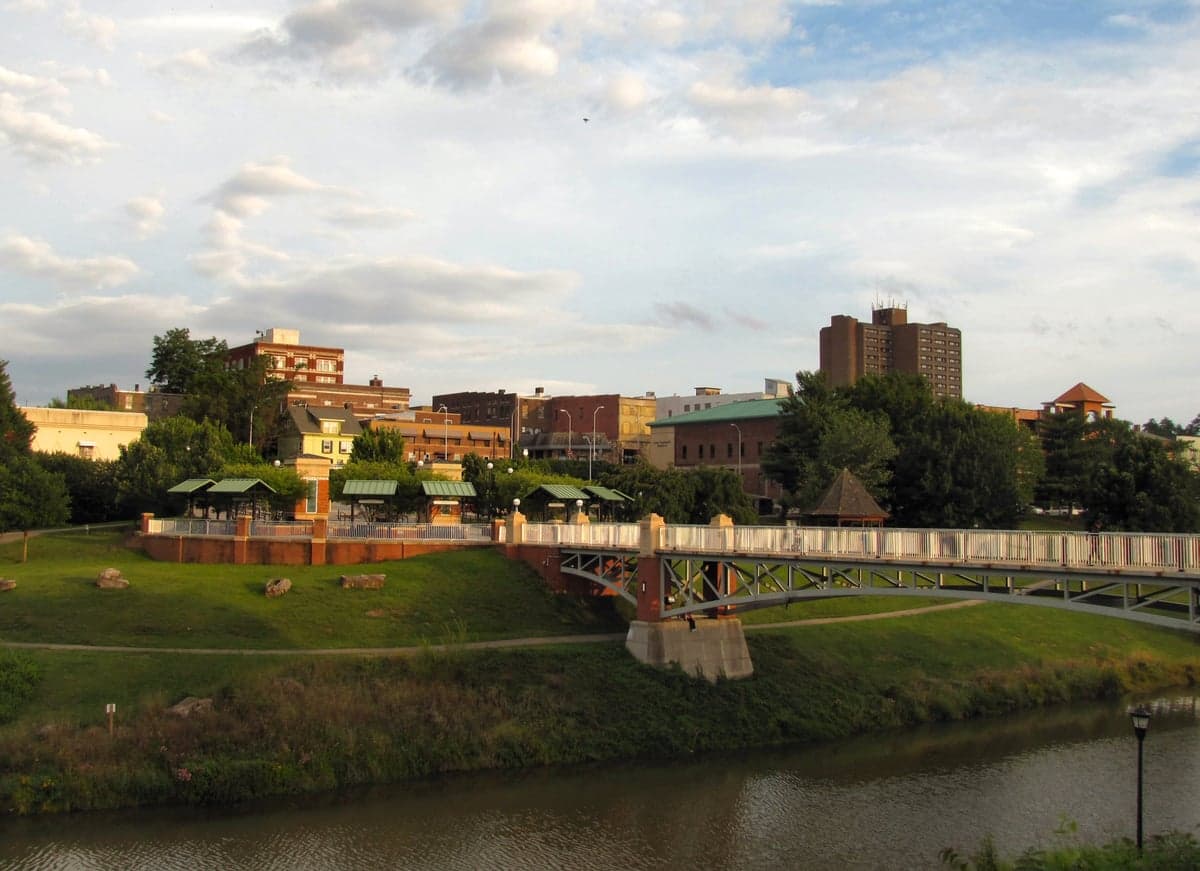
Photo: Wikipedia
Personal Sovereignty in Maryville, TN
Viable for self-reliance. Generally workable, though some barriers may limit total independence.
What does Personal Sovereignty tell us?
Personal Sovereignty measures your capacity for self-reliance and independence with minimal government friction. Higher scores mean fewer barriers between you and the way you want to live... but it assumes you have the space you need and good neighbors.
What does this tell us?
Personal Sovereignty measures your capacity for self-reliance and independence with minimal government friction. Higher scores mean fewer barriers between you and the way you want to live... but it assumes you have the space you need and good neighbors.
State Policy
Energy independence: Importer (25% of energy produced in-state)
Personal Liberty
Homesteading

Personal Liberty Analysis
Maryville, Tennessee, offers a personal sovereignty environment that is among the strongest in the Southeast, largely because it sits within a state that has aggressively pushed back against federal overreach and maintains a deep-seated culture of self-reliance. For the prepper or survivalist-minded individual, the key question isn't whether the government will leave you alone—it’s whether you can legally and practically build the independent life you want. The answer here is a qualified yes, provided you understand the specific local constraints that temper the state’s otherwise libertarian-leaning posture. Blount County, where Maryville is the seat, consistently votes +40 points Republican, and that political reality translates into a local governance style that is generally hands-off, but not lawless.
Tax burden and regulatory posture: How Tennessee’s policies affect your autonomy
Tennessee’s tax structure is a major asset for anyone seeking to maximize personal financial sovereignty. The state has no personal income tax on wages, no tax on interest or dividends, and no state-level property tax on intangible assets like stocks or bonds. This means every dollar you earn stays in your pocket, not the state’s coffers. The trade-off is a relatively high combined state and local sales tax rate—around 9.75% in Maryville—but for a prepper focused on long-term asset accumulation and land ownership, the absence of income tax is a massive win. Property taxes in Blount County are moderate, averaging about 0.67% of assessed value, which is well below the national average. Regulatory posture at the state level is business-friendly and construction-permissive; Tennessee is a “right-to-work” state with minimal occupational licensing burdens compared to the Northeast or West Coast. Locally, Maryville’s zoning is more restrictive than rural Blount County but far less onerous than Knoxville. You won’t face the kind of environmental or land-use red tape that plagues Oregon or Colorado, but you will need to navigate subdivision covenants if you buy in a planned community. For the survivalist, the key takeaway is that the state won’t tax your labor, and the county won’t nickel-and-dime your property—but you must choose your lot carefully to avoid HOA-style restrictions that can limit your autonomy.
Self-defense and gun law specifics: What you can and cannot do in Maryville
Tennessee is a constitutional carry state, meaning that as of 2021, any law-abiding adult 21 or older can carry a handgun openly or concealed without a permit. Maryville and Blount County fully respect this; you will not encounter the kind of municipal overrides seen in cities like Nashville or Memphis. The state also has a strong “Stand Your Ground” law with no duty to retreat, and a Castle Doctrine that extends to your vehicle and place of business. For the prepper, this is foundational: your right to defend your life and property is legally unambiguous. However, there are practical limits. Private property rights still govern—businesses can post “no guns” signs, and while those signs carry force of law only if properly posted under Tennessee code, most gun owners here simply avoid those establishments. Magazine capacity and “assault weapon” bans do not exist at the state or local level. The NFA is still federal law, so suppressors and short-barreled rifles require ATF paperwork, but Tennessee passed a Second Amendment Sanctuary Act in 2021 that theoretically prohibits state resources from enforcing future federal gun bans. In practice, this means you can build an armory without worrying about local police knocking on your door. The sheriff’s office in Blount County is notably pro-2A, and the county has a high rate of concealed carry permits per capita. For the survivalist, Maryville offers a legal environment where your defensive capabilities are limited only by federal law and your own budget.
Self-reliance and homesteading viability: Lot sizes, zoning, and off-grid feasibility
This is where Maryville’s sovereignty picture gets nuanced. The city itself is fairly suburban, with typical lot sizes of 0.25 to 0.5 acres in most subdivisions. If you want true homesteading—say, 5+ acres with chickens, a large garden, and a workshop—you need to look outside the city limits into unincorporated Blount County. There, zoning is minimal, and you can find parcels ranging from 1 to 20 acres at prices significantly lower than comparable land in Colorado or the Pacific Northwest. Off-grid feasibility is high in the county but not automatic. Tennessee has no state-level ban on rainwater collection, and many rural properties already use well water and septic systems. Solar panels are legal and common, though you’ll need to check with the local utility (Blount County’s electric cooperative) for net metering policies. The catch is that building codes in unincorporated areas are still enforced by the state’s “Standard Building Code,” which means you cannot simply throw up a shack. You will need permits for electrical and plumbing work, and a permanent dwelling must meet minimum square footage and safety standards. For the serious prepper, the workaround is to buy land with an existing structure or to build a “pole barn” or “workshop” that you later convert—a gray area that many locals exploit. Livestock ordinances are county-dependent; Blount County allows horses, cattle, and poultry on parcels of 1 acre or more, but pigs and goats may require additional setbacks. The bottom line: you can achieve a high degree of self-reliance here, but you must buy the right land and be willing to work within a reasonable regulatory framework that is far lighter than the West Coast but heavier than, say, rural Idaho.
Personal liberties: Parental rights, medical autonomy, speech, and property
Tennessee has been a national leader in asserting parental rights. The state passed the “Parental Bill of Rights” in 2022, which legally affirms that parents have the fundamental right to direct their children’s education, healthcare, and moral upbringing. This means no school district in Maryville can hide curriculum or medical decisions from you. In practice, Blount County Schools are conservative and transparent; critical race theory and gender ideology are not taught, and parents are actively involved. Medical autonomy is more complicated. Tennessee did not expand Medicaid, and the state has some of the most restrictive abortion laws in the country, which aligns with the conservative audience’s values. However, for the prepper concerned about medical freedom, the state has no specific protections for alternative or holistic medicine beyond what federal law allows. You can refuse vaccines for yourself and your children (religious exemptions are available for school mandates), but you cannot legally practice medicine without a license. Free speech is robustly protected; Maryville is not a “cancel culture” hotspot, and public discourse is generally respectful of conservative viewpoints. Property rights are strong, with no state-level rent control and a straightforward eminent domain process that requires just compensation. The one area of concern is the growing use of “public health orders” at the county level—during COVID, Blount County did impose some restrictions, but they were far lighter than in Knoxville or Nashville. For the survivalist, the key is that your rights are well-defined and generally respected, but you cannot assume total immunity from local emergency powers. The state legislature has since passed laws limiting the governor’s ability to issue prolonged emergency orders, which is a positive sign for future sovereignty.
Overall, Maryville offers a high degree of personal sovereignty relative to most of the United States, particularly when compared to the Northeast, West Coast, or even major Southern cities like Atlanta or Nashville. The combination of no income tax, constitutional carry, strong parental rights, and available land for homesteading makes it a viable destination for the prepper or survivalist who wants to live free without going completely off-grid. The trade-offs are the moderate sales tax, the need to navigate local zoning if you want true self-sufficiency, and the reality that Tennessee is still part of the federal system—you cannot escape the IRS or the EPA entirely. But for someone looking to maximize autonomy within a community that shares your values, Maryville ranks among the top options in the Eastern time zone. It’s not a libertarian utopia, but it’s about as close as you’ll get in the modern American South without moving to the remote mountains of Montana or Idaho.

* Values derived from national, state, county, city and local statistics and may differ in a specific area. Last updated: 2026-05-01T13:26:05.000Z
Narrative content on this page is AI-generated and may contain mistakes. Verify any details that matter before acting on them.
ReloMaps may earn a commission from affiliate links at no extra cost to you.

