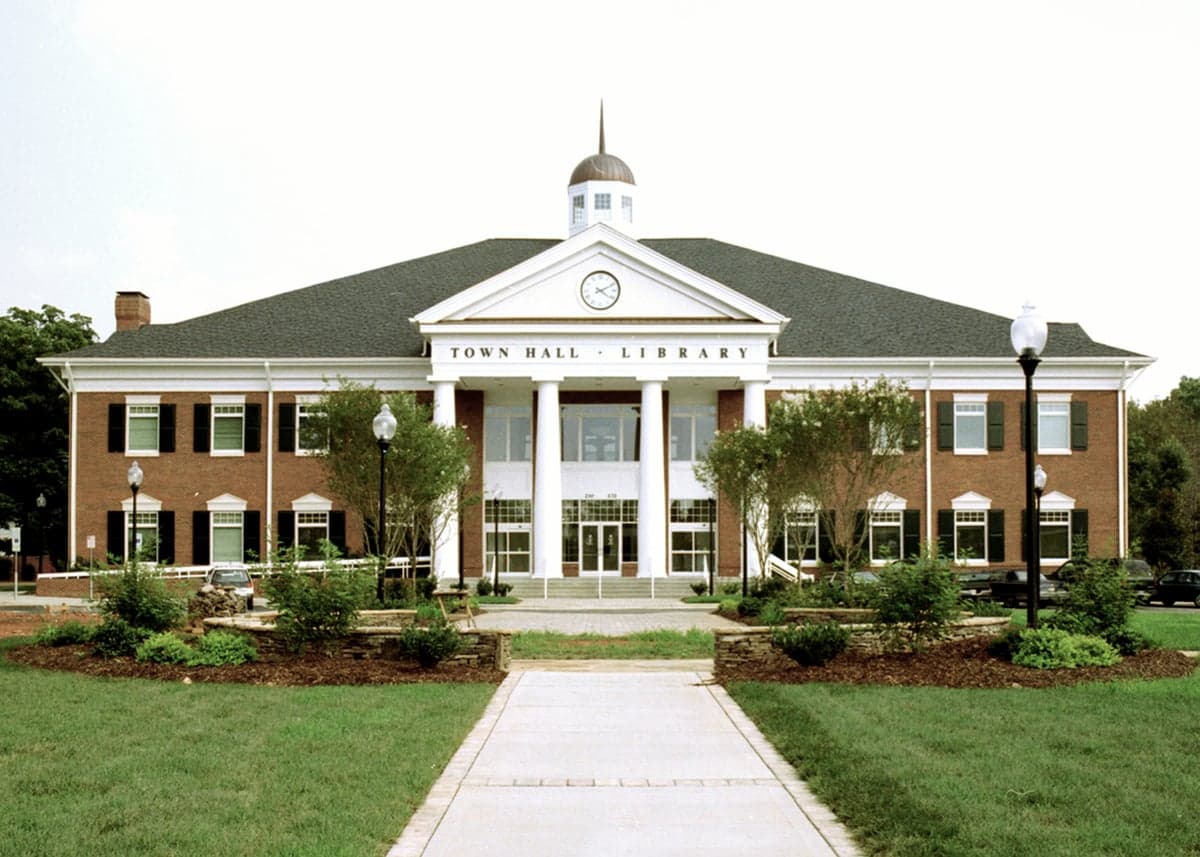
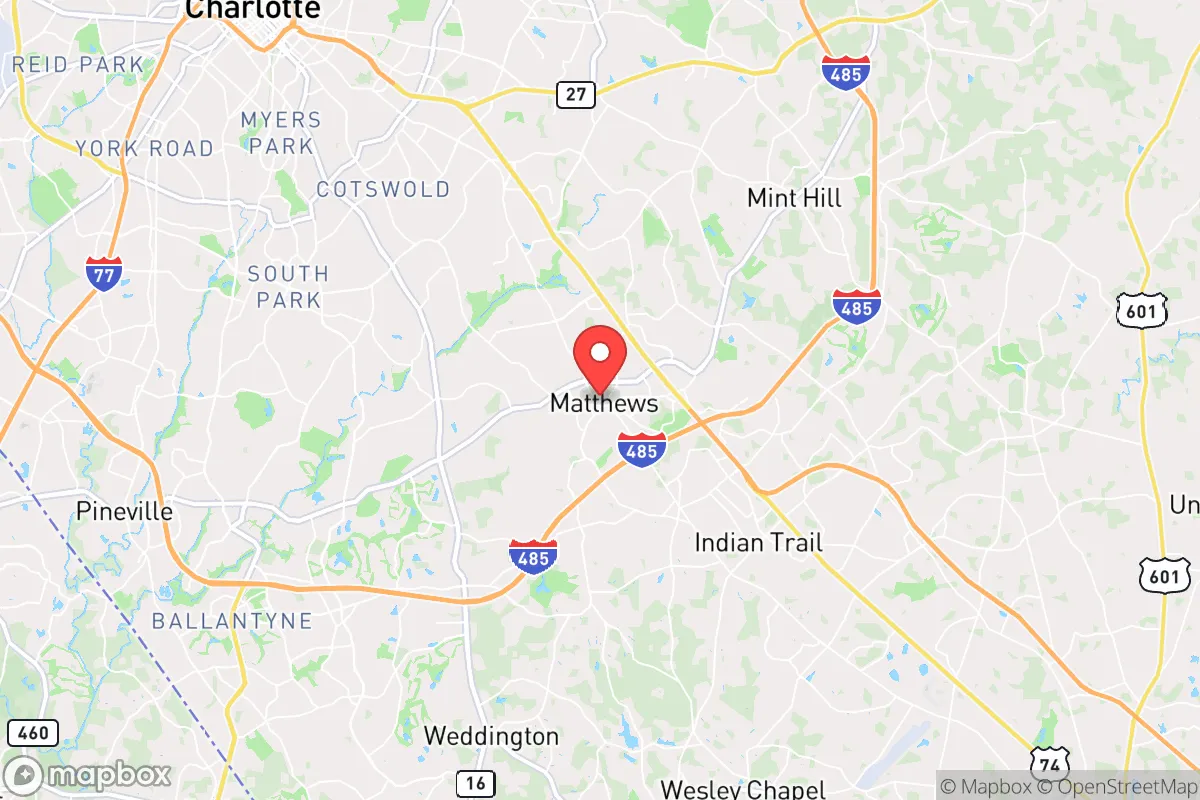
Photo: Wikipedia
Demographics of Matthews, NC
Affluence Level in Matthews, NC
An upper-middle-class area. Household wealth, education levels, and homeownership run ahead of national benchmarks.
People of Matthews, NC
The people of Matthews, North Carolina today form a predominantly white, highly educated, and family-oriented suburban community of nearly 30,000 residents. With a 70.3% white population, 13.2% Black, 6.1% Hispanic, 3.6% East/Southeast Asian, and 2.5% Indian-subcontinent residents, the city is notably more diverse than its rural past but remains less diverse than neighboring Charlotte. A striking 53.9% of adults hold a college degree, reflecting the city's role as a professional-class bedroom community, while the foreign-born share of 5.8% is modest for the Charlotte metro, indicating a population shaped more by domestic in-migration than international immigration.
How the city was settled and grew
Matthews was originally settled in the late 18th century by Scots-Irish and English farmers drawn to the fertile Piedmont land granted under the headright system. The village that formed around the intersection of what is now Trade and John streets was a quiet agricultural crossroads for over a century, known briefly as "Stumptown" for the tree stumps left after clearing. The arrival of the railroad in the 1870s transformed it into a cotton and timber shipping point, and the town was officially incorporated in 1879. The historic downtown Matthews district, centered on Trade Street, was built by these early merchant and farming families, and many of their descendants still occupy older homes in neighborhoods like Fullwood and Stumptown, where century-old farmhouses sit alongside newer infill construction. Through the mid-20th century, Matthews remained a small, overwhelmingly white farming town of fewer than 1,000 people, with a small Black population concentrated in the Matthews-Mint Hill Road area near the former segregated school sites.
Modern era (post-1965)
Matthews' explosive growth began in the 1970s and 1980s as Charlotte's suburban sprawl pushed southeast along the Independence Boulevard corridor. The completion of I-485 in the 1990s sealed the city's fate as a prime commuter suburb, and the population surged from roughly 2,000 in 1970 to nearly 30,000 today. This wave was overwhelmingly white and middle-to-upper-middle-class, drawn by new large-lot subdivisions like Weddington Woods and Providence Plantation, which offered good schools and low crime. The Black population, historically small, grew modestly during this period as some families moved from Charlotte seeking newer housing, settling in areas like Stallings Road and the East John Street corridor. The Hispanic population began arriving in the 1990s and 2000s, primarily for construction and service jobs, and is concentrated in the South Trade Street area and around the Matthews Township Parkway commercial strip. The East/Southeast Asian and Indian-subcontinent communities are more recent, arriving from the 2000s onward, drawn by tech and finance jobs in Charlotte; they tend to settle in newer subdivisions like Bridle Path and the Preserve at Matthews, where high home prices reflect their professional status. Notably, the Indian-subcontinent population (2.5%) is nearly as large as the East/Southeast Asian population (3.6%), a split that mirrors the broader Charlotte metro's pattern of separate Asian and Indian enclaves.
The future
Matthews is approaching build-out, with little undeveloped land remaining, which will slow population growth and likely drive up home prices further. The city is not homogenizing into a single melting pot; rather, distinct enclaves are solidifying. The older, white, native-born population remains dominant in historic neighborhoods and the large-lot subdivisions, while newer, more diverse residents cluster in the higher-density townhome and apartment developments near the I-485 interchange. The Hispanic and Asian/Indian populations are growing slowly but steadily, primarily through domestic moves from other U.S. metros rather than direct immigration, given the low foreign-born share. The Black population share has plateaued near 13%, as most Black in-movers choose Charlotte or other suburbs with larger Black communities. Over the next 10-20 years, Matthews will likely become slightly more diverse but remain a predominantly white, affluent, and college-educated suburb, with the main demographic shift being an aging population as the original suburban wave retires in place.
For someone moving in now, Matthews offers a stable, low-crime, high-amenity suburban environment with excellent schools and a strong sense of local identity. The population is becoming more diverse but at a measured pace, and the city's character remains that of a family-oriented, conservative-leaning community where professional-class homeowners set the tone. New arrivals should expect a place that values order, tradition, and property values, with demographic change happening gradually rather than disruptively.

* Values derived from national, state, county, city and local statistics and may differ in a specific area. Last updated: 2026-05-03T20:27:11.000Z
Narrative content on this page is AI-generated and may contain mistakes. Verify any details that matter before acting on them.
ReloMaps may earn a commission from affiliate links at no extra cost to you.

