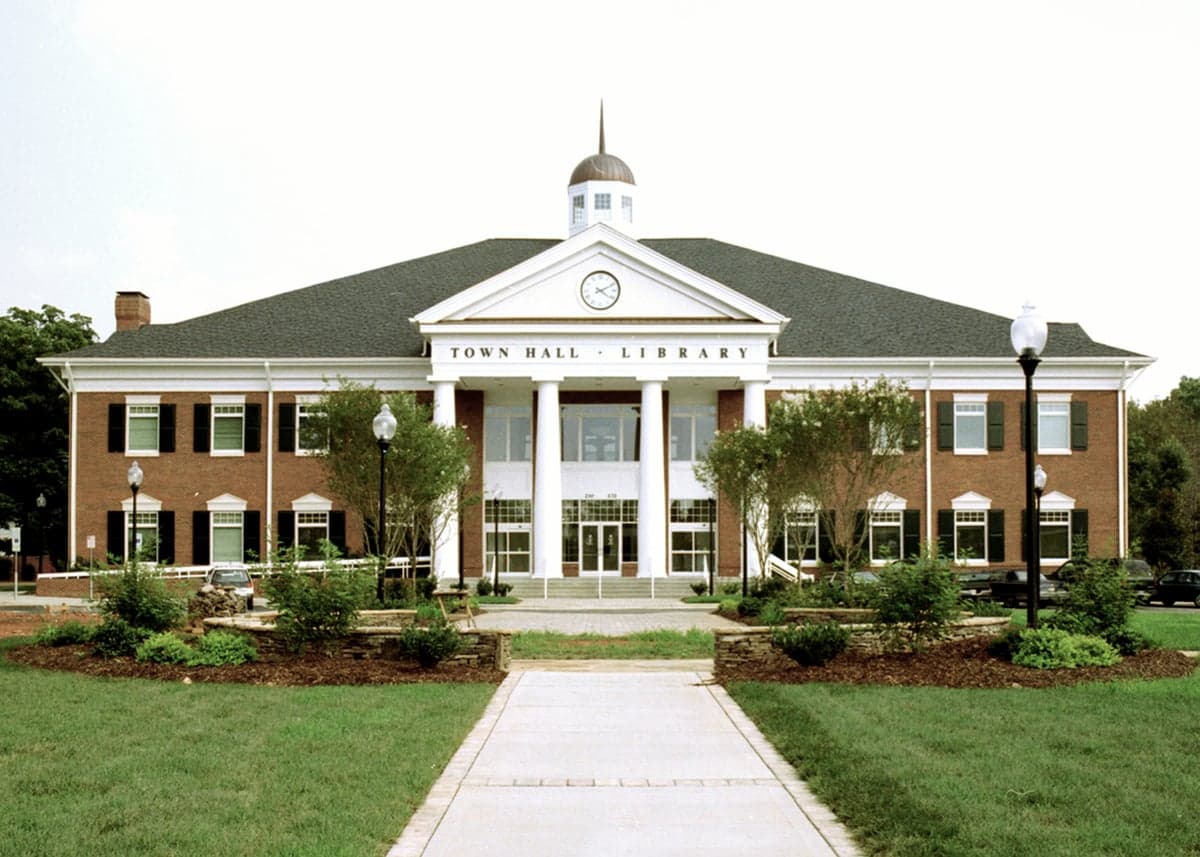
Photo: Wikipedia
Personal Sovereignty in Matthews, NC
Viable for self-reliance. Generally workable, though some barriers may limit total independence.
What does Personal Sovereignty tell us?
Personal Sovereignty measures your capacity for self-reliance and independence with minimal government friction. Higher scores mean fewer barriers between you and the way you want to live... but it assumes you have the space you need and good neighbors.
What does this tell us?
Personal Sovereignty measures your capacity for self-reliance and independence with minimal government friction. Higher scores mean fewer barriers between you and the way you want to live... but it assumes you have the space you need and good neighbors.
State Policy
Energy independence: Importer (15% of energy produced in-state)
Personal Liberty
Homesteading

Personal Liberty Analysis
Matthews, North Carolina offers a notably strong environment for personal sovereignty compared to many suburban enclaves, largely because it sits within a state that has actively pushed back against federal overreach in recent years. While no town is a libertarian utopia, Matthews benefits from North Carolina’s generally pro-liberty legal framework, including constitutional carry, low property taxes relative to the national average, and a state preemption law that prevents local governments from enacting their own gun control ordinances. For a single individual or parent approaching relocation with a survivalist or prepper mindset, the key question is whether this Charlotte suburb provides enough breathing room to live on your own terms—and the answer is a qualified yes, with some important caveats about local zoning and HOA influence.
Tax burden and regulatory posture: how Matthews compares to surrounding areas
North Carolina’s flat income tax rate of 4.5% (as of 2025) and a state sales tax capped at 7.25% keep the overall tax burden manageable, but Matthews adds its own local layer. The town’s property tax rate sits around 0.54% of assessed value, which is moderate for Mecklenburg County but higher than some rural counties to the east. For a $350,000 home, that’s roughly $1,890 annually—not crushing, but worth noting if you’re comparing to Union County’s lower rates just across the line. The regulatory posture in Matthews is generally business-friendly, but the town has a reputation for enforcing zoning codes more strictly than its unincorporated neighbors. There is no county-level income tax in North Carolina, which keeps more money in your pocket, and the state’s right-to-work laws mean you can’t be forced into union membership. For a prepper concerned about government overreach, the biggest win here is that North Carolina has a Taxpayer Bill of Rights that limits how aggressively the state can pursue back taxes, and property tax revaluations are capped at 8% annual increases in most cases. That predictability matters when you’re budgeting for long-term self-sufficiency.
Self-defense and gun law specifics: what Matthews allows and restricts
Matthews is located in a state that passed constitutional carry (permitless carry) in 2023, meaning any law-abiding adult 18 or older can carry a concealed handgun without a permit. This is a major plus for personal sovereignty. North Carolina also has a strong preemption law (NCGS 14-409.40) that explicitly prohibits local governments from enacting their own gun bans, magazine capacity limits, or registration requirements. That means Matthews cannot pass its own AWB or red flag law, even if the town council wanted to. The state does have a pistol purchase permit system for handguns (the “PPP” system), but it’s being phased out as of 2024, and private sales of long guns require no paperwork. Stand-your-ground laws are in effect, and there is no duty to retreat in any place you have a lawful right to be. For parents, this means you can legally keep firearms in your home for self-defense without storage mandates, and there is no state law requiring safe storage that could be used to prosecute you for a defensive use. The only real restriction to note: Matthews is within Mecklenburg County, which has a higher crime rate than rural areas, so the practical need for self-defense is real—but the legal framework supports it.
Self-reliance and homesteading viability: lot sizes, zoning, and off-grid feasibility
This is where Matthews shows its suburban limitations. The town’s zoning code is typical of a Charlotte bedroom community: minimum lot sizes in most residential zones are around 0.25 to 0.5 acres, and many newer subdivisions are governed by HOAs that restrict everything from chicken coops to clotheslines. If you want to raise livestock, grow a substantial garden, or install solar panels without HOA approval, Matthews proper is not the place. The town’s zoning ordinance explicitly limits “agricultural uses” to parcels of 3 acres or more in the RA zoning district, and even then, livestock is restricted to “customary domestic animals” like chickens (hens only, no roosters) and rabbits. Beekeeping is allowed but requires a permit. Off-grid living is effectively impossible within town limits because the code requires connection to municipal water and sewer for any habitable structure. However, the unincorporated areas of Union County just east of Matthews—like the communities of Wesley Chapel or Mineral Springs—offer 1- to 5-acre lots with no HOA, where you can install a well, septic, and solar without municipal interference. For a prepper, the strategic play is to live just outside Matthews’ town limits while still having access to its grocery stores and medical facilities. The town’s proximity to I-485 also means you can bug out quickly toward the Uwharrie National Forest or the mountains if needed.
Personal liberties: parental rights, medical autonomy, speech, and property
North Carolina has been a battleground for parental rights, and the current legal landscape is favorable. The state’s Parents’ Bill of Rights (enacted in 2023) gives parents the explicit right to direct their child’s education, access school curricula, and opt their children out of any assignments or activities they find objectionable. Matthews is part of the Charlotte-Mecklenburg school system, which is large and politically diverse, but the state law overrides any local policies that conflict with parental authority. On medical autonomy, North Carolina does not have a state-level vaccine mandate for adults, and COVID-era emergency orders have expired. The state also has a religious exemption for vaccinations in schools, though it’s not as broad as some states. For speech and property rights, North Carolina is a “Dillon’s Rule” state, meaning local governments only have powers explicitly granted by the state—this limits Matthews’ ability to pass overreaching ordinances on signs, noise, or land use. Property rights are further protected by the state’s eminent domain laws, which require “public use” (not just “public benefit”) and full market value compensation. For a parent concerned about government overreach into family decisions, the combination of the Parents’ Bill of Rights and the lack of state-level medical mandates provides a solid buffer against the kind of top-down control seen in blue states.
Overall, Matthews offers a moderate-to-strong sovereignty profile for a suburban town in the Southeast. It’s not a rural homesteading paradise, but it sits within a state that has consistently pushed back against federal overreach on guns, taxes, and parental rights. The biggest threats to personal autonomy here are local: HOAs that restrict self-reliance, zoning that prevents off-grid living, and the proximity to Charlotte’s urban politics. If you can find a property just outside town limits—ideally in Union County with no HOA—you get the best of both worlds: Matthews’ infrastructure and North Carolina’s liberty-friendly laws. Compared to similar suburbs in Virginia or Georgia, Matthews ranks favorably on gun rights and tax burden, but it lags behind more rural areas in homesteading feasibility. For a single individual or parent who values self-defense, low taxes, and parental control over education, Matthews is a solid B+—worth a serious look, but only if you’re strategic about where exactly you plant your flag.

* Values derived from national, state, county, city and local statistics and may differ in a specific area. Last updated: 2026-05-03T20:27:11.000Z
Narrative content on this page is AI-generated and may contain mistakes. Verify any details that matter before acting on them.
ReloMaps may earn a commission from affiliate links at no extra cost to you.

